Understanding symmetry Adding 2-digit Numbers Worksheets for 8-Year-Olds
5 filtered results
-
From - To
Enhance your child's math skills with our "Understanding Symmetry Adding 2-Digit Numbers Worksheets" designed specifically for 8-year-olds! These engaging worksheets blend the fundamental concepts of symmetry with the challenge of adding two-digit numbers. Each activity promotes critical thinking, visual learning, and mathematical precision, helping children develop both addition fluency and spatial awareness. Perfect for home or classroom use, these worksheets provide a fun and effective learning experience. Encourage your child to excel in math through hands-on practice that aligns with educational standards. Unlock their potential today! Visit the link for more information and to download worksheets.
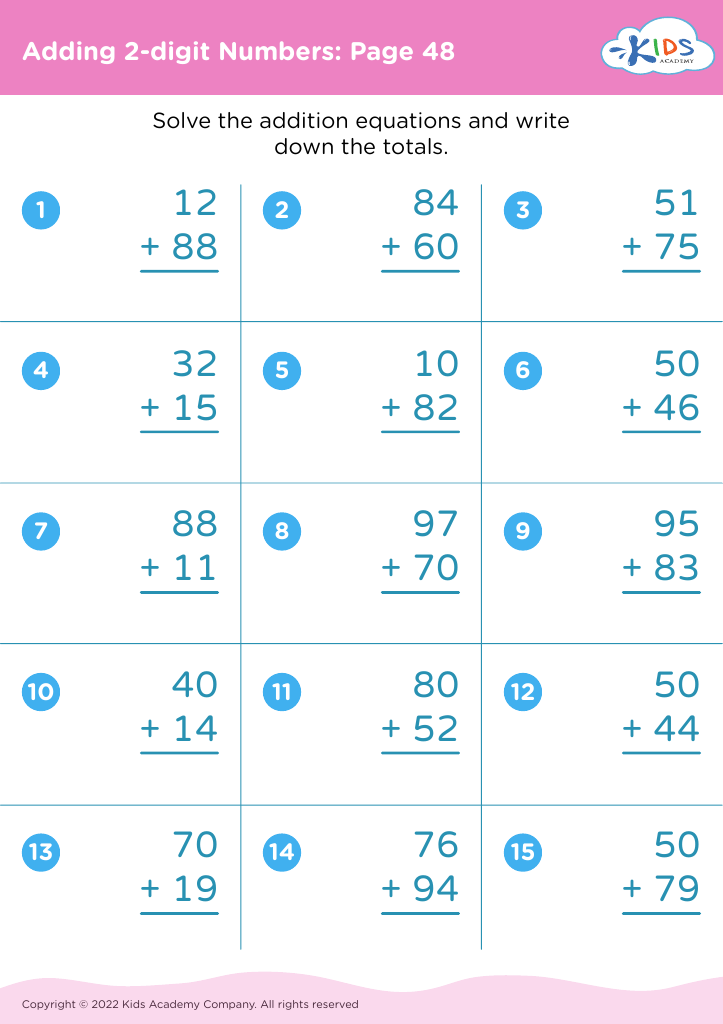
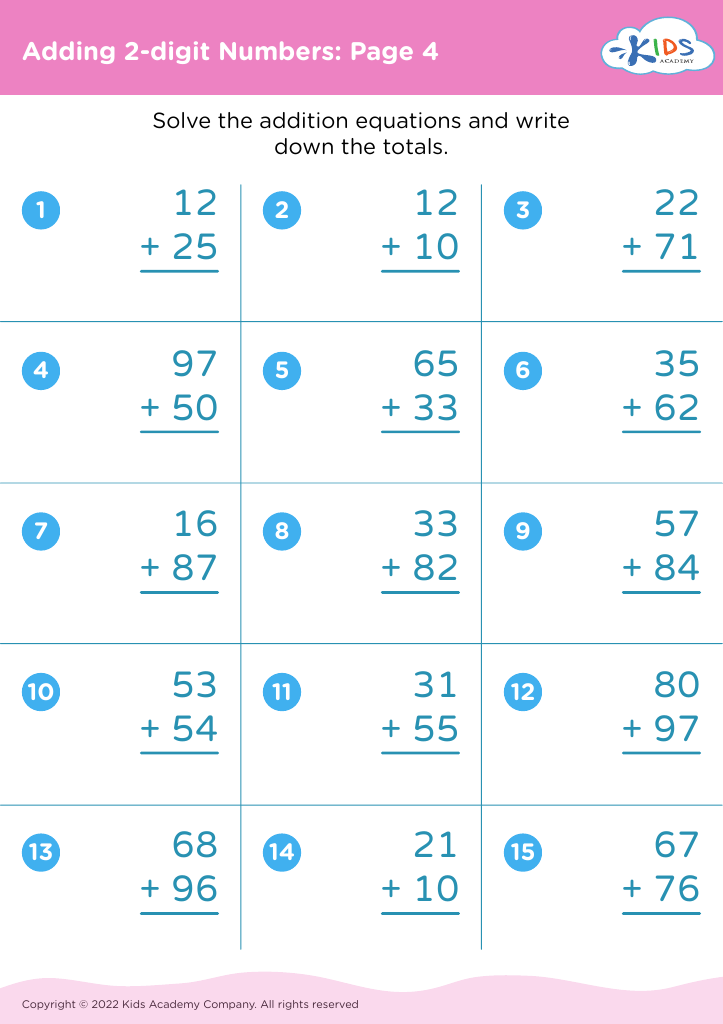
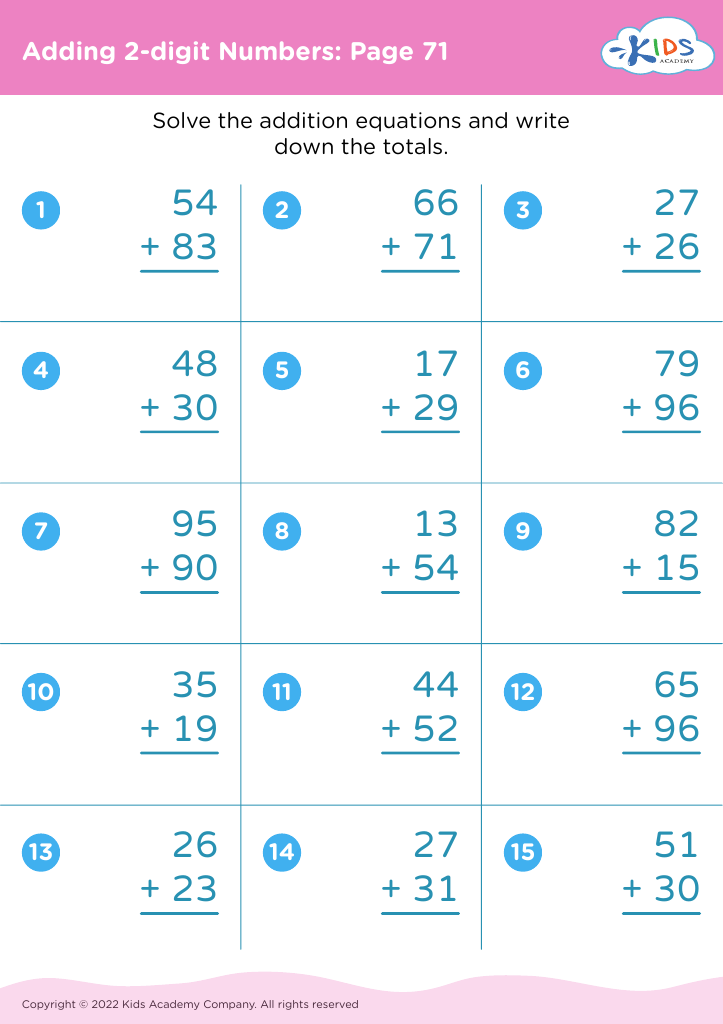
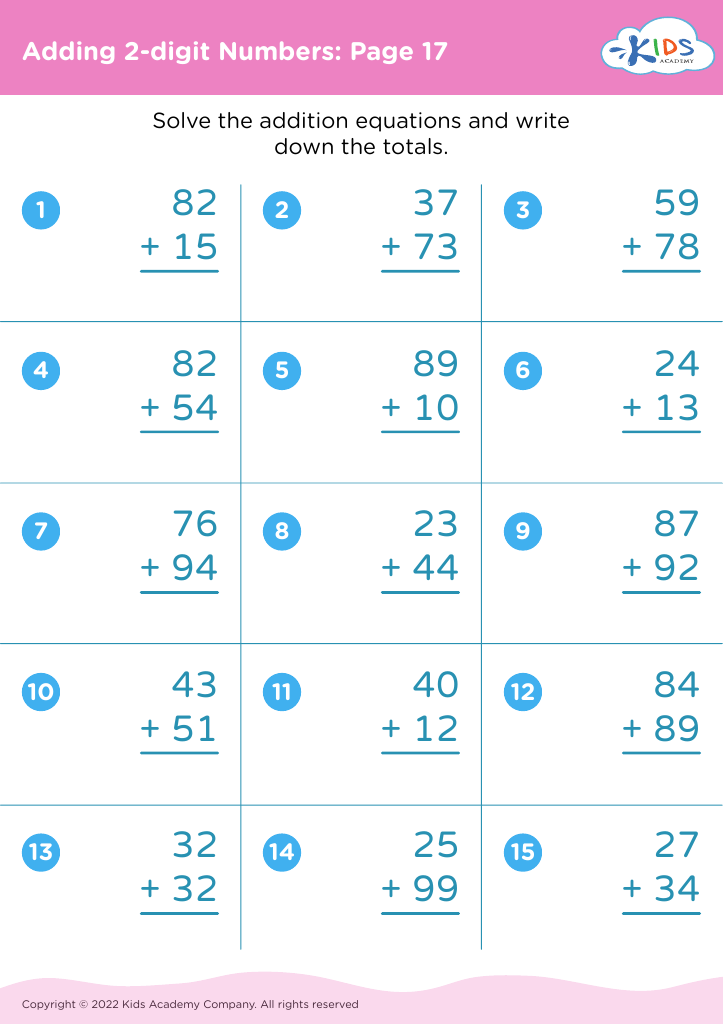
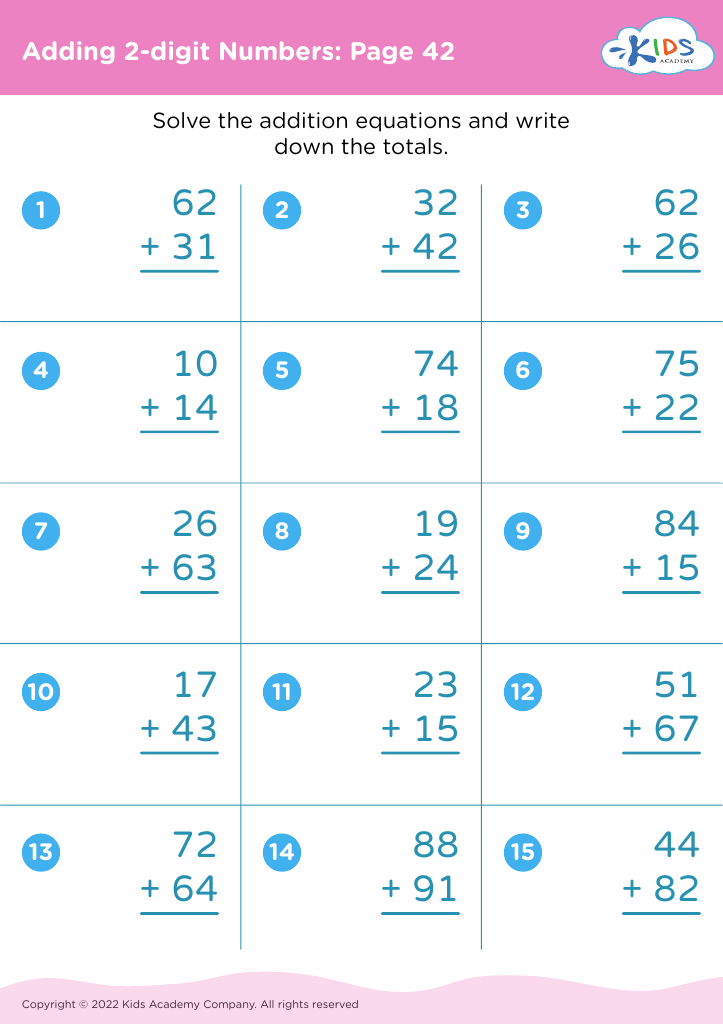








Understanding symmetry and adding 2-digit numbers are critical concepts for 8-year-olds, and both are foundational for future success in mathematics and other disciplines.
Symmetry helps children develop spatial awareness and geometric understanding. Recognizing symmetrical patterns enhances their ability to conceptualize shapes, manipulate objects in their mind, and understand more complex mathematical concepts like transformations and equivalence. These skills are not only vital for geometry but also play a crucial role in everyday tasks such as reading maps, arranging objects, and even in arts and design.
Adding 2-digit numbers builds essential arithmetic skills and number sense. Mastery of addition forms the basis for future mathematical operations such as subtraction, multiplication, and division. By learning to add larger numbers, children become more proficient in mental math, problem-solving, and logical thinking. These skills extend beyond math; they improve overall cognitive function, support computational thinking in science and technology, and develop practical abilities necessary for daily life—like budgeting or calculating distances.
Parents and teachers who focus on these areas provide children with a strong mathematical foundation, encourage critical thinking, enhance academic performance, and promote confidence in handling more complex problems in the future. Early mastery of these concepts fosters a positive attitude toward learning and encourages lifelong mathematical curiosity.








