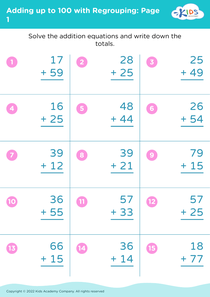
Critical Thinking Adding up to 100 Without Regrouping Worksheets for 8-Year-Olds
3 filtered results
-
From - To
Take your 8-year-old's math skills to the next level with our "Critical Thinking Adding up to 100 Without Regrouping" worksheets! Tailored to boost calculation abilities, these resources promote critical thinking by challenging young minds with addition problems. No regrouping required ensures a focus on understanding number relationships. Curated to support classroom learning and at-home practice, our sheets are ideal for reinforcing school lessons and enhancing your child's problem-solving skills. Boost confidence, master addition, and watch your student excel—all while having fun! Explore our printable worksheets now and make math both understandable and enjoyable.
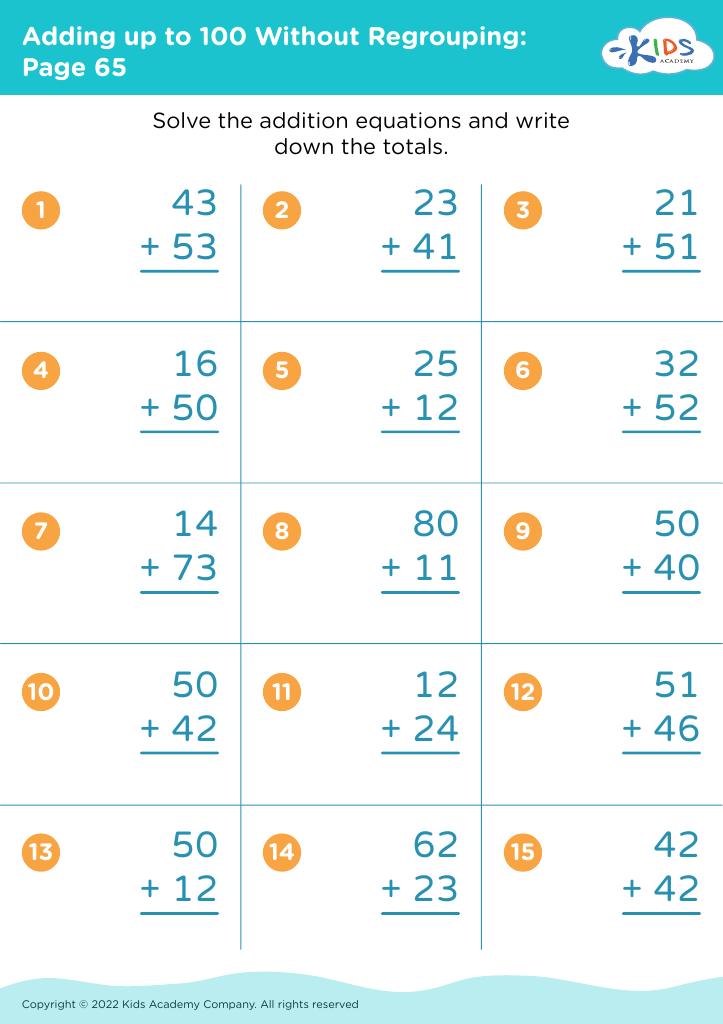
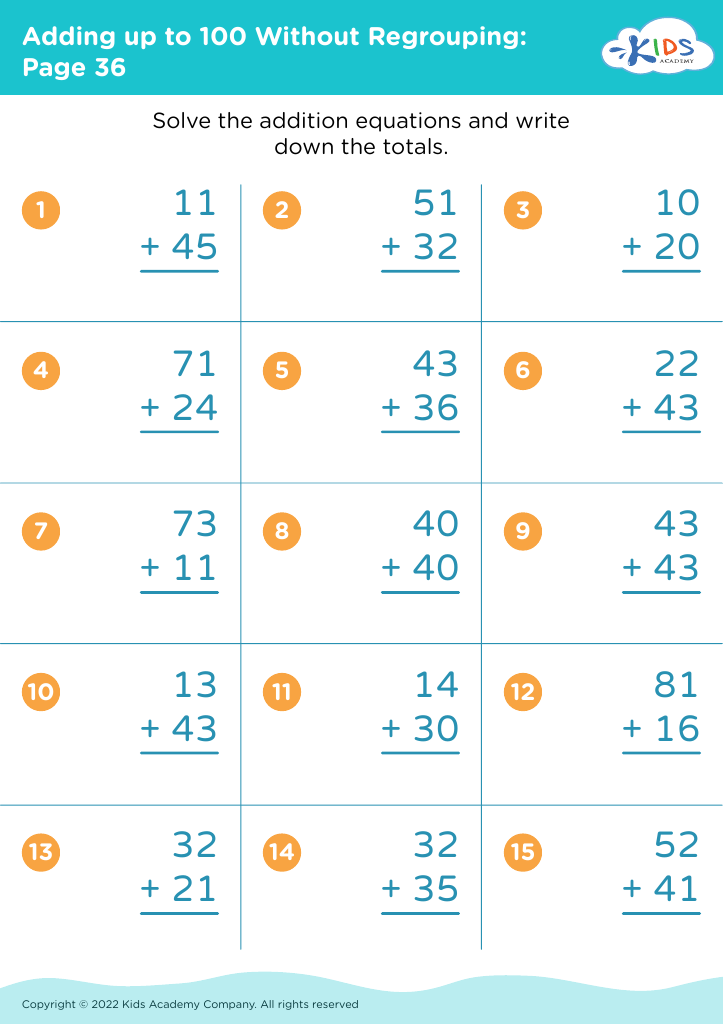
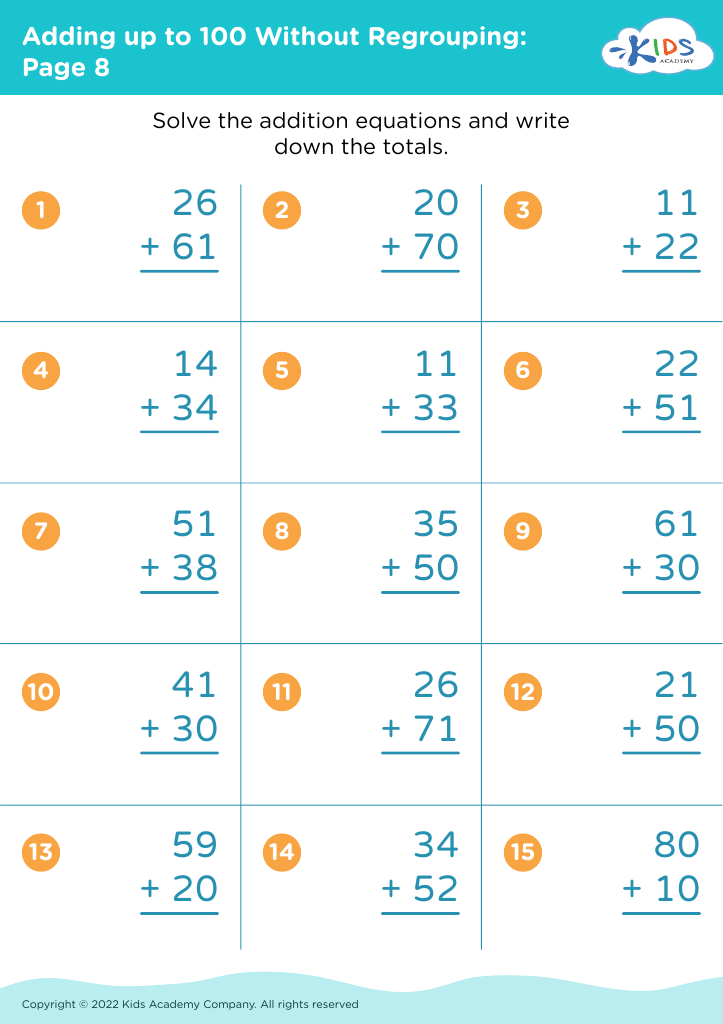




Parents and teachers should prioritize teaching 8-year-olds how to add up to 100 without regrouping because it forms the foundation for essential mathematical skills. At this developmental stage, children are learning to think logically and solve problems efficiently. Mastering addition up to 100 requires an understanding of number relationships and basic arithmetic, which are crucial for more complex mathematical concepts they will encounter later.
Critical thinking is sharpened through math exercises because children learn to analyze numerical problems, identify patterns, and apply systematic approaches to solve them. Without the need to regroup, students focus on understanding the straightforward addition, which builds their confidence and solidifies their mental math skills. These activities also improve memory and concentration.
Furthermore, achieving competence in addition without regrouping helps children engage more meaningfully in classroom activities. For instance, they can participate in group work confidently and independently complete assignments. This foundational knowledge boosts their academic self-esteem and fosters a genuine interest in mathematics.
Thus, by focusing on these addition skills, parents and teachers equip children with critical thinking capabilities and prepare them for a lifetime of mathematical learning and everyday problem-solving. Ensuring these skills are well-developed also means fostering a child’s analytical abilities, which are pivotal across all areas of education and personal growth.