Mathematical reasoning Adding up to 100 Without Regrouping Worksheets for 8-Year-Olds
3 filtered results
-
From - To
Our "Mathematical Reasoning: Adding up to 100 Without Regrouping Worksheets for 8-Year-Olds" are designed to help children build foundational math skills. These engaging worksheets focus on practicing addition within 100 through easy-to-understand exercises, avoiding the need for regrouping. Perfect for young learners, they enhance mathematical reasoning and fluency. These resources employ fun and varied approaches to ensure kids stay engaged while improving their problem-solving abilities. Ideal for both classroom and home use, our worksheets aim to make math comprehension enjoyable and effective, setting the stage for future mathematical success. Download now for an educational adventure!
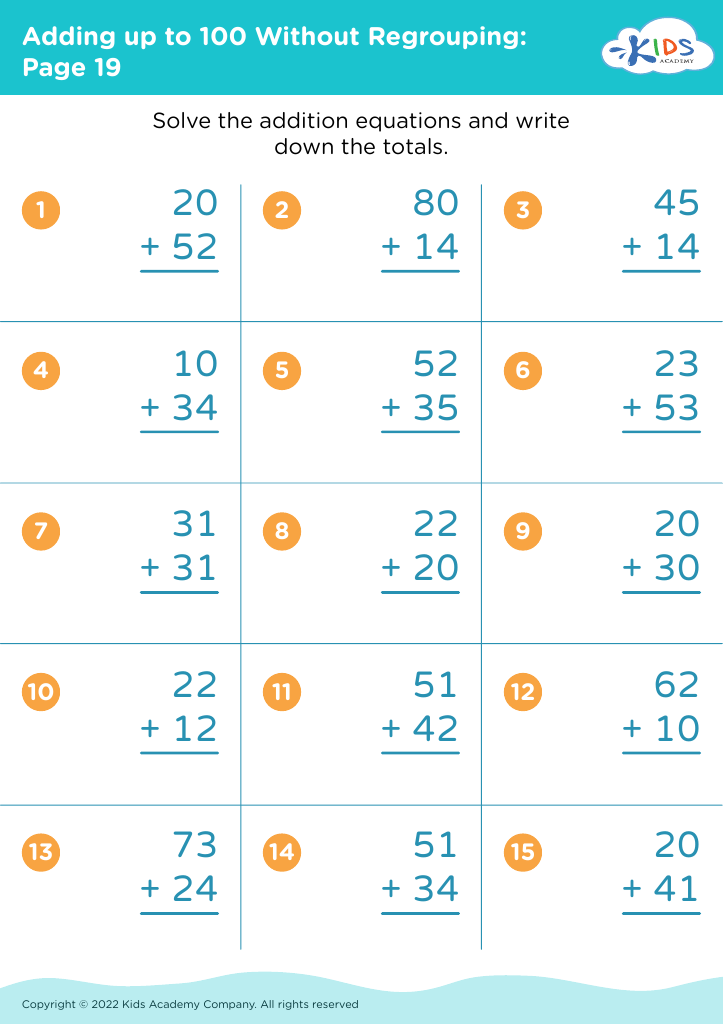
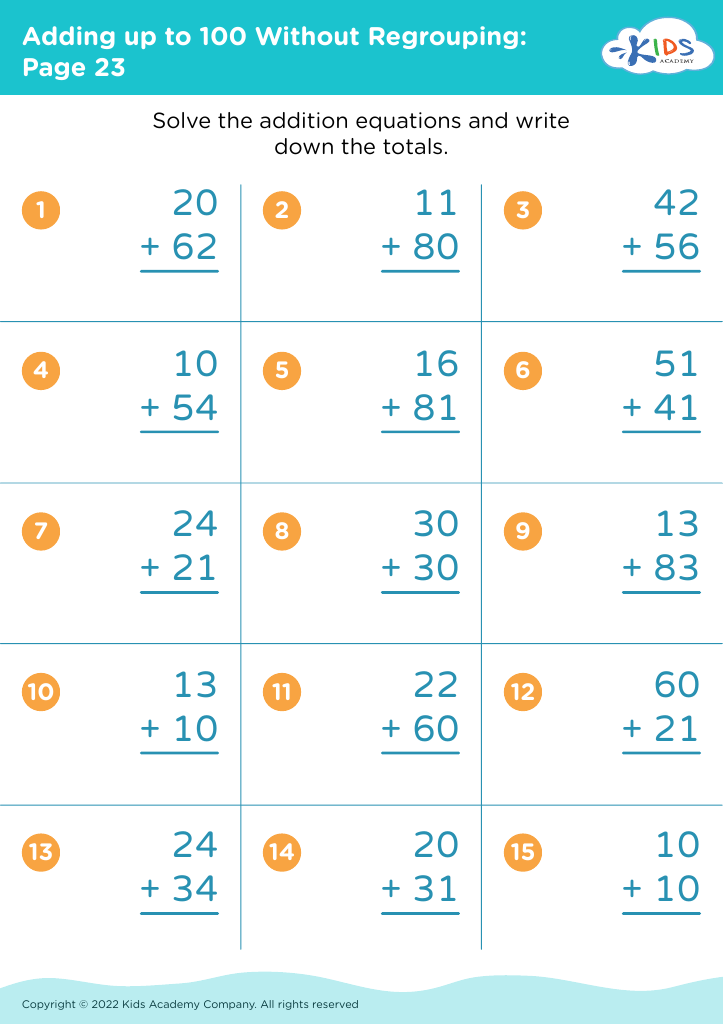
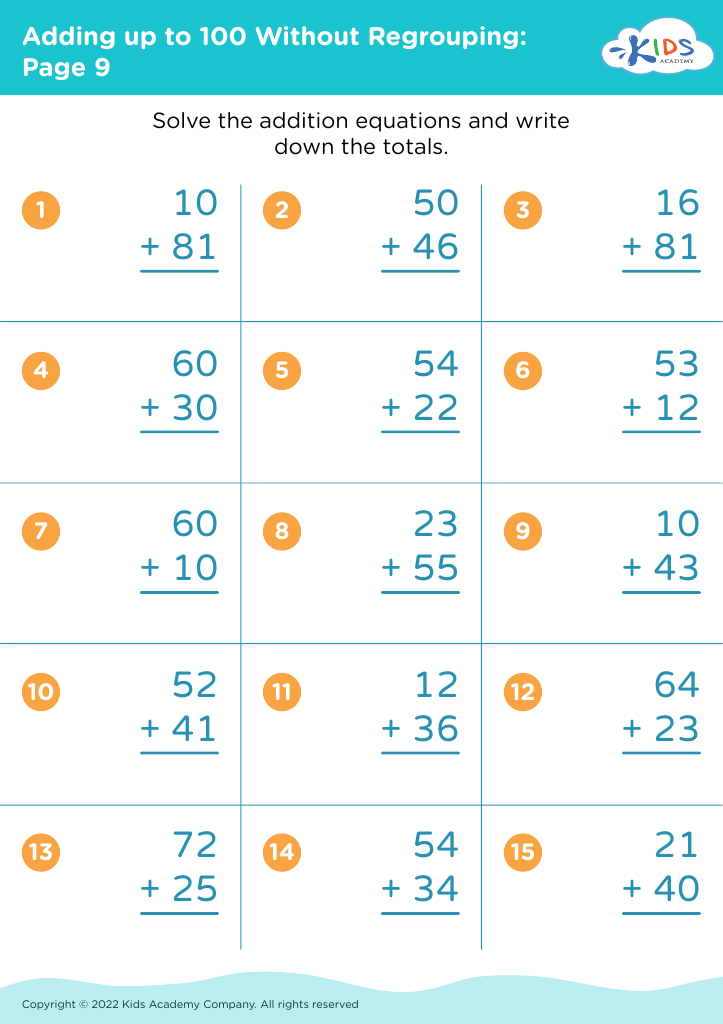




Mathematical reasoning involving addition up to 100 without regrouping is crucial for 8-year-old children as it forms the cornerstone of their numeracy skills. At this developmental stage, children are transitioning from basic arithmetic to more complex operations, and mastering addition within 100 lays a solid foundation for future math concepts.
First, this skill bolsters number sense, allowing children to understand and manipulate numbers confidently. By focusing on non-regrouping (where numbers added don’t carry over into the next digit place), students learn straightforward addition and develop accuracy, which fosters a positive mathematical mindset and reduces anxiety associated with math problems.
Secondly, fluency in basic addition enhances their ability to tackle real-world problems involving money, measurements, and time, thereby making math a practical tool in everyday life. It also promotes logical thinking and problem-solving skills, which are applicable across various subjects.
Moreover, practicing addition within this range strengthens cognitive abilities, as children learn to hold numbers in their minds, visualize problems, and execute multi-step processes. Finally, a solid grasp of addition to 100 serves as a stepping stone to more advanced topics such as regrouping, subtraction, multiplication, and division. Thus, parents and teachers should emphasize this skill, as it equips children with the confidence and competence essential for their academic and everyday success.