Understand fractions Adding up to 1000 Misc Worksheets for 8-Year-Olds
3 filtered results
-
From - To
Explore our engaging collection of "Understand Fractions: Adding up to 1000 Misc Worksheets for 8-Year-Olds." Designed to make learning fractions fun and easy, these worksheets are perfect for young mathematicians eager to master complex fraction and addition concepts. Our carefully curated activities guide kids through understanding fractions and performing addition problems up to 1000. These printable resources foster essential math skills while keeping children captivated and motivated. Ideal for both classroom and home use, these worksheets provide a comprehensive approach to tackling challenging math subjects for 8-year-olds. Start your fraction adventure today!
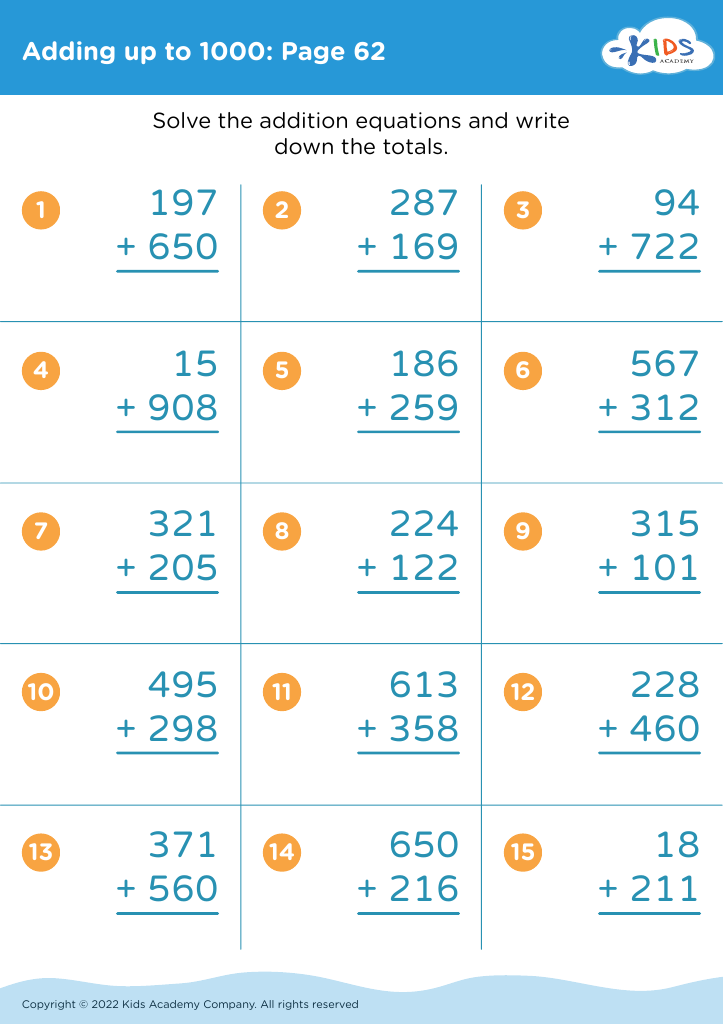
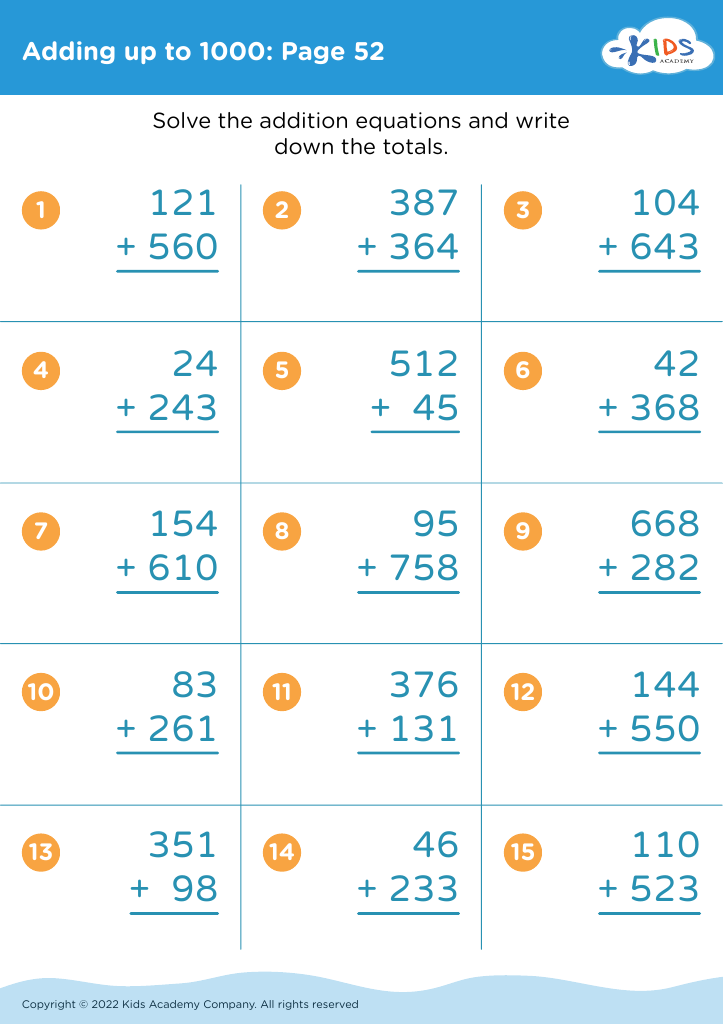
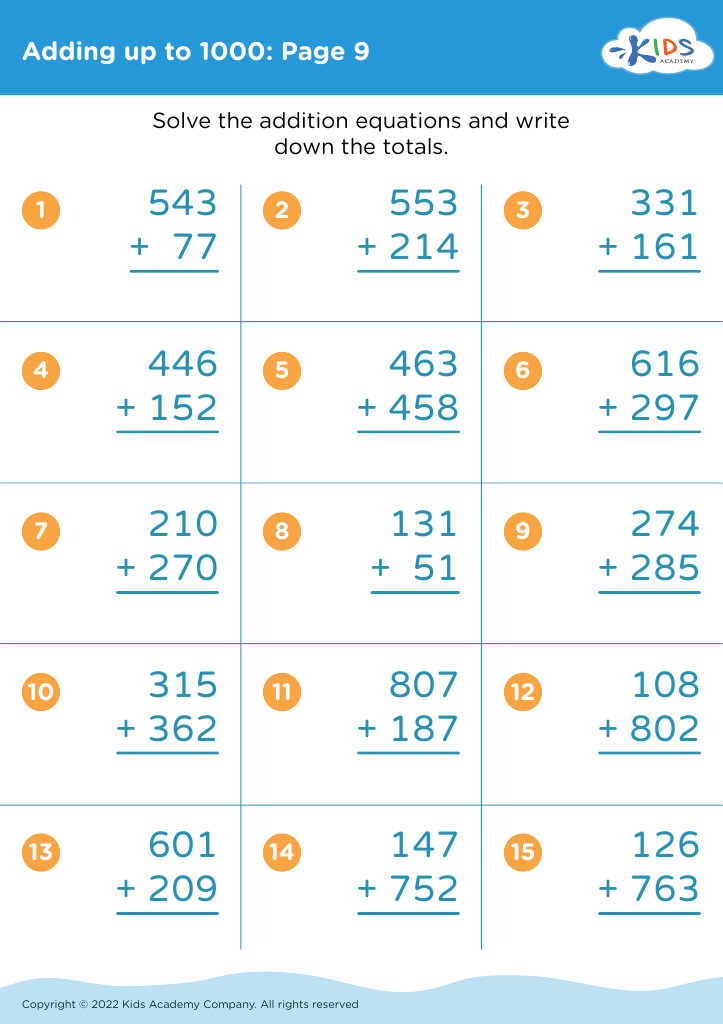


Parents and teachers should understand that mastering the concept of fractions at an early age sets a foundational stone for math proficiency in later stages. At around eight years old, children are developing critical thinking skills and their ability to understand more abstract concepts, such as fractions, adding up to more complex numbers like 1000, and miscellaneous mathematical operations.
Teaching fractions helps children improve their number sense, allowing them to comprehend parts of a whole, equivalence, and efficiency in problem-solving. Knowledge of fractions goes beyond math class; it's an essential life skill - used in cooking, time management, and real-world decision making. Proficiency in basic mathematics is necessary for future subjects like algebra and geometry.
Additionally, understanding large numbers like 1000 helps expand a child's mental arithmetic capabilities and improves their confidence in tackling larger problems. This touchpoint aids their performance and positively influences their attitude towards higher mathematical challenges. Miscellaneous exercises promote flexibility, nurturing kids to adapt to various situations and enhancing their cognitive development.
Thus, focusing on these mathematical elements aids in constructing a robust education trajectory, fosters invaluable life skills, and contributes to a child's holistic academic growth, making them analytical thinkers and problem solvers. Therefore, prioritizing these learning areas can ultimately benefit children throughout their education and personal finances, and beyond.