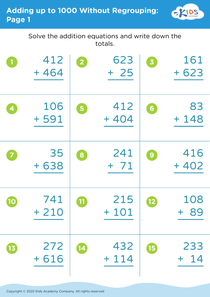
Recognizing Patterns Adding up to 1000 with Regrouping Worksheets for 8-Year-Olds
4 filtered results
-
From - To
Unlock your child's mathematical potential with our "Recognizing Patterns Adding up to 1000 with Regrouping Worksheets" designed specifically for 8-year-olds. These engaging worksheets help young learners identify and understand number patterns while mastering regrouping strategies for addition. Through a variety of fun activities, children will discover how different combinations can sum up to 1000, enhancing their numerical fluency and critical thinking skills. These resources are perfect for reinforcing classroom learning or providing additional practice at home. Give your child the tools they need to succeed in math while making learning enjoyable and interactive. Start exploring the world of numbers today!
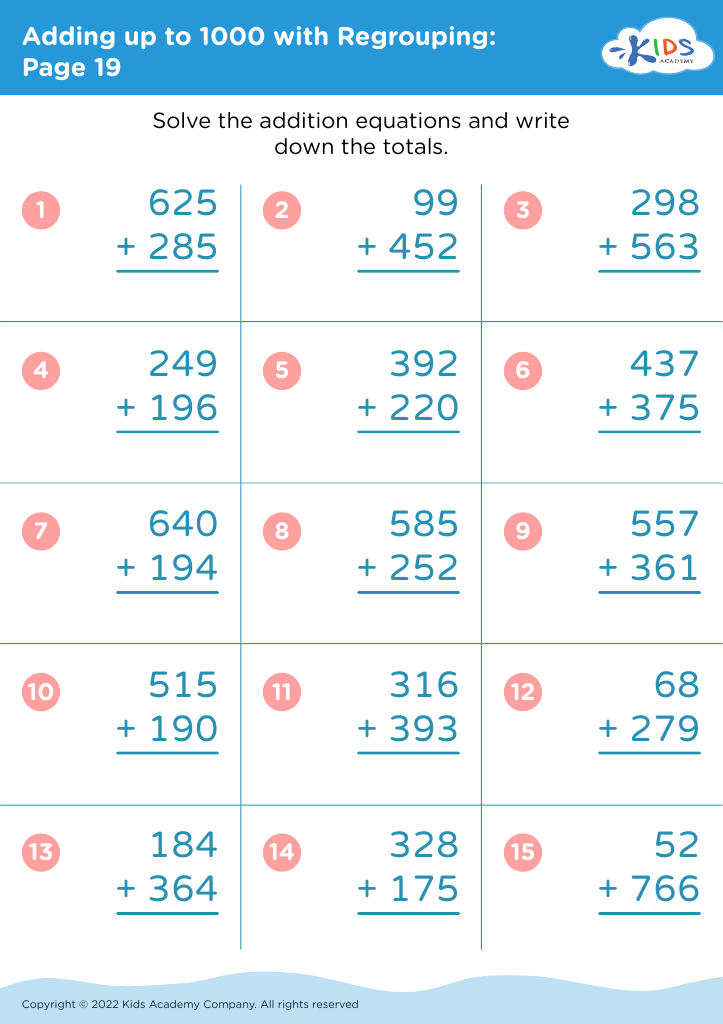
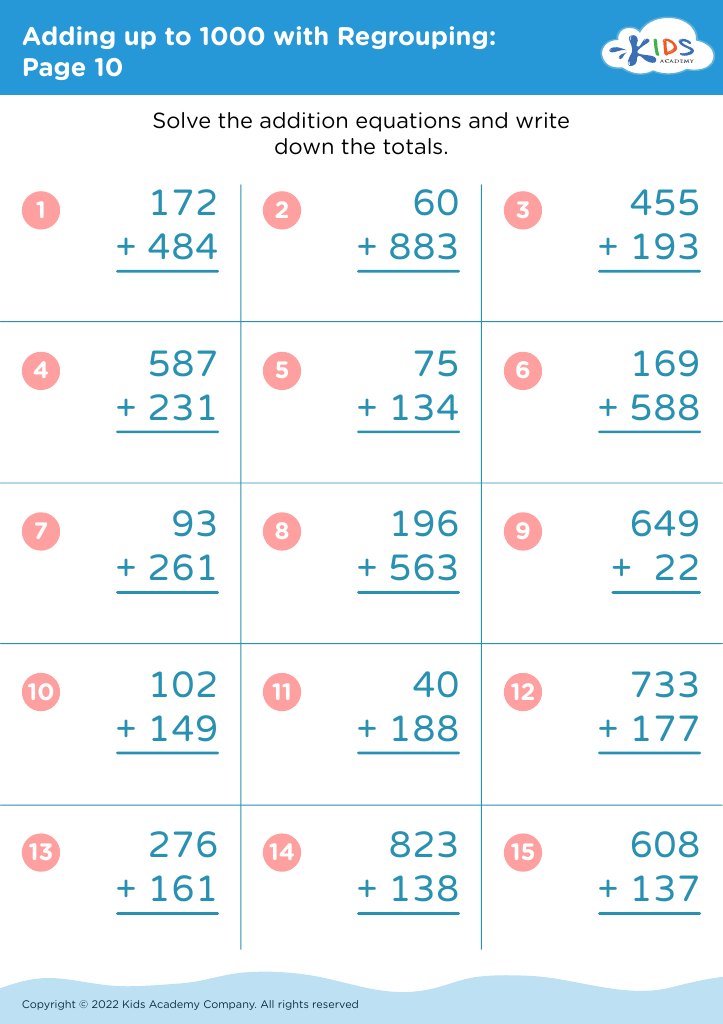
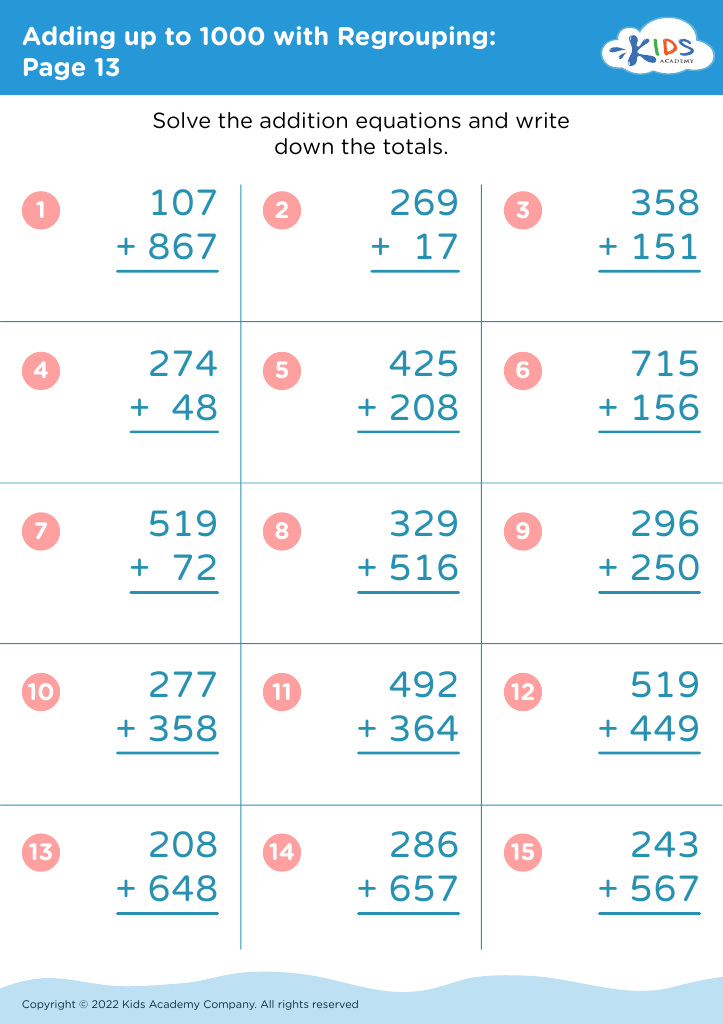
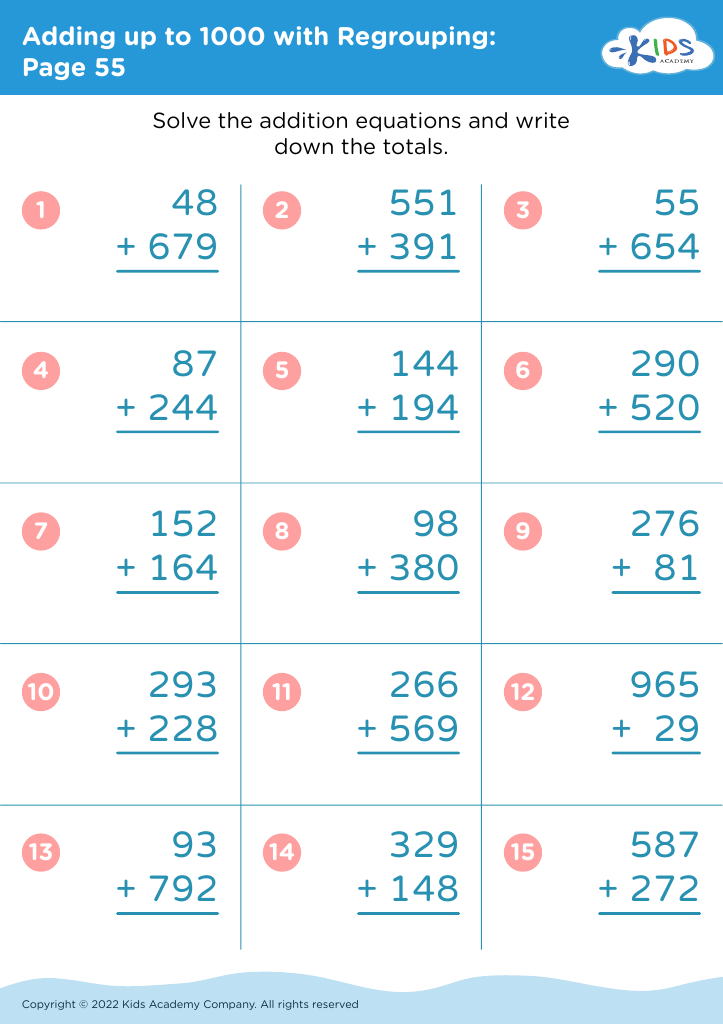


Recognizing patterns in addition, particularly when regrouping, is crucial for 8-year-olds as they develop their mathematical skills. At this age, children begin to encounter more complex numerical concepts, including two- and three-digit addition. Understanding how numbers relate to one another through patterns reinforces foundational math skills, offering a deeper insight into the number system.
By focusing on adding up to 1000 with regrouping, children learn to visualize and concrete relationships between numbers. This approach enhances their ability to solve problems more efficiently and accurately, fostering a sense of confidence in their abilities. Recognizing patterns helps students identify shortcuts and strategies, significantly reducing their calculation time and minimizing errors.
Moreover, mastering these concepts cultivates critical thinking and logical reasoning. As children encounter real-world scenarios where they apply these skills—such as budgeting or measuring—they build a strong mathematical mindset.
For teachers and parents, supporting this learning process by providing engaging activities and practical examples can spark a child's interest in math, helping them see advantages beyond the classroom. Ultimately, understanding these patterns not only enhances arithmetic skills but also lays a robust foundation for future mathematical concepts, positioning children for continued academic success.