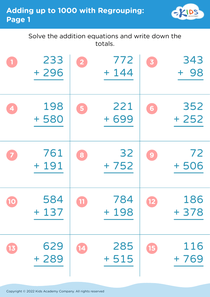
Improve counting skills Adding up to 1000 Without Regrouping Worksheets for 8-Year-Olds
4 filtered results
-
From - To
Enhance your 8-year-old's counting skills with our engaging "Adding Up to 1000 Without Regrouping" worksheets. Designed specifically for young learners, these worksheets provide a fun and interactive way to practice addition without the complexities of regrouping. Children will develop their mathematical confidence as they work through various exercises that encourage number recognition and reinforce essential counting techniques. Each activity is thoughtfully crafted to align with age-appropriate learning standards, making mastering addition enjoyable and effective. Perfect for home or classroom use, our worksheets support foundational math skills, ensuring your child can successfully navigate the world of numbers with ease.
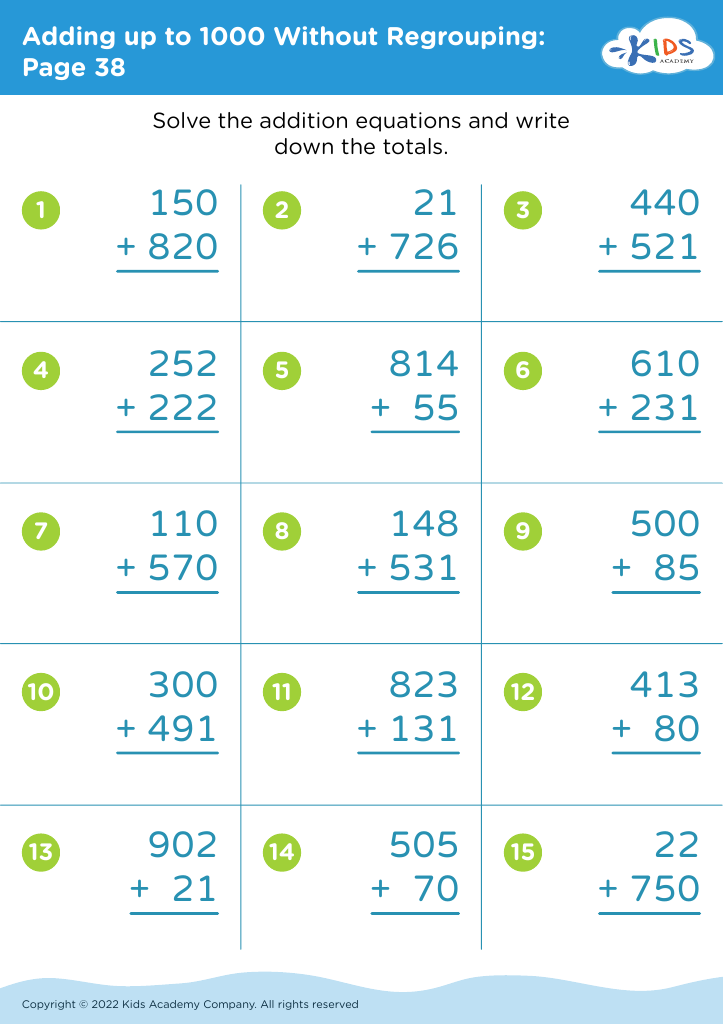
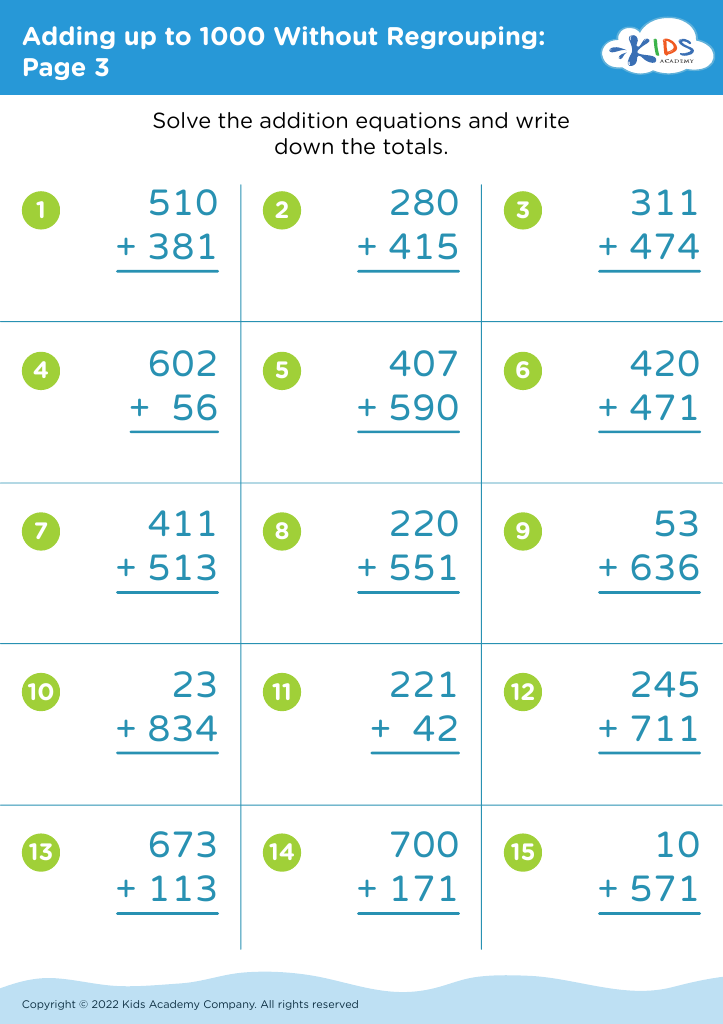
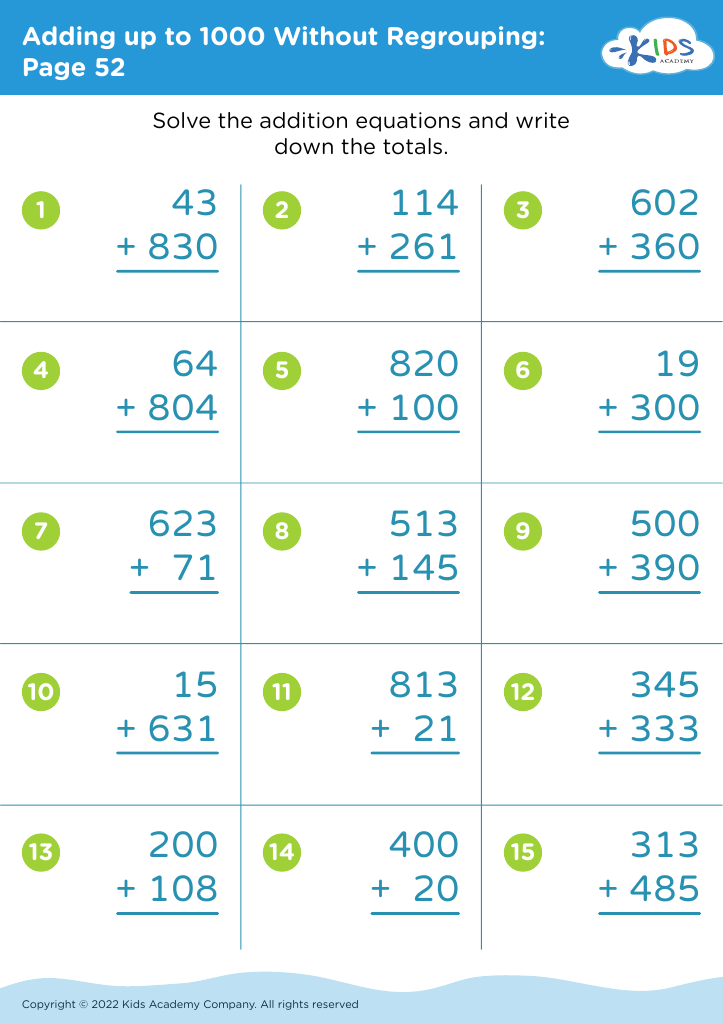
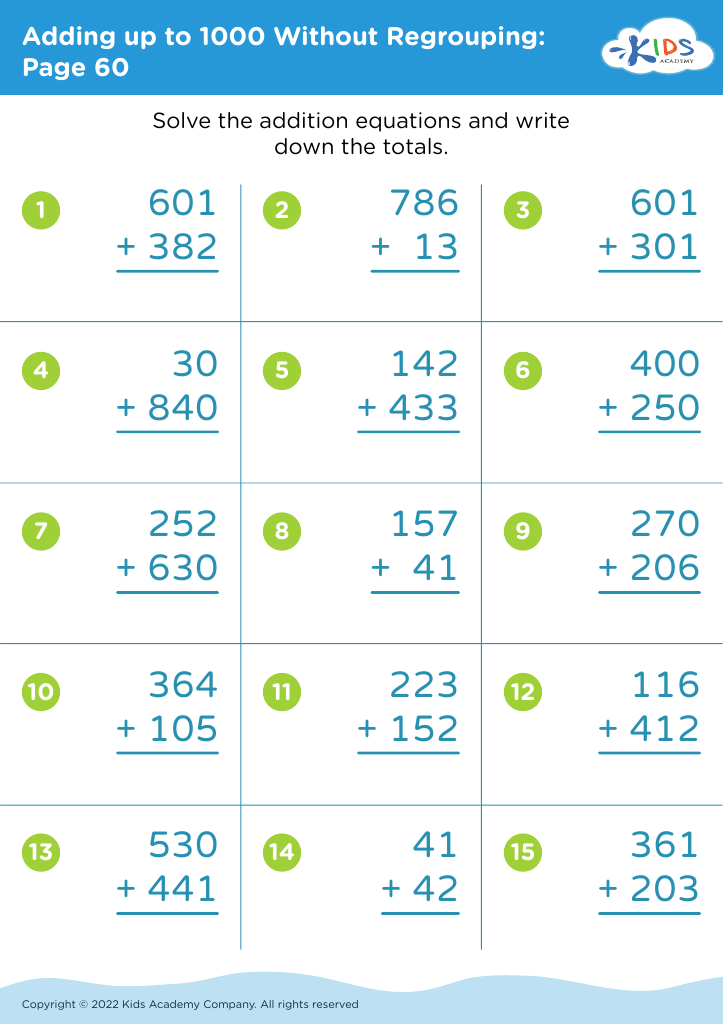


Improving counting skills, particularly the ability to add up to 1000 without regrouping, is vital for 8-year-olds as it lays the foundation for more complex mathematical concepts. At this age, children are transitioning from basic arithmetic to more sophisticated problem-solving. Mastering these skills enhances their confidence and promotes a deeper understanding of numbers, which is crucial for future learning in math and related subjects.
Strong counting skills enable children to tackle everyday situations, such as budgeting, measuring, and comparing quantities, which are essential life skills. Additionally, when children can add without regrouping, they develop mental math abilities, enhancing their cognitive flexibility and critical thinking skills.
For parents and teachers, fostering these skills is important because it prepares children for standardized tests and ensures they are on track with their peers. Moreover, the ability to compute without regrouping helps in recognizing patterns, ultimately promoting mathematical reasoning. Engaging children in activities that reinforce these skills not only enriches their learning experience but also cultivates a positive attitude toward math. By supporting their counting abilities, parents and teachers can help build a solid foundation for a child's future academic success and confidence in their mathematical abilities.