Simplifying Fractions Adding up to 1000 Without Regrouping Worksheets for 8-Year-Olds
3 filtered results
-
From - To
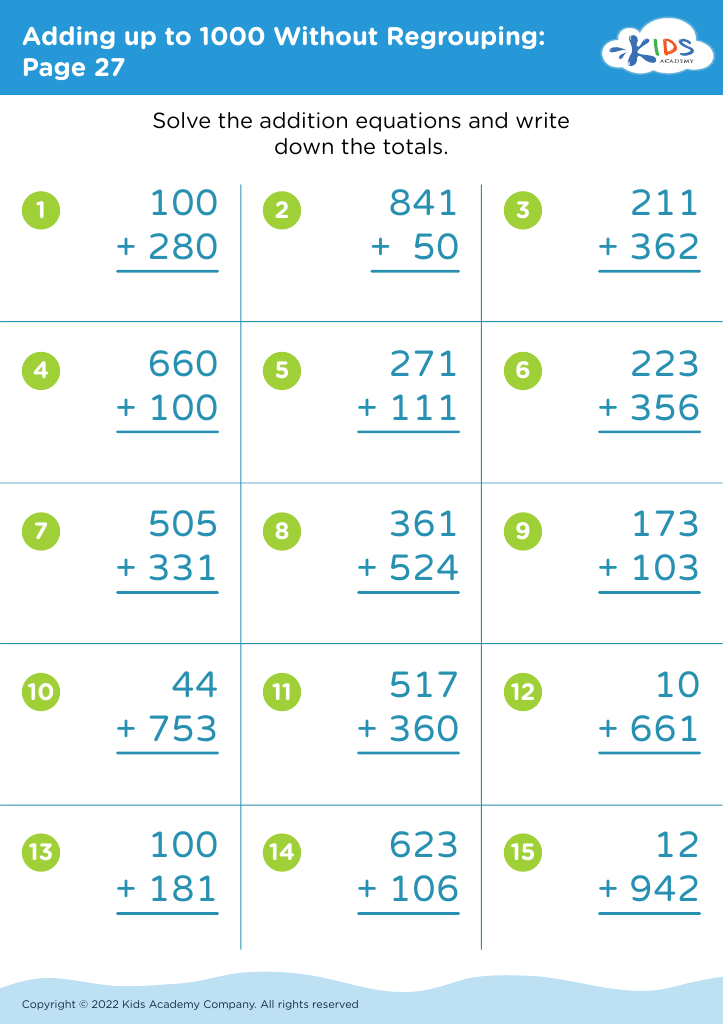
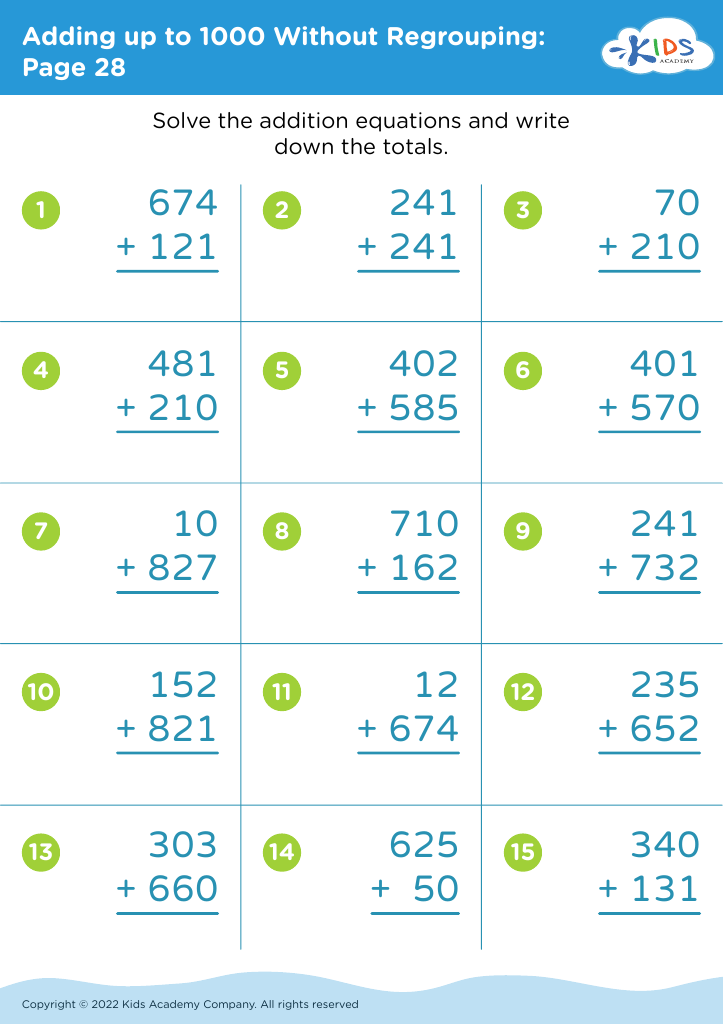
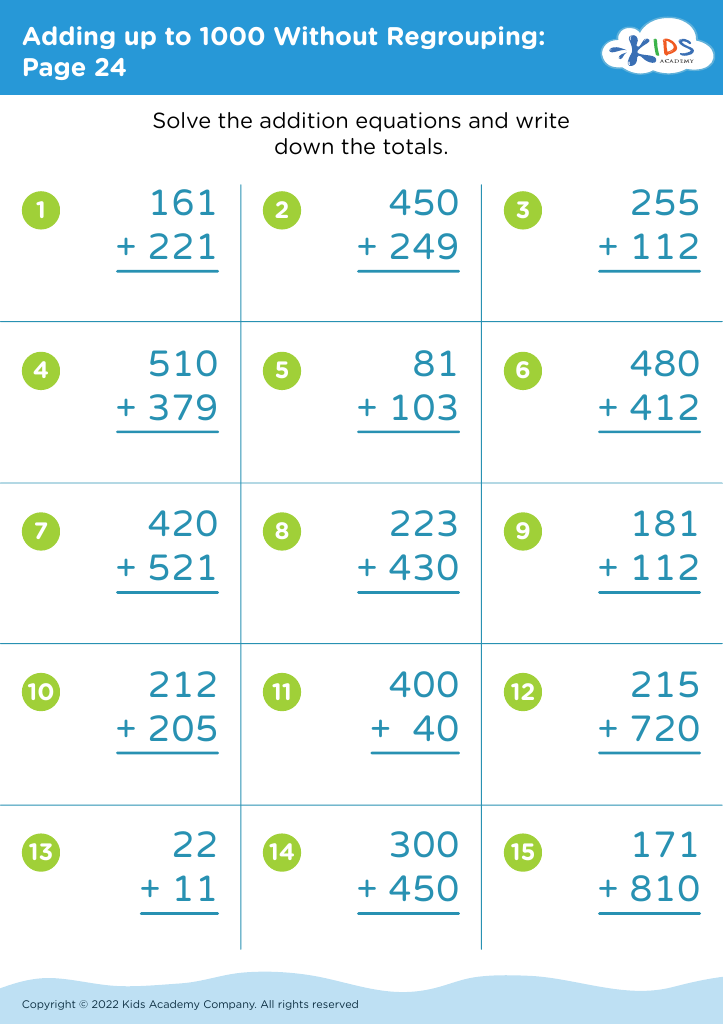
Enhance your 8-year-old’s understanding of fractions with our “Simplifying Fractions Adding up to 1000 Without Regrouping” worksheets! Tailored for young learners, these easy-to-follow worksheets make simplifying fractions fun and engaging. Students will confidently practice simplifying fractions while also applying skills to addition problems within 1000, without the complexity of regrouping. These exercises foster foundational math skills, ensuring children grasp the concepts effortlessly. Perfect for classroom or home use, these worksheets blend learning with interactive challenges to build proficiency and confidence in math. Boost your child's numeracy skills today with these expertly designed resources!


Simplifying fractions and mastering the concept of numerals adding up to 1,000 without regrouping are fundamental arithmetic skills crucial for an 8-year-old's cognitive development and future academic success. Simplifying fractions helps children understand equivalence, an essential foundation for more advanced mathematical concepts and problem-solving strategies. When educators or parents emphasize fraction simplification, they foster a child's ability to see relationships and patterns, improving their analytical thinking and number sense.
Similarly, mastering addition to 1,000 without regrouping promotes a solid grasp of place value—understanding the importance of ones, tens, and hundreds. This skill lays the groundwork for more complex operations like multiplication and division. When children practice adding without regrouping, they enhance their accuracy and speed, developing confidence in their math abilities. Together, these skills contribute to a child's broader understanding of numbers, facilitating smoother transitions to higher-order math concepts.
Furthermore, providing engaging, supportive practice in these areas nurtures a child's positive attitude toward math, reducing anxiety and building a lifelong interest and competence in the subject. Parents and teachers play a critical role in establishing a robust numerical foundation during this formative educational stage, enabling children to succeed academically and in real-life applications of mathematics.