Identifying shapes Adding up to 1000 Worksheets for 8-Year-Olds
3 filtered results
-
From - To
Enhance your 8-year-old's mathematical skills with our "Identifying Shapes Adding Up to 1000" worksheets! Designed to make learning fun and engaging, these worksheets combine shape recognition with addition challenges, helping kids to visualize and solve problems effectively. Through a variety of activities, children will practice identifying different shapes while mastering addition up to 1000. Our printable resources are user-friendly and age-appropriate, ensuring a supportive learning experience for young learners. Foster a love for math and creativity in your child with these exciting, educational games and exercises. Download now and empower your 8-year-old's skills today!
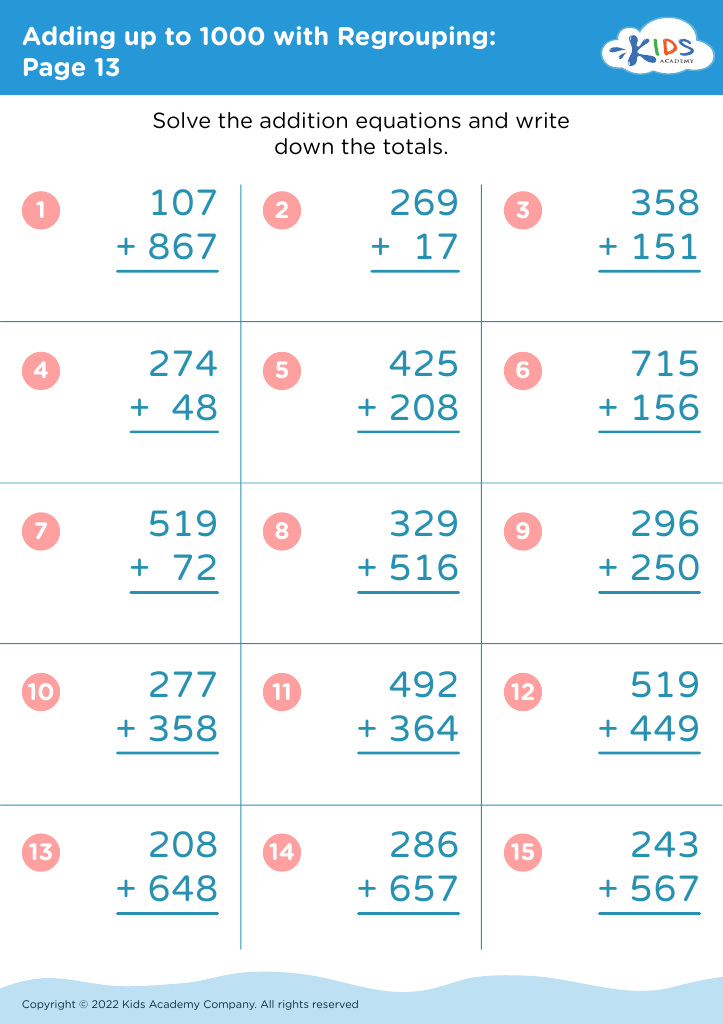
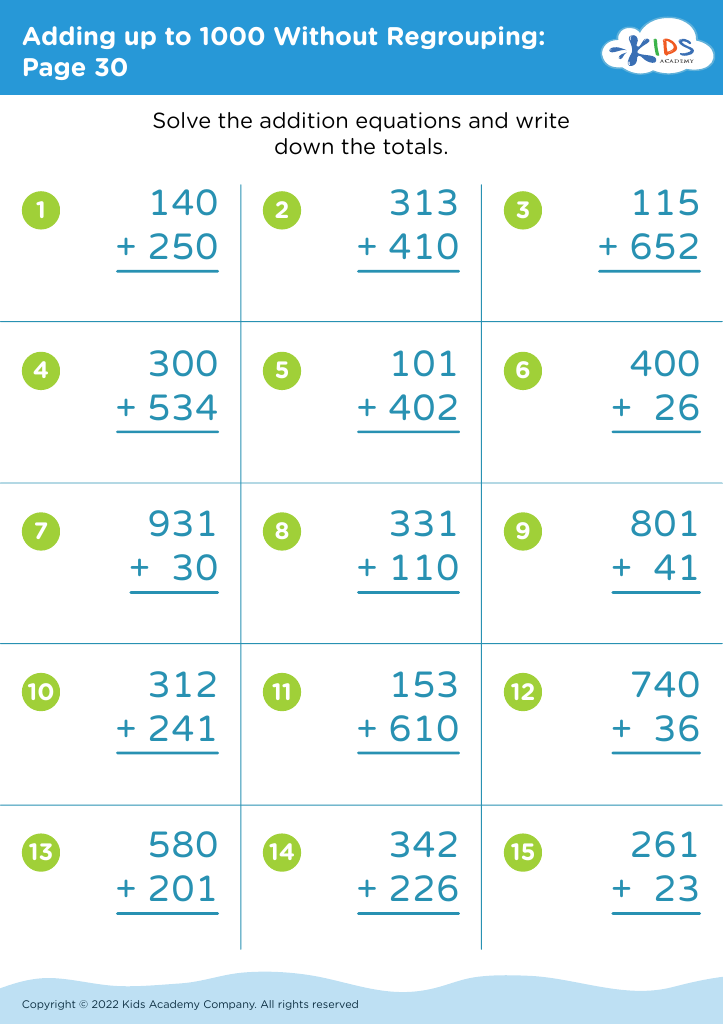
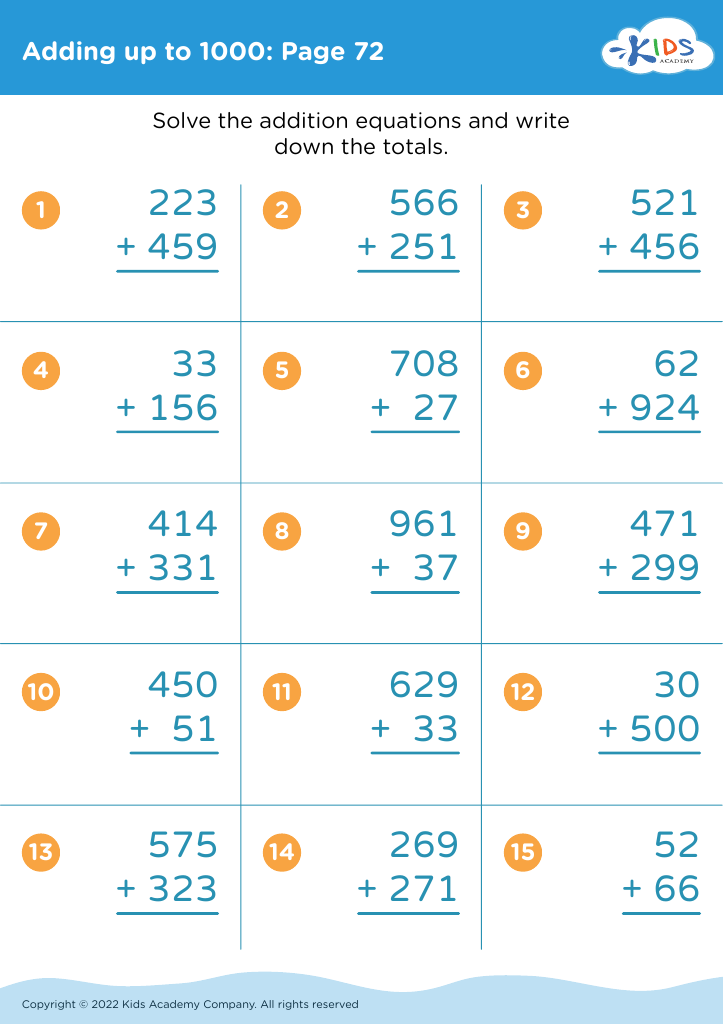



Identifying shapes and understanding various mathematical concepts, such as adding up to 1,000, are crucial skills for 8-year-old children. These skills lay the foundation for critical thinking and problem-solving abilities. When children recognize shapes, they enhance their spatial awareness, which helps in subjects like mathematics, science, and art. Shapes are everywhere in the world around them, and understanding these can foster creativity and improve visual-perceptual skills.
Similarly, learning to add numbers up to 1,000 cultivates numerical fluency. This competency enables children to tackle more complex mathematical concepts in the future, such as subtraction, multiplication, and even basic algebra. Mastering arithmetic improves their confidence and encourages a positive attitude towards mathematics as they progress through school. Additionally, strong mathematical skills are essential for practical life experiences, such as budgeting and measuring, which children will need in adulthood.
By focusing on these areas, parents and teachers not only help children perform well academically but also promote cognitive development. Identifying shapes and mastering addition challenges children to think critically and sequentially, skills that are useful beyond the classroom and into their everyday lives. Thus, fostering these competencies equips them for various future endeavors.








