Recognizing Patterns Adding up to 1000 Worksheets for 8-Year-Olds
6 filtered results
-
From - To
Discover our "Recognizing Patterns Adding up to 1000 Worksheets for 8-Year-Olds," designed to engage and challenge young minds. These thoughtfully crafted worksheets help children recognize numerical patterns, enhancing their addition skills within 1000. Perfect for both classroom use and home practice, our worksheets offer diverse exercises that make learning fun and interactive. By mastering these patterns, students build a strong math foundation and boost their problem-solving abilities. Give your 8-year-old a head start in math with our expertly designed resources, fostering a love for numbers and a keen analytical mind. Empower learning with us!
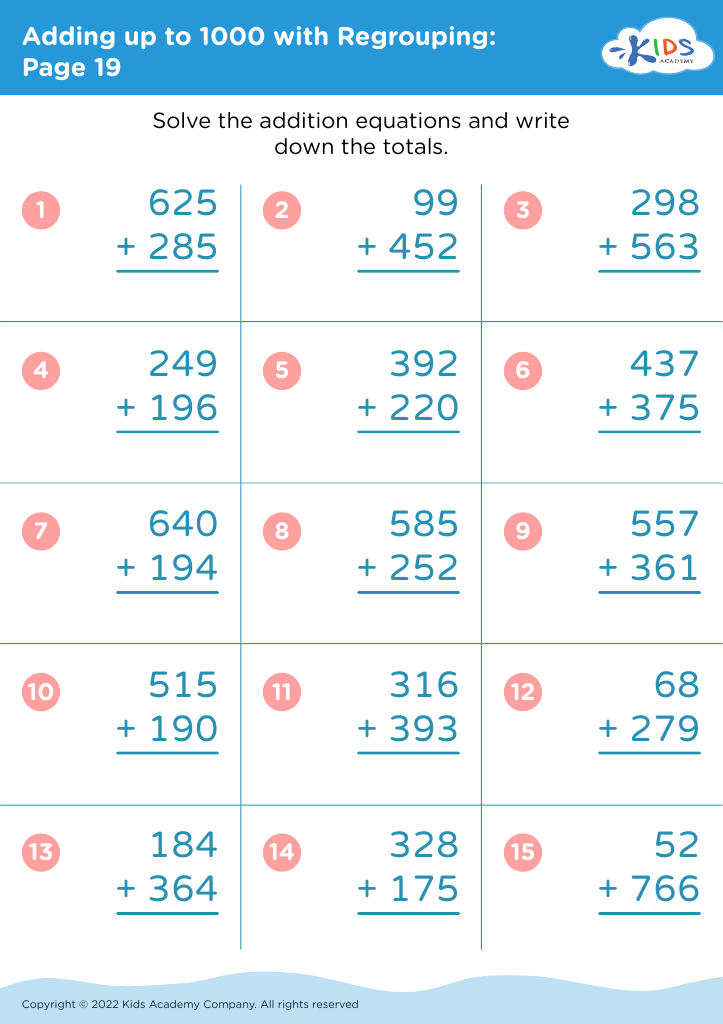
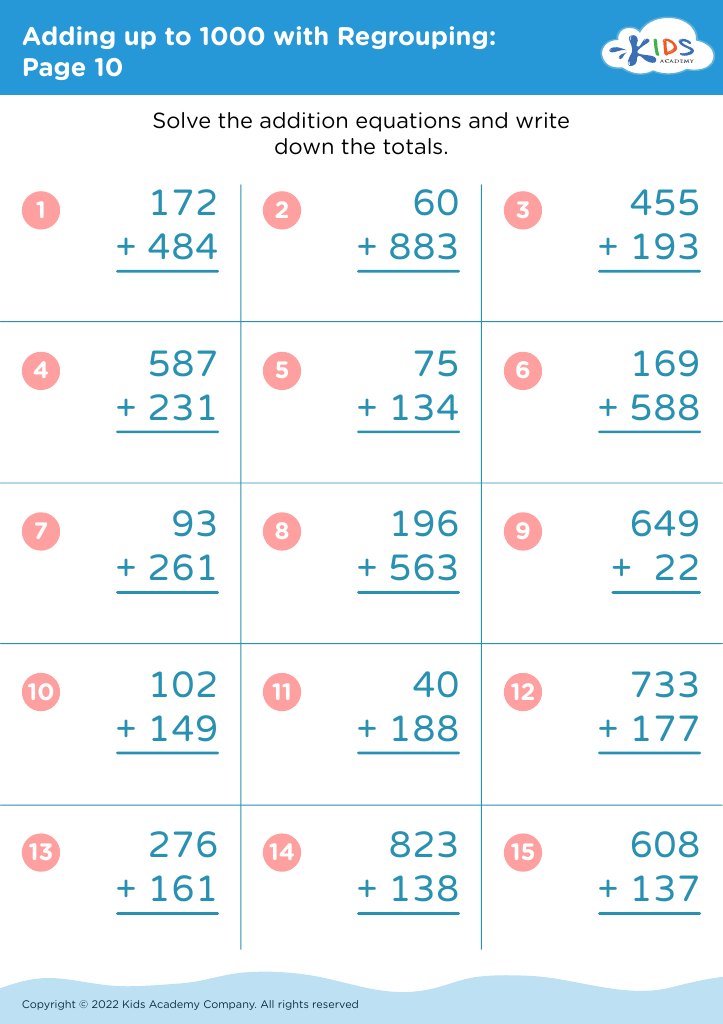
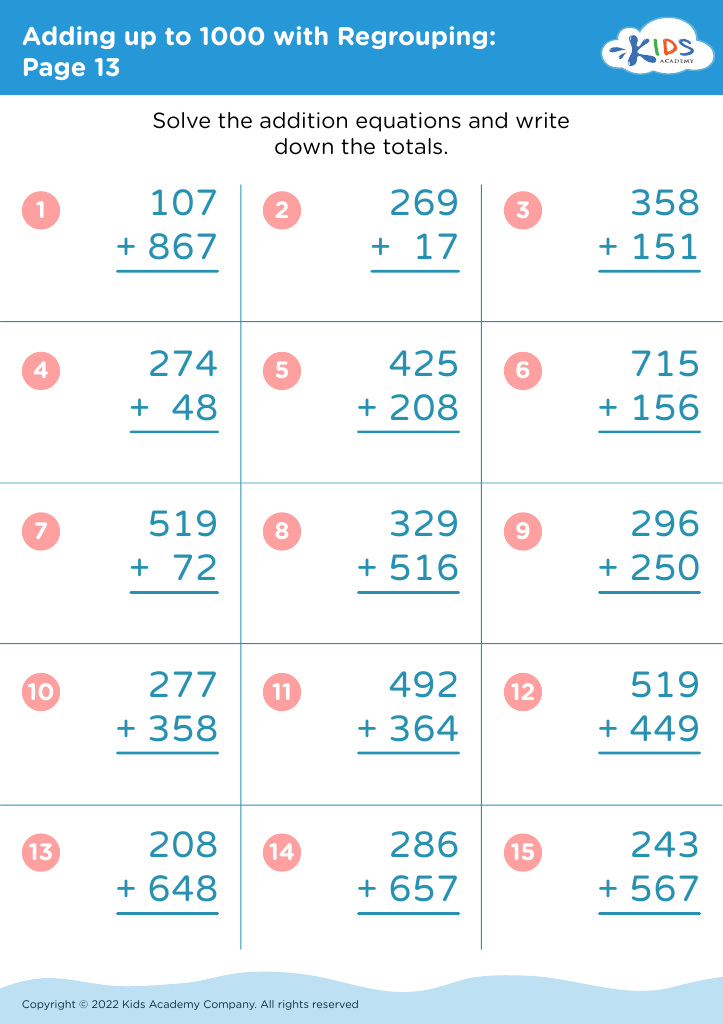
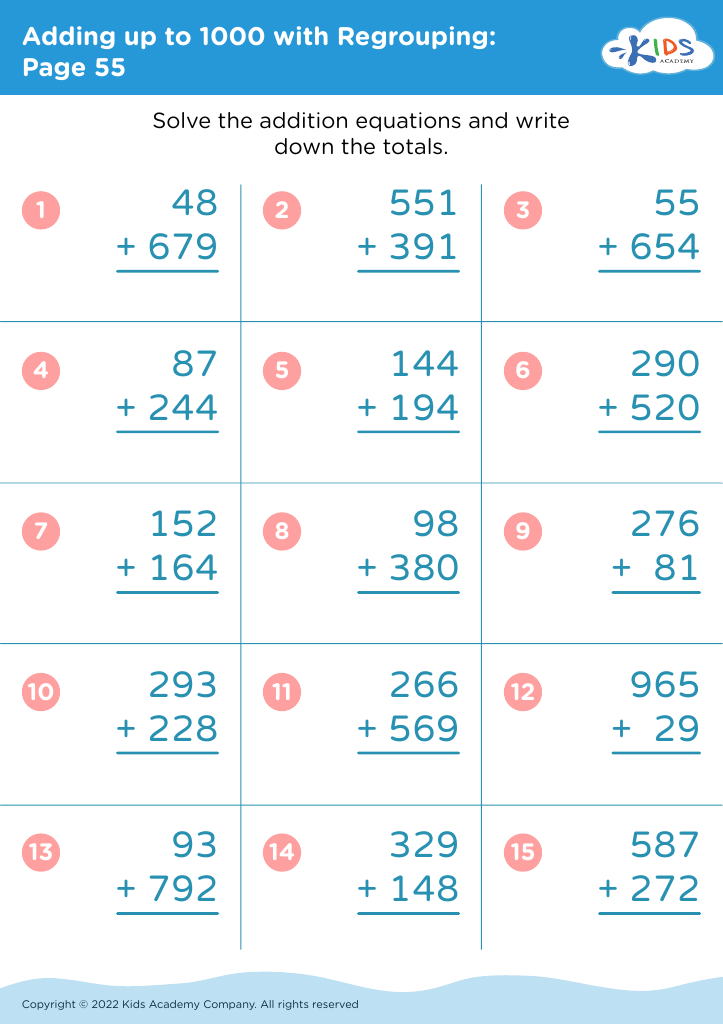
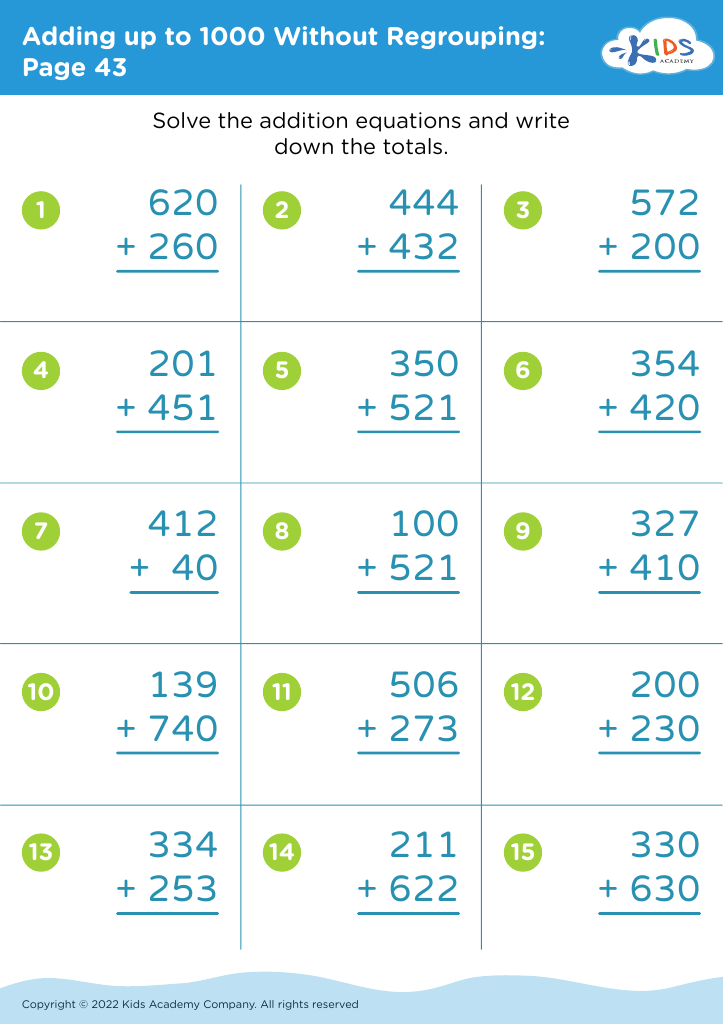
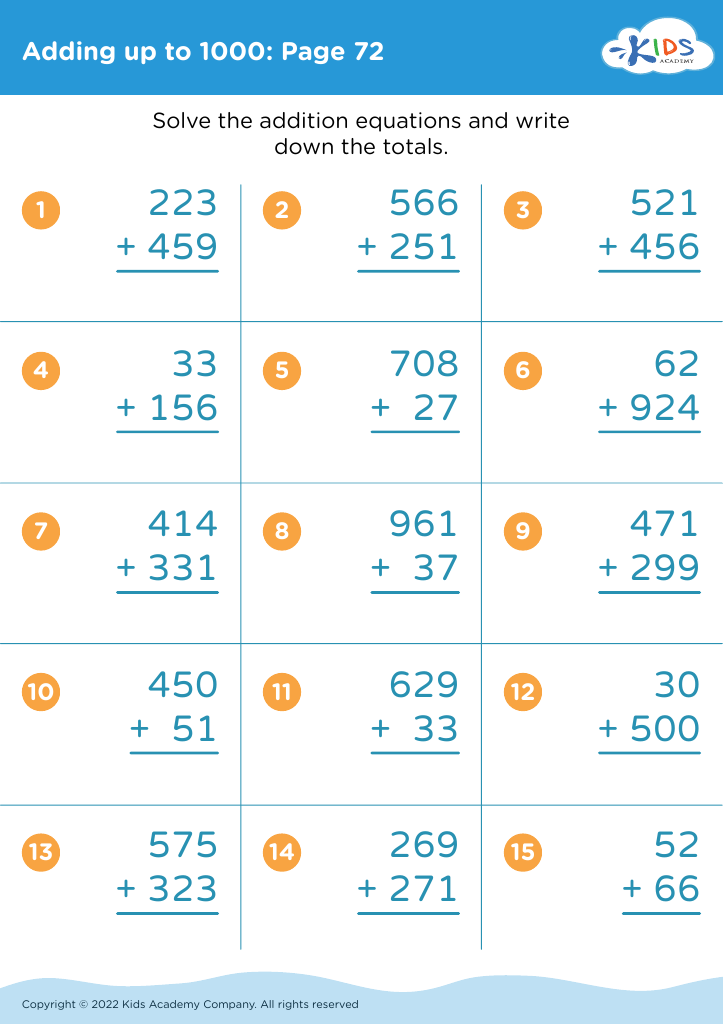



Recognizing patterns and understanding numbers up to 1000 forms a crucial part of foundational mathematical skills for 8-year-olds. At this stage, children's cognitive abilities are developing rapidly, and grasping these concepts boosts critical thinking, problem-solving, and analytical skills.
When children learn to recognize patterns, they start to see the consistency and relationships within numbers. This skill is essential for advanced math because it helps them understand the structure within the number system, such as place value, arithmetic operations, and even early algebraic thinking. Spotting patterns also enhances their ability to predict outcomes and develop reasoning skills, which are valuable across academic disciplines.
Additionally, working with numbers up to 1000 helps children become comfortable with larger quantities and builds confidence in their ability to handle complex problems. It bridges simple counting to more extensive operations, creating a smoother transition to more advanced grades.
Parents and teachers who emphasize these skills provide the children with tools for success in later mathematical concepts such as multiplication, division, and fractions. Societal demands emphasize STEM (Science, Technology, Engineering, Math) proficiency, making these early skills not only essential for academic success but also for future career competitiveness. Thus, recognizing patterns and numbers up to 1000 isn’t just about immediate learning; it’s about laying down a roadmap for lifelong intellectual growth and success.








