Comparing quantities Adding up to 50 Worksheets for 8-Year-Olds
3 filtered results
-
From - To
Empower your 8-year-old's math skills with our "Comparing Quantities Adding Up to 50 Worksheets." These carefully crafted exercises boost your child's confidence by teaching them how to compare and add quantities up to 50. Perfect for classroom use or extra practice at home, each worksheet provides engaging problems that help young learners master foundational math concepts. By focusing on addition within 50, these worksheets encourage logical thinking and problem-solving skills. Make math enjoyable and accessible for your child with our easy-to-print, high-quality worksheets designed to enhance their learning journey.
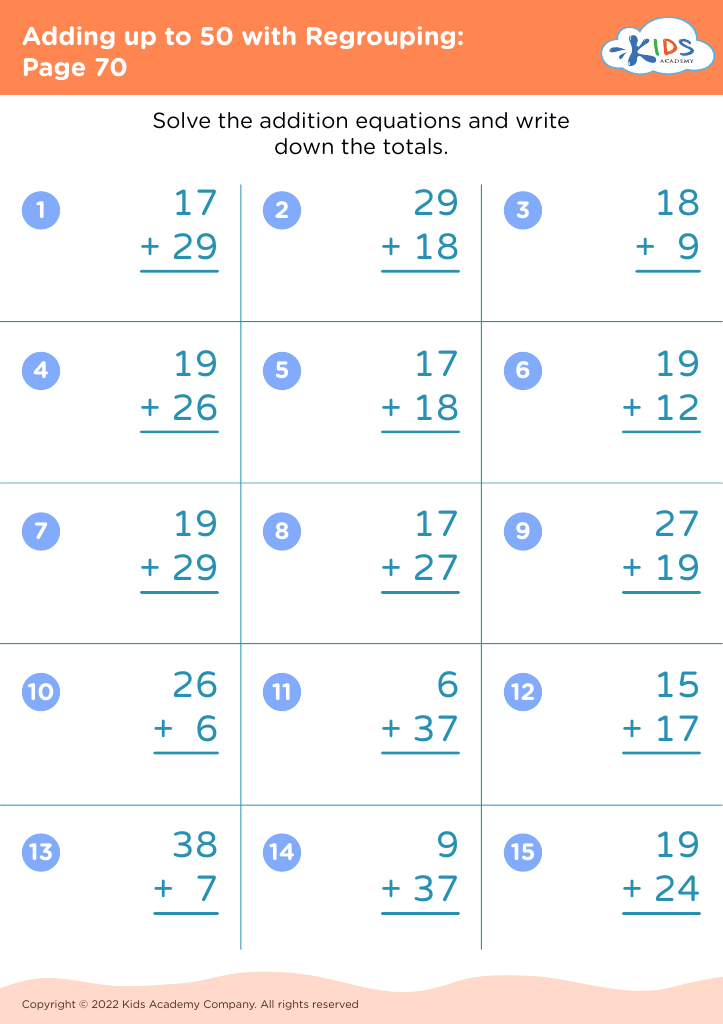
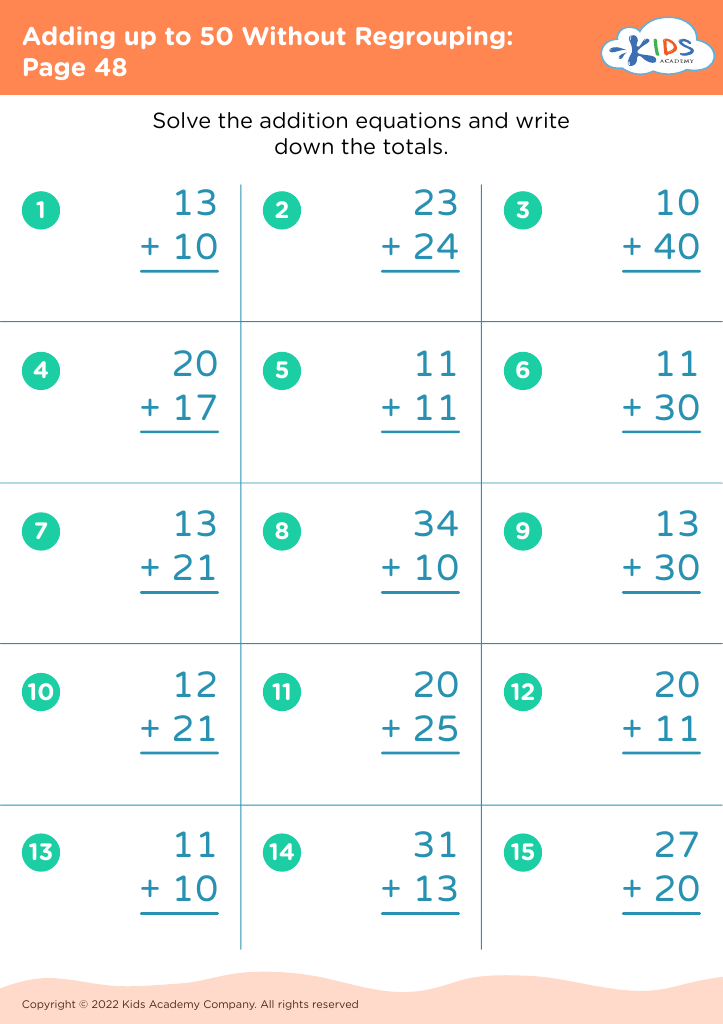
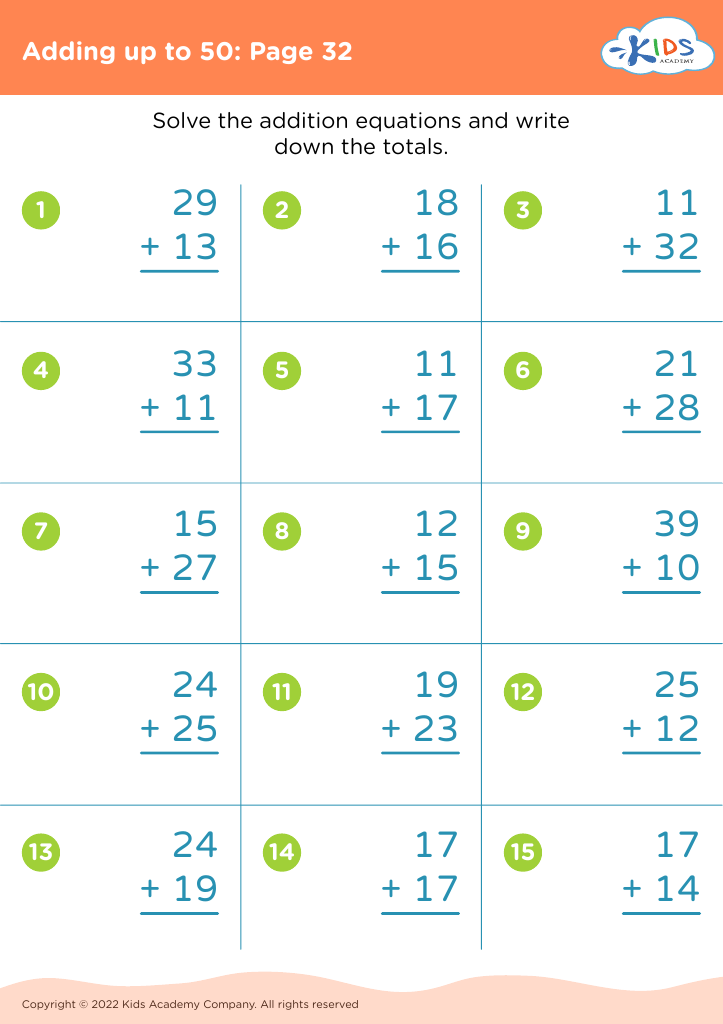




Parents and teachers play a crucial role in the early mathematical development of 8-year-olds by focusing on comparing quantities and adding up to 50. These foundational skills are essential for several reasons.
First, they help children understand numerical relationships and basic arithmetic operations, which are fundamental for more advanced math concepts they will encounter later. By comparing quantities, children learn to assess sizes and values, fostering critical thinking and problem-solving skills.
Adding up to 50 builds significant addition fluency, making future calculations both easier and faster. Proficiency in this range ensures that students can manage everyday math tasks and challenges in higher education and beyond. Moreover, these skills directly translate to real-world applications such as handling money, measuring ingredients, or scheduling time.
Furthermore, developing these abilities enhances a child's confidence in their mathematical skills. When students master early math concepts, they are more likely to have a positive attitude towards the subject, reducing math anxiety and establishing a strong foundation for lifelong learning.
In short, focusing on comparing quantities and adding up to 50 helps nurture a comprehensive understanding of math, promotes cognitive and practical skill development, and fosters a positive learning experience, all crucial for an 8-year-old's academic and personal growth.








