Recognizing equivalent fractions Adding up to 50 Worksheets for 8-Year-Olds
3 filtered results
-
From - To
Boost your 8-year-old's math skills with our engaging "Recognizing Equivalent Fractions Adding Up to 50 Worksheets"! These printable resources combine the excitement of adding numbers up to 50 with the essential learning skill of identifying equivalent fractions. Designed by expert educators at Kids Academy, each worksheet offers fun activities that enhance comprehension and spark a love for math. Perfect for classroom use or at-home practice, these worksheets help kids confidently identify, compare, and work with fractions, fostering both numerical and conceptual understanding. Start exploring today and turn math challenges into triumphs for your young learner!
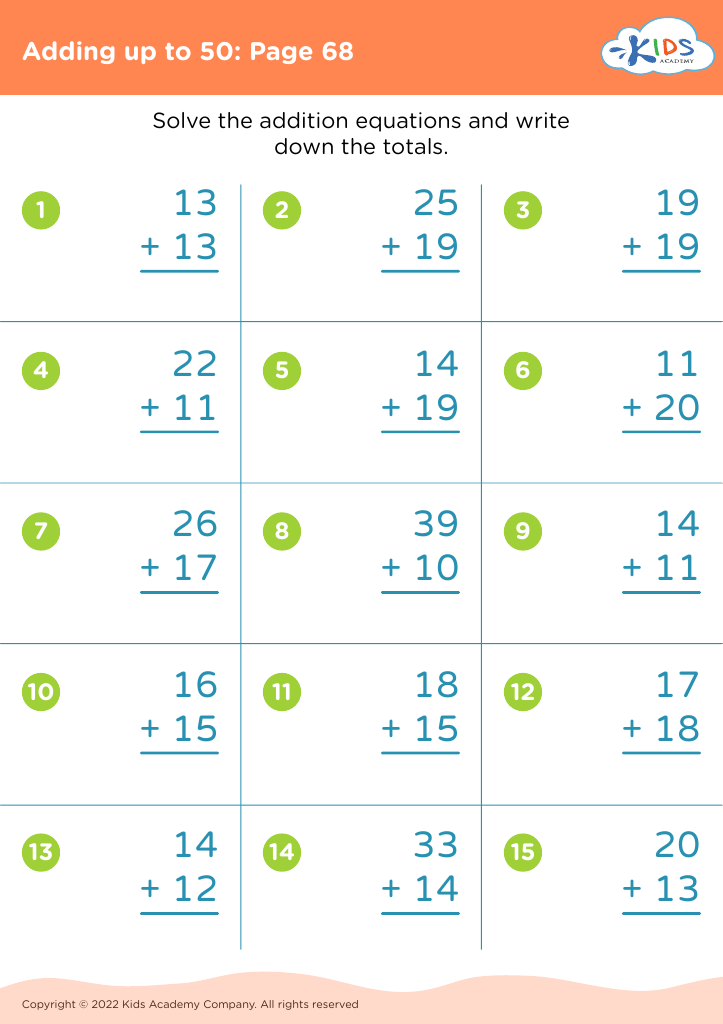
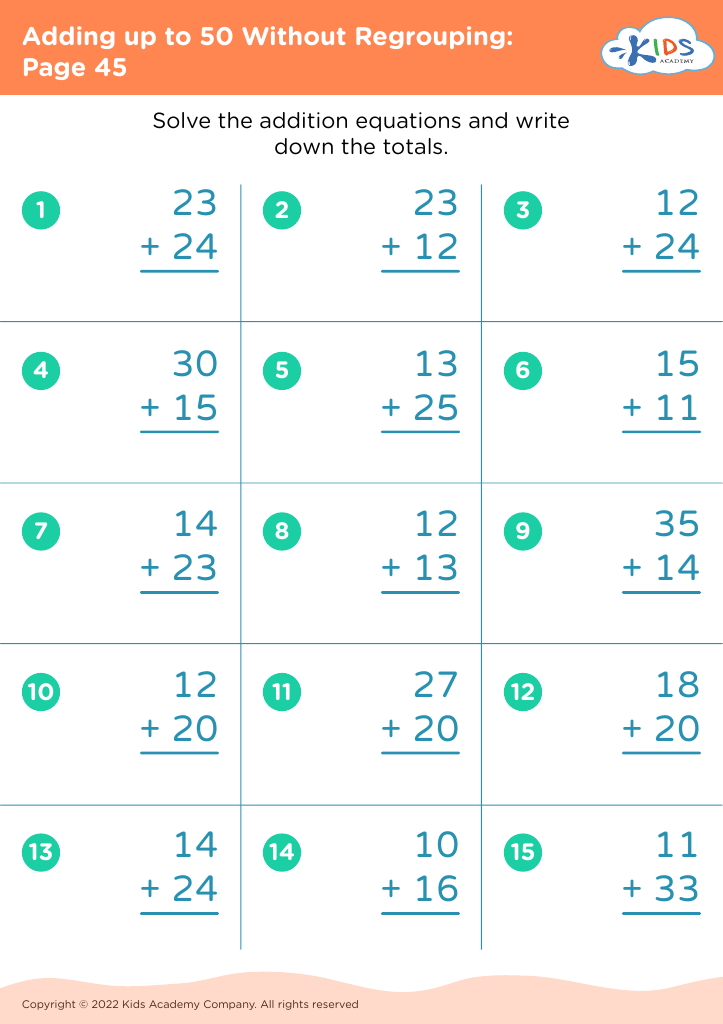
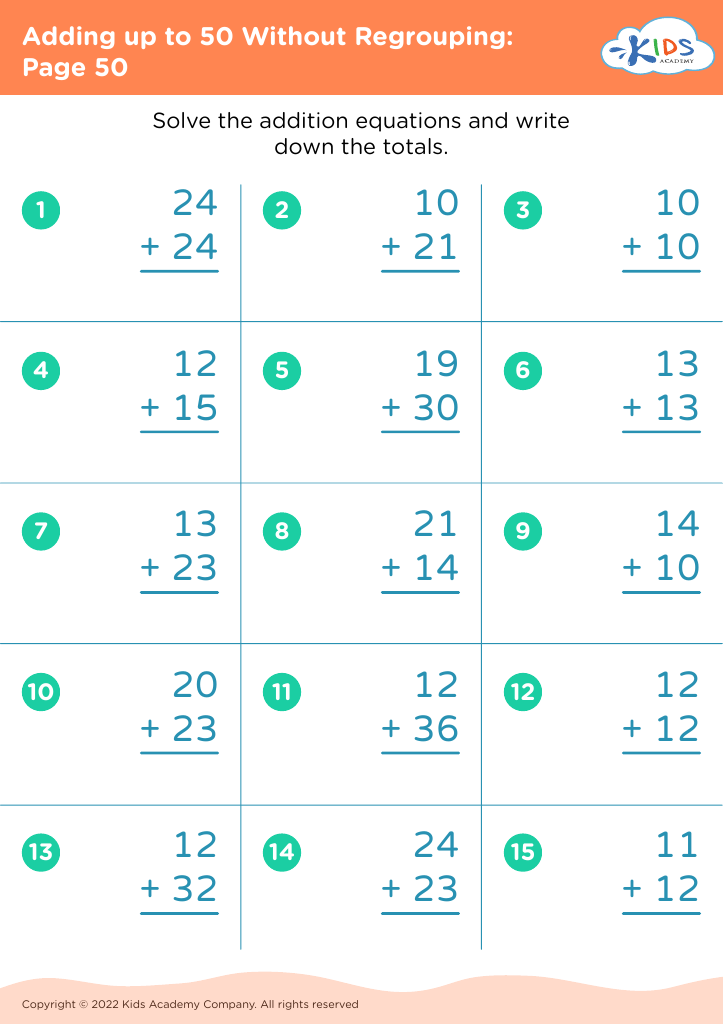




Recognizing equivalent fractions and grasping their concept is foundational in mathematical education, notably for 8-year-olds, who are beginning to develop abstract thinking skills. Equivalent fractions – fractions that represent the same value despite having different numerators and denominators – enhance a child's understanding of proportions, ratios, and various arithmetic operations. This knowledge is crucial because it forms the groundwork for more complex math concepts such as algebra, probability, and real-world applications like measurement and financial literacy.
When children grasp the concept of equivalent fractions and can confidently add up numbers to 50, they build strong arithmetic skills that carry over into other subject areas. For instance, knowing that 1/2 is the same as 2/4 can make it easier for them to manage fractions when they encounter mixed numbers or convert measurements in science.
Additionally, by supporting skills like recognizing equivalent fractions and adding numbers, parents and teachers emphasize the importance of accuracy and attention to detail. These skills are applicable beyond math, aiding in problem-solving, critical thinking, and logical reasoning in various contexts.
Ultimately, fostering these skills at an early age encourages a positive attitude toward learning, equips children with necessary lifelong skills, and instills confidence in their academic abilities. Thus, it's imperative for parents and teachers to prioritize teaching equivalent fractions and basic arithmetic.








