
Comparison Skills Addition Worksheets for 8-Year-Olds
4 filtered results
Difficulty Level
Grade
Age
-
From - To
Subject
Activity
Standards
Boost your child's arithmetic abilities with our engaging Comparison Skills Addition Worksheets designed specifically for 8-year-olds. These worksheets focus on enhancing children’s comprehension of addition by comparing different quantities and understanding numerical relationships. By practicing with diverse problems, young learners develop critical thinking and problem-solving skills while making math a fun and interactive experience. Our user-friendly format encourages independent learning and allows children to progress at their own pace. Perfect for home or classroom settings, these worksheets not only reinforce addition concepts but also build a solid foundation for more complex mathematical operations. Start fostering your child's math confidence today!
Favorites
With answer key
Interactive
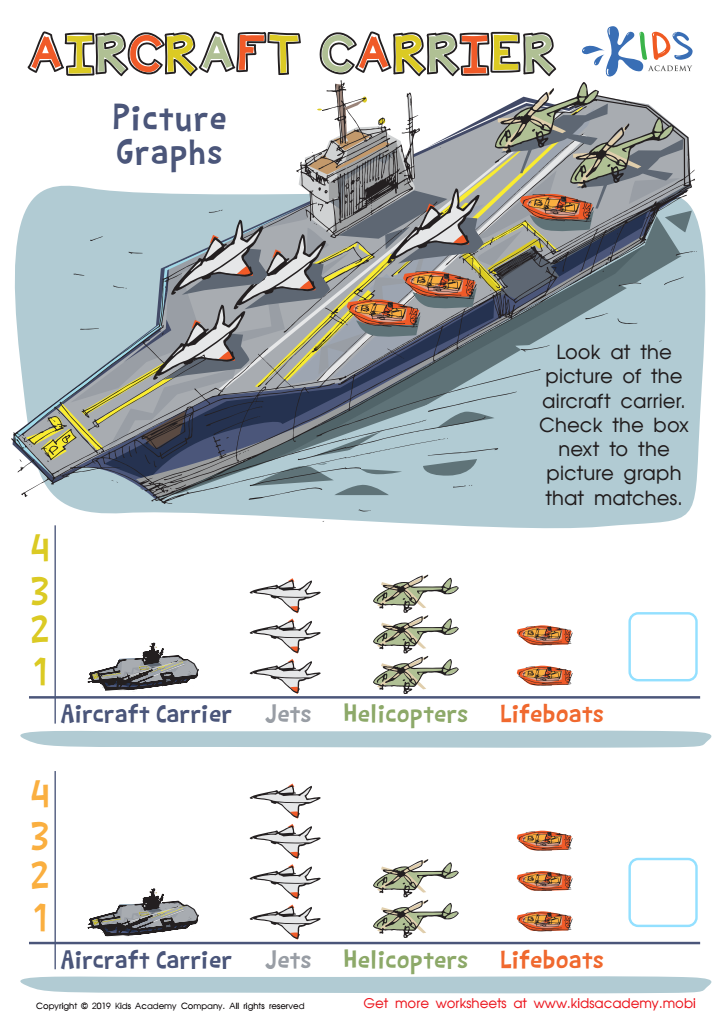
Aircraft Carrier Picture Graphs Worksheet
Kids love learning about jets and boats with this awesome worksheet! It's a great way to engage them as they work on picture graphs. Representing numerical values with pictures, this free PDF requires them to choose which picture graph and representation best match the carrier in the picture. It's also great practice for visual discrimination!
 Assign to My Students
Aircraft Carrier Picture Graphs Worksheet
Worksheet
Join Kids Academy for Free
Who is primarily going to use this learning content?








Comparison skills in addition are crucial for 8-year-olds as they form the foundation for both mathematical understanding and critical thinking. At this stage, children begin to encounter more complex mathematical concepts, and honing their comparison skills allows them to make quick, informed decisions about numbers. By evaluating different sums or finding which addition equation yields a larger total, students develop number sense, an essential skill that enhances their overall mathematical proficiency.
Moreover, comparison skills foster problem-solving abilities, enabling children to analyze various strategies for arriving at correct answers. For parents and teachers, encouraging the development of these skills helps prepare students for advanced mathematical concepts they will encounter in later grades, such as subtraction, multiplication, and division.
Additionally, comparison skills promote confidence and independence in young learners. When children can quickly assess and compare numbers, they become more self-assured in their calculations, which increases their willingness to engage in challenging mathematical tasks. This sets the stage for a positive attitude toward learning and a lifelong appreciation for mathematics. Therefore, both parents and teachers should prioritize developing comparison skills in addition to ensure a strong mathematical foundation for their children.








