
Fraction identification Math Worksheets for 8-Year-Olds
6 filtered results
Difficulty Level
Grade
Age
-
From - To
Subject
Activity
Standards
Unlock the world of fractions with our Fraction Identification Math Worksheets, designed specifically for 8-year-olds! These engaging and educational worksheets enhance children's understanding of fractions through fun exercises that simplify complex concepts. Students will learn to identify, compare, and manipulate fractions with visual aids and practical examples that turn learning into an exciting adventure. Perfect for classroom use or at-home practice, these worksheets boost math skills while building confidence in young learners. Download now from Kids Academy to spark a love for math in your child today!
Favorites
With answer key
Interactive
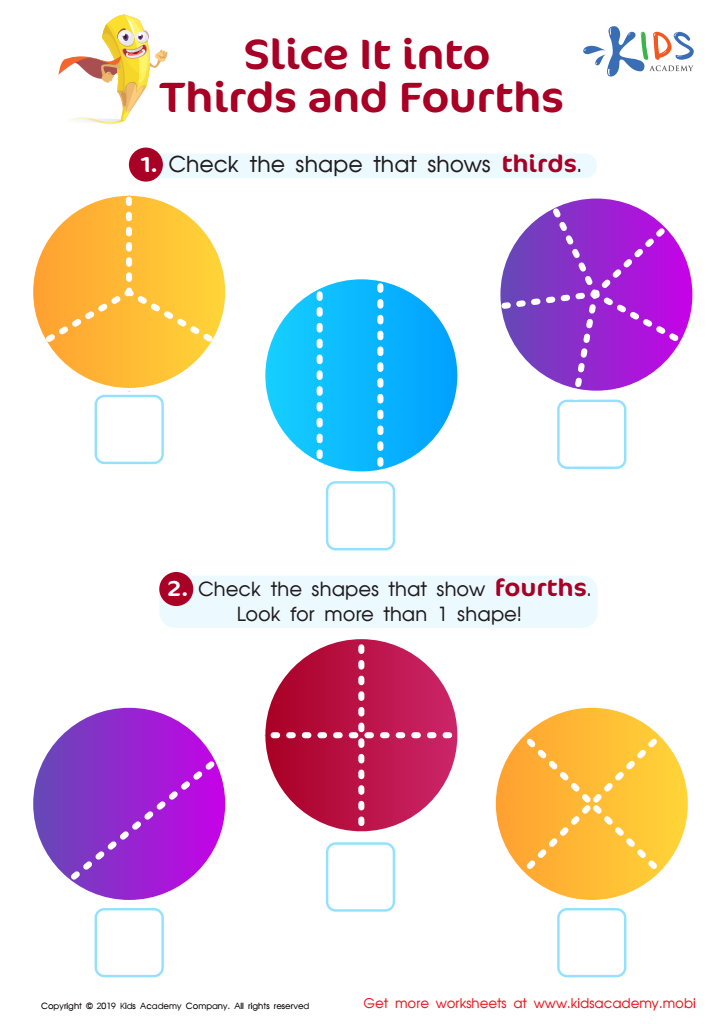
Slice in Thirds Fourths Worksheet
This worksheet helps kids learn fractions visually by dividing circles into thirds and fourths. They will learn that fractions must be equal parts, not just sets, by choosing the right colorful circles. It's an easy way to master fractions and have fun doing it!
 Assign to My Students
Slice in Thirds Fourths Worksheet
Worksheet
Join Kids Academy for Free
Who is primarily going to use this learning content?




.jpg)


Understanding fractions is a fundamental math skill that lays the foundation for more advanced mathematical concepts. At the age of eight, children are at a crucial developmental stage where they begin transitioning from concrete to more abstract forms of thinking. Mastering fractions helps them grasp the idea of part-whole relationships, which is essential not only in math but also in everyday life.
By learning to identify and work with fractions, kids improve their numerical literacy and problem-solving skills. These skills are integral in real-world applications such as cooking, shopping, and time management. Additionally, research indicates that early proficiency in math, including fractions, is a strong predictor of future academic success and higher-order thinking skills.
Parents and teachers should focus on fraction identification to ensure a robust mathematical foundation, which can reduce math anxiety later in life. Engaging young learners with flexible and interactive methods, such as visual aids, games, and hands-on activities, can make learning fractions enjoyable and more comprehensible. In essence, investing time and effort into teaching fractions not only contributes to academic achievement but also equips children with essential life skills, empowering them to approach more complex mathematical challenges with confidence.








