Fractions understanding Math Worksheets for 8-Year-Olds
3 filtered results
-
From - To
Boost your child's math skills with our expertly designed "Fractions Understanding Math Worksheets for 8-Year-Olds." These printable worksheets offer a fun and interactive way for children to understand fractions. Through engaging activities, kids will learn to identify and compare fractions, understand wholes and parts, and solve fraction-based problems. Aligned with educational standards, our worksheets make complex concepts accessible and enjoyable. Perfect for reinforcing classroom lessons or homeschooling, these resources are crafted to build a solid foundation in fractions, ensuring kids gain confidence and competence in their math abilities. Help your child master fractions today!
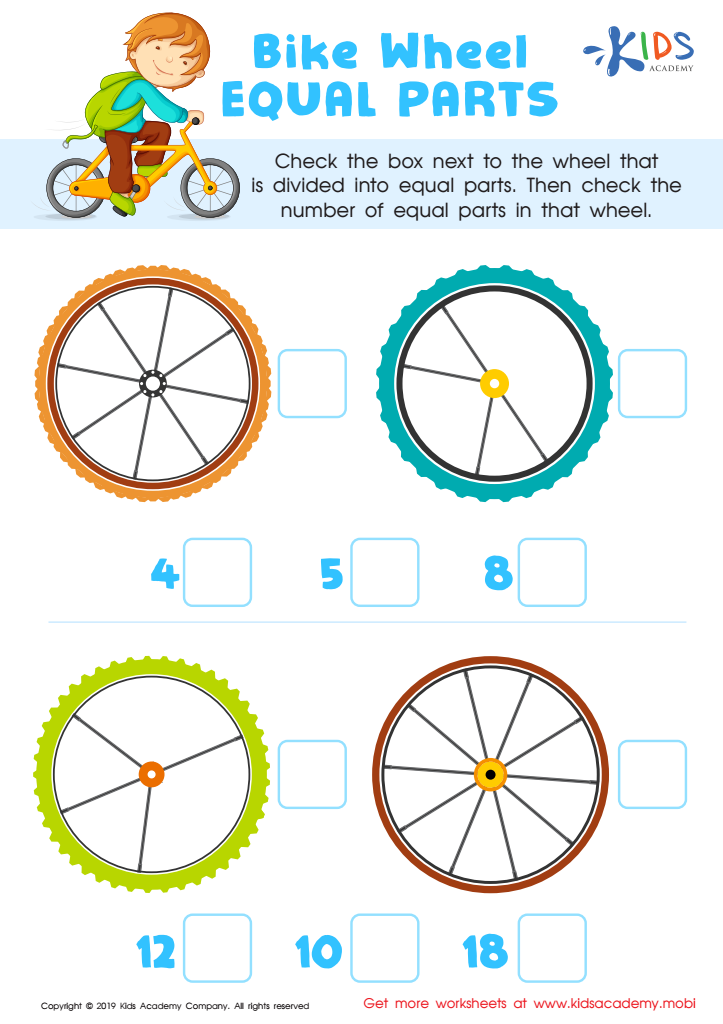
Bike Wheel Equal Parts Worksheet
 Assign to My Students
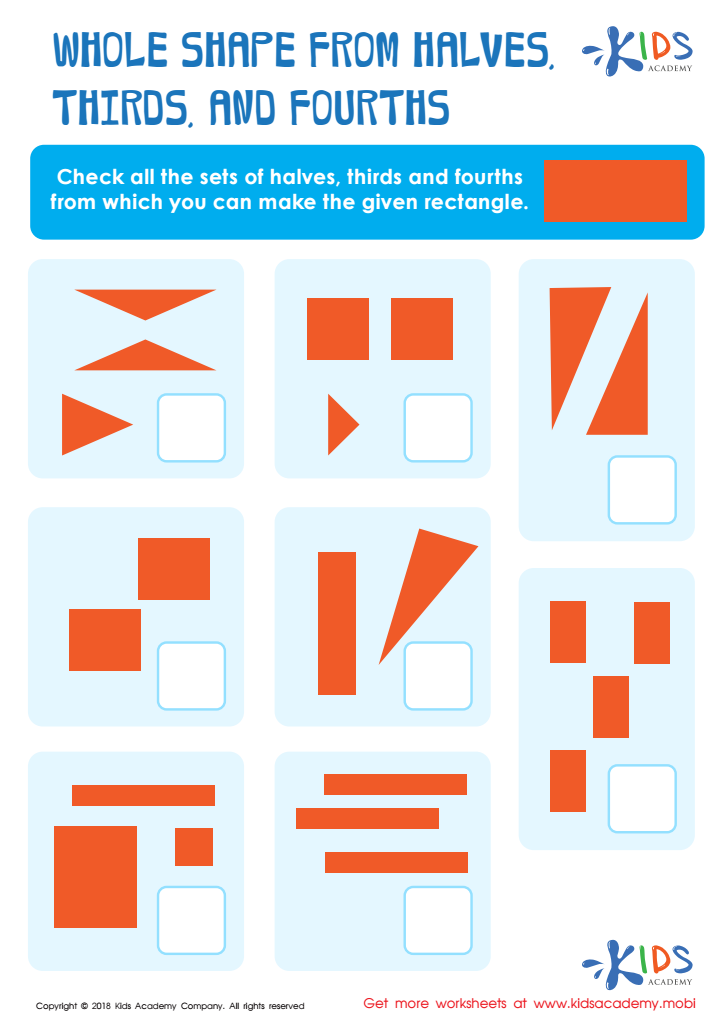
Whole Shape from Halves, Thirds and Fourths Worksheet








Understanding fractions is crucial for 8-year-olds as it lays the foundation for more complex mathematical concepts and everyday problem-solving abilities. At this age, children are developing cognitive skills that allow them to grasp abstract ideas better. Learning fractions helps enhance their numerical understanding and ability to see the relationships between whole parts and their segments.
Parents and teachers should care about fractions because early comprehension in this area influences future success in mathematics. Fractions serve as a bridge from simple arithmetic to higher-level math, including algebra and calculus. Moreover, skills in fractions are necessary for topics like measurement, ratios, and probability.
Real-world applications underscore the importance; from splitting a pizza to determining doses in medicine or scaling a recipe, the examples are endless. A solid grounding in fractions fosters logical thinking and problem-solving skills—cornerstones of educational development.
By incorporating fractions at an early stage, educators and parents ensure that children gain confidence in their mathematical abilities, reducing the likelihood of math anxiety. This positive mindset leads students to approach more challenging concepts with curiosity and resilience. In the end, mastering fractions is not just about math; it’s about equipping students with tools for lifelong learning and everyday practical use.








