Improving observational skills Math Worksheets for 8-Year-Olds
3 filtered results
-
From - To
Unlock your child's potential with our "Improving Observational Skills Math Worksheets" designed specifically for 8-year-olds. These engaging worksheets enhance visualization and critical thinking abilities, helping kids learn to observe patterns, relationships, and details in mathematical concepts. By integrating fun activities and real-life examples, our worksheets not only reinforce essential math skills but also foster a deeper understanding of the world around them. Perfect for at-home practice or in the classroom, these resources make learning a fulfilling adventure! Equip your child with the tools they need to thrive in math while boosting their observational prowess. Try them out today!
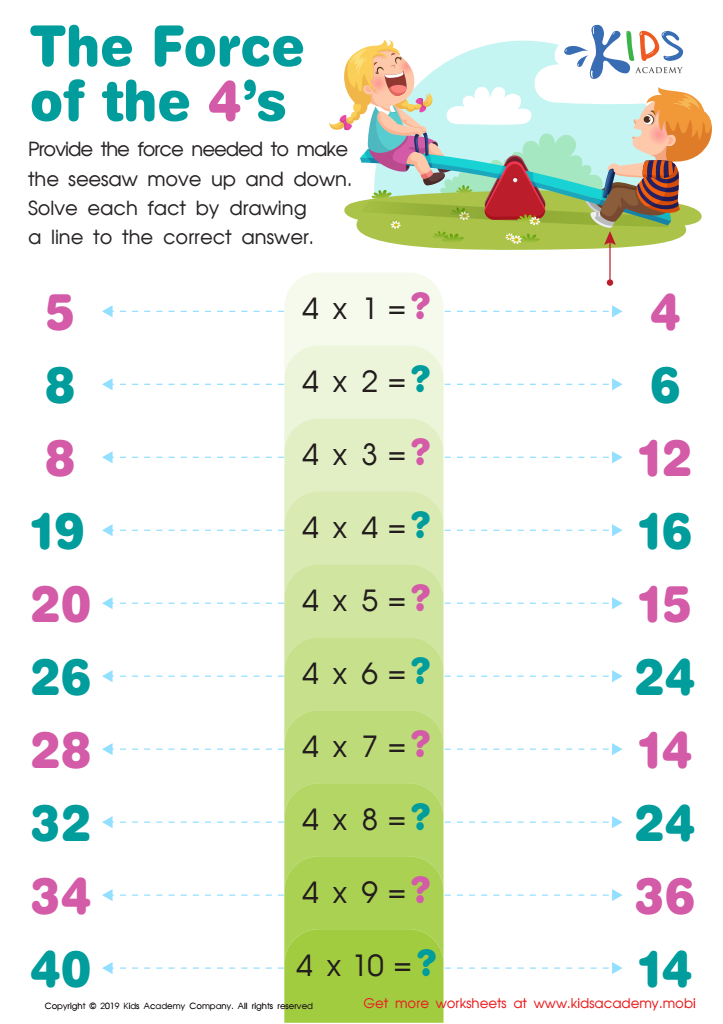
The Force of the 4's Worksheet
 Assign to My Students








Improving observational skills in mathematics for 8-year-olds is crucial for several reasons. First, observational skills lay the groundwork for problem-solving and critical thinking. At this age, children are starting to understand fundamental math concepts, such as addition, subtraction, patterns, and shapes. Enhancing their ability to observe and analyze these elements helps them connect concepts and apply them in real-life situations.
Moreover, observational skills encourage active learning. When students learn to scrutinize information, they become more engaged and inquisitive. This promotes a growth mindset, as they learn to approach challenges with curiosity rather than fear of failure, fostering a lifelong love for learning.
Furthermore, developing strong observational skills helps children notice details, recognize relationships, and draw conclusions based on their findings. This skill set is not only applicable in math but extends to science, social studies, and daily life scenarios, aiding them in becoming well-rounded learners.
Finally, strong observational skills in math can boost children's confidence. As they become adept at recognizing patterns and solving problems, they feel empowered, which positively impacts their overall academic performance. Therefore, parents and teachers should prioritize enhancing these skills to set a solid foundation for their children's future educational success.








