
Learning addition Math Worksheets for 8-Year-Olds
3 filtered results
Difficulty Level
Grade
Age
-
From - To
Subject
Activity
Standards
Engage your 8-year-old in learning addition with enjoyable and effective math worksheets from Kids Academy. These printable activities are specially designed to complement your child’s cognitive abilities and make math practice fun. From simple sums to more complex problems, these worksheets will gradually build your child's confidence and proficiency in addition. Each exercise aims to strengthen essential math skills while keeping your child motivated. Filtering by age ensures your kid gets the right challenge for their developmental stage. Develop strong addition skills and boost your child’s math performance with these interactive and educational tools.
Favorites
With answer key
Interactive
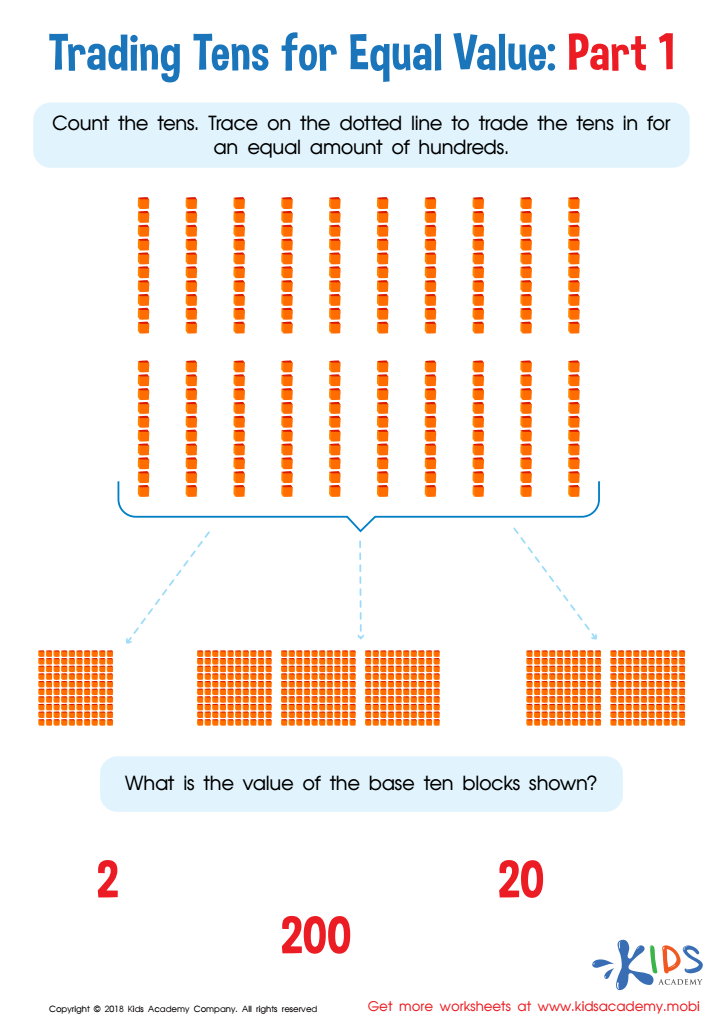
Trading Tens for Equal Value Worksheet: Part 1
This worksheet helps 3rd graders count large numbers and recognize base numbers. It lists 10 cubes and asks students to identify the hundreds, then circle the base blocks. This colorful pdf provides a fun, visual way to help students strengthen their math basics.
 Assign to My Students
Trading Tens for Equal Value Worksheet: Part 1
Worksheet
Join Kids Academy for Free
Who is primarily going to use this learning content?






Parents and teachers should place a high value on 8-year-olds learning addition because it forms the bedrock of future mathematical understanding. At this age, children are developing cognitive skills that allow them to grasp basic arithmetic concepts. Mastery of addition not only enhances their problem-solving abilities but also builds confidence in tackling more complex mathematical operations, such as subtraction, multiplication, and division as they progress in their academic journey.
Learning addition at an early age also reinforces logic and reasoning abilities, as children learn to approach numbers and equations methodically. This foundational knowledge promotes critical thinking skills, which are transferable to other subjects and real-life situations.
Moreover, fluency in addition aids in developing quick mental calculation skills, which are essential in daily activities such as shopping, cooking, and time management. By engaging in addition activities, children practice patience and persistence, as they understand that proficiency comes with repeated effort and practice.
Investing time and effort into teaching addition at a young age also opens the door to fostering a positive attitude toward mathematics. When children find early success in math, they are more likely to enjoy and pursue the subject long-term, leading to academic success and enhanced career opportunities in STEM fields. For these reasons, foundational arithmetic proficiency is a vital educational focus that benefits children extensively.








