Observational skills Math Worksheets for 8-Year-Olds
3 filtered results
-
From - To
Enhance your child's learning experience with our engaging Observational Skills Math Worksheets designed specifically for 8-year-olds. These worksheets focus on developing critical thinking and observational skills through fun and interactive activities. Children will explore patterns, identify shapes, and solve puzzles, all while strengthening their mathematical understanding. Our carefully crafted exercises promote cognitive development and boost confidence in young learners. Whether used at home or in the classroom, these worksheets serve as an essential tool for fostering a love of math. Dive into the world of exploration and discovery with our dynamic resources! Perfect for curious minds eager to learn and grow.
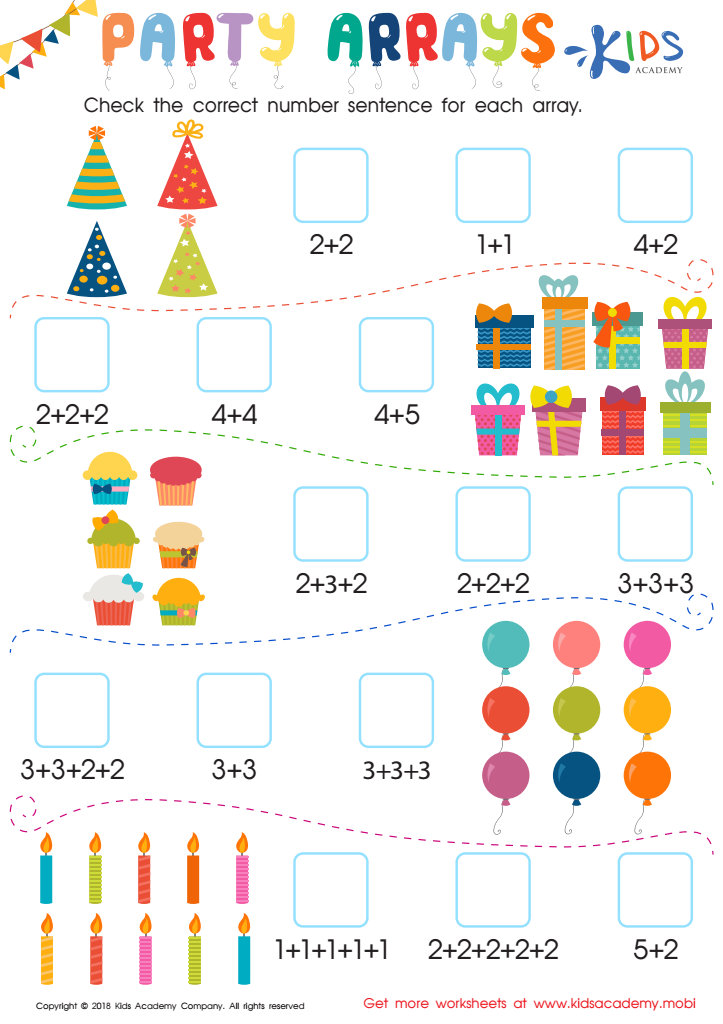
Party Arrays Worksheet
 Assign to My Students








Observational skills in mathematics are crucial for 8-year-olds as they form the foundation for critical thinking and problem-solving. At this developmental stage, children begin to engage more deeply with their environment and the mathematical concepts around them. When parents and teachers foster strong observational skills, they are helping children to identify patterns, make connections between numbers and real-world scenarios, and develop spatial awareness—all key to understanding mathematics.
Moreover, strong observational skills enable children to approach math in a more intuitive and relaxed manner. They learn to notice details, compare shapes, and explore fractions through everyday activities, such as cooking or playing games. This active engagement enhances their enjoyment of math, encouraging a growth mindset as opposed to a fixed one.
Additionally, children with sharpened observational skills are better equipped to justify their reasoning and explain their thought processes, which is crucial for building effective communication skills in math. This leads to a more profound comprehension of mathematical concepts and prepares them for more complex challenges in higher grades. Therefore, by nurturing observational skills, parents and teachers can significantly enhance a child’s math competency and overall academic excellence.








