Reading analog clocks Math Worksheets for 8-Year-Olds
5 filtered results
-
From - To
Enhance your child's time-telling skills with our engaging “Reading Analog Clocks Math Worksheets for 8-Year-Olds.” Designed specifically for young learners, these worksheets offer a fun and interactive way to practice telling time on analog clocks. Children will engage with various exercises, including identifying hour and minute hands, reading times, and solving time-related problems. Our resources promote critical thinking and reinforce math skills while making learning enjoyable. Perfect for classroom use or at-home practice, these worksheets help ensure that your child gains confidence in reading analog clocks. Download and explore our collection to make learning about time a delightful experience!
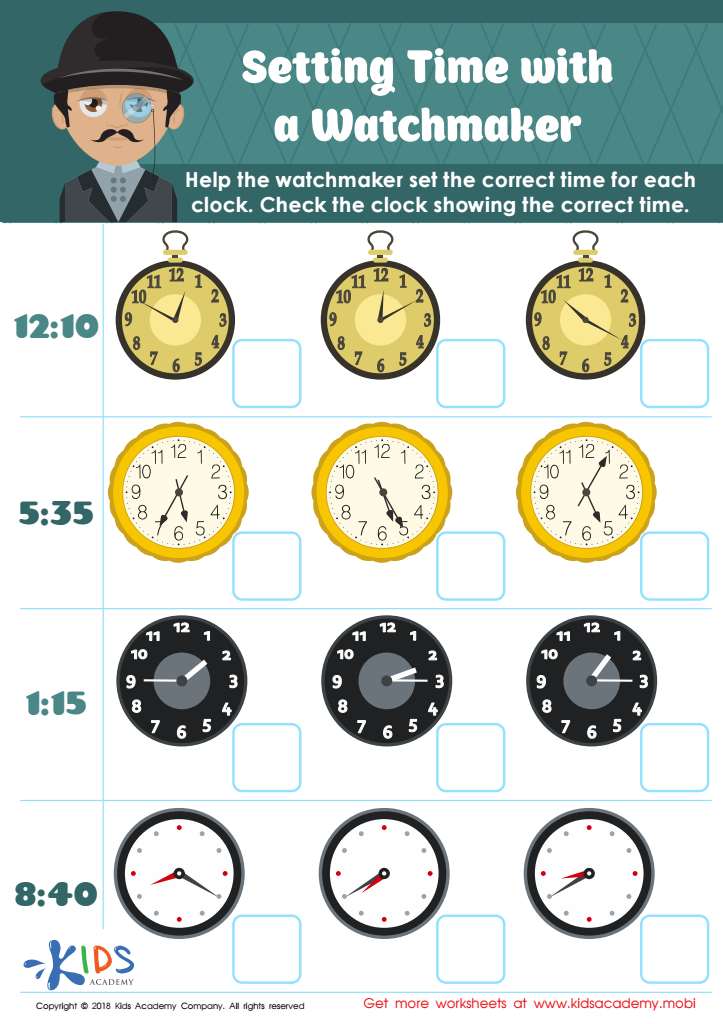
Setting Time with Watchmaker Worksheet
 Assign to My Students






Teaching 8-year-olds how to read analog clocks is important for several reasons. Firstly, it enhances their understanding of time concepts, promoting essential life skills. While digital clocks are ubiquitous, analog clocks foster a deeper grasp of hours and minutes, helping children visualize the passage of time better. This skill is not just about telling time; it strengthens their overall math abilities.
Understanding analog clocks also nurtures critical cognitive skills, such as problem-solving and spatial awareness. When children learn to read the clock, they engage in counting, recognizing patterns, and calculating intervals. Such practices reinforce their mathematical foundation, making future learning easier.
Moreover, recognizing time helps children develop self-management skills. Knowing how to read an analog clock equips them with the ability to plan their activities and manage their schedules more effectively, fostering independence and responsibility.
Lastly, teaching children about analog clocks connects them with traditions and routines, such as school bells or family gatherings. It cultivates a sense of community and shared experiences. Thus, emphasizing reading analog clocks is crucial for cognitive development, practical skills, and familial connections, making it a worthwhile endeavor for both parents and teachers.








