Filters

6 filtered results

Clear all filters
Favorites
With answer key
Interactive

6 filtered results

Difficulty Level

Grade


Enhance your child’s hand-eye coordination with our Cursive Alphabet Worksheets designed specifically for 9-year-olds. These engaging printables focus on developing fine motor skills and ensuring your child gains proficiency in cursive writing. Through a variety of exercises, kids will practice tracing and writing cursive letters, improving their handwriting consistency and overall coordination. Each worksheet offers a structured yet creative approach to mastering the art of cursive in an enjoyable way. Perfect for adding an extra layer of learning at home or in the classroom, these worksheets are an essential tool for any 9-year-old's educational development.

Check out this FREE Trial Lesson on Cursive Alphabet for age 9!

H

Favorites
With answer key
Interactive
  • 9
  • Hand-eye Coordination
  • Cursive Alphabet
Cursive ABCs: Uppercase E

Cursive ABCs: Uppercase E

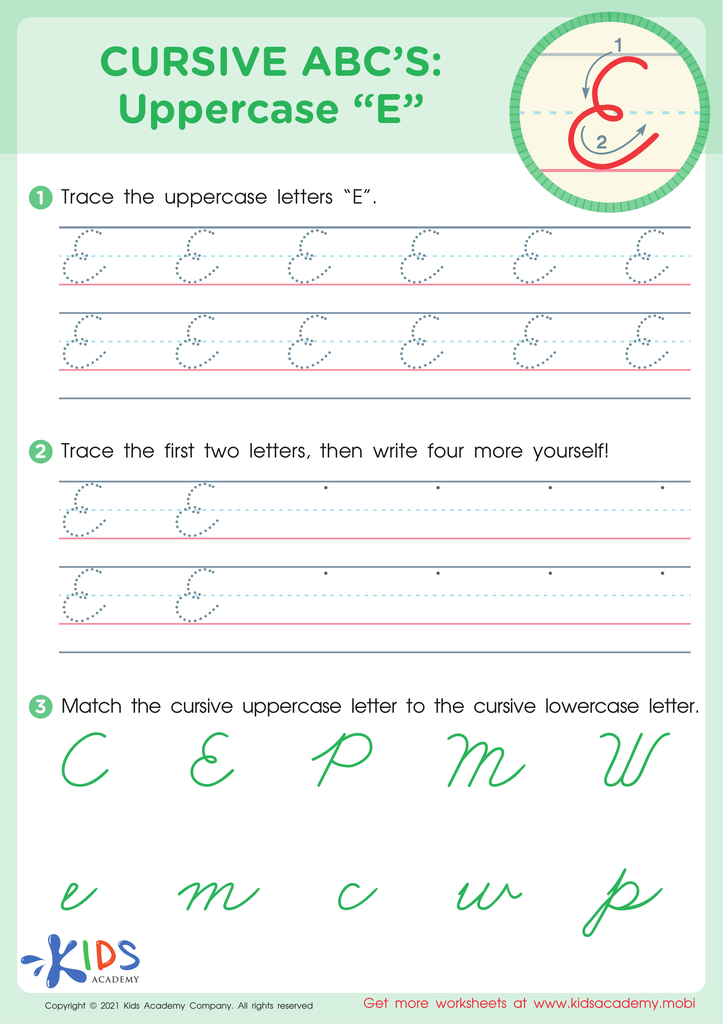
Ask your child if they can identify the letter 'E' and give examples. Each letter is unique, so provide coaching. Have them trace cursive 'E' to become familiar and boost confidence. Then, ask them to write it on their own.
Cursive ABCs: Uppercase E
Worksheet
Cursive ABCs: Uppercase F

Cursive ABCs: Uppercase F

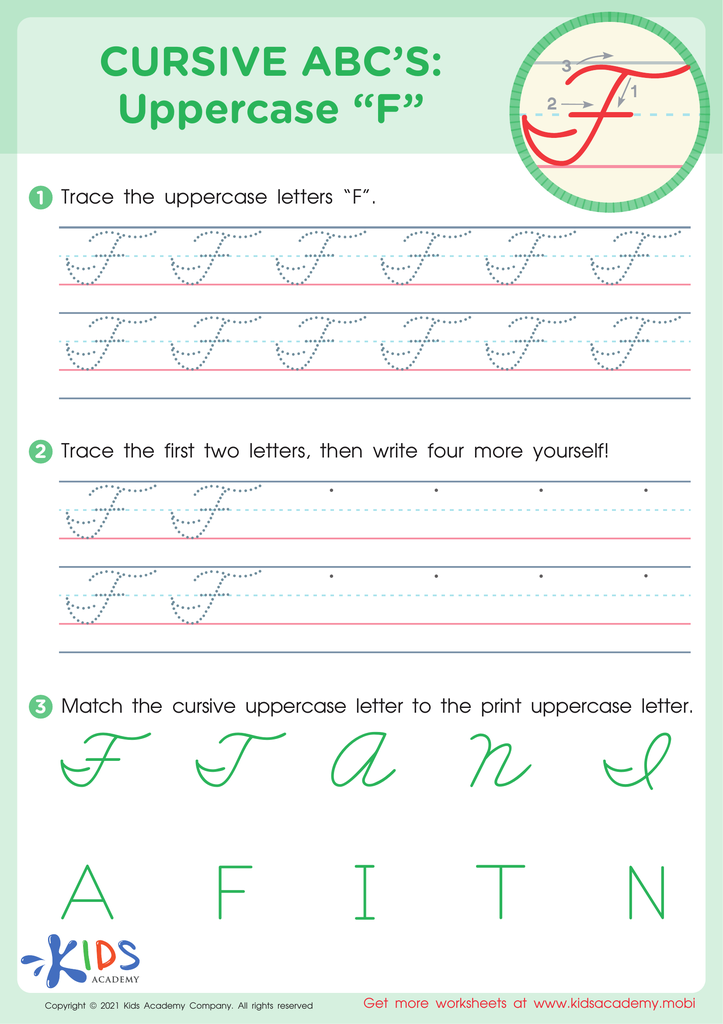
Help your kids trace the letters in these worksheets and watch their confidence grow as they learn to write cursive uppercase and lowercase letters. Ask them to identify the letters in words and give examples of words that start with an uppercase 'F', then have them write some letters on their own and assess their progress.
Cursive ABCs: Uppercase F
Worksheet
Cursive ABCs: Uppercase C

Cursive ABCs: Uppercase C

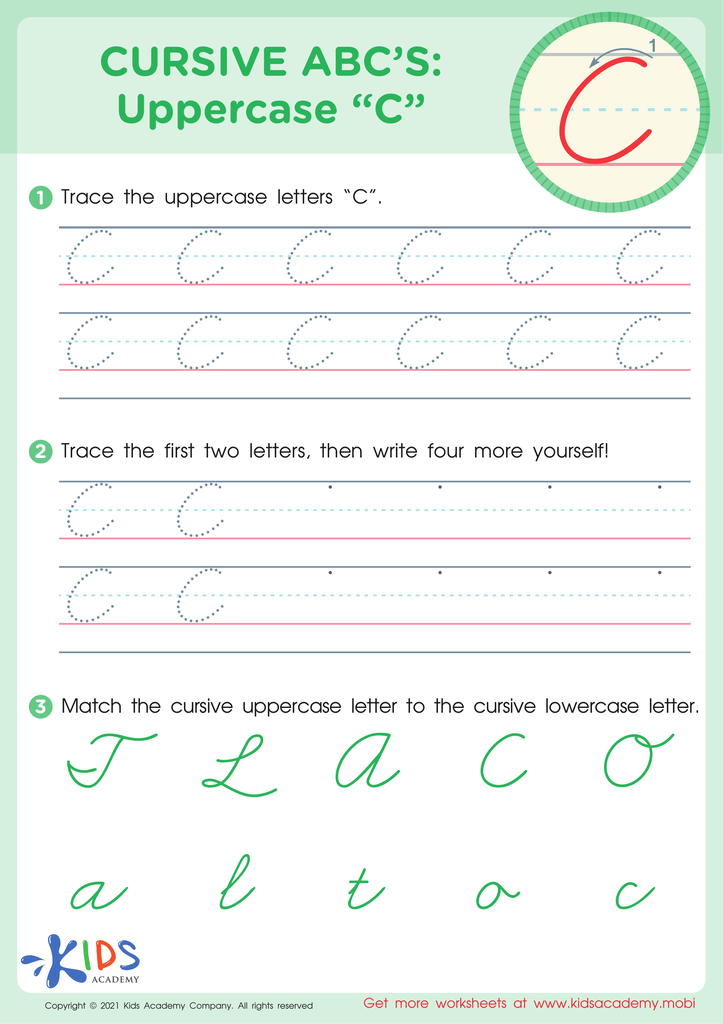
These worksheets are perfect for those wanting to improve their handwriting or learn letter recognition. The tracing exercises help younger students sharpen their writing skills and teach how to write the 'C' in cursive. First, they trace the given examples and then practice writing it solo. A letter recognition test is at the bottom of the page to check progress.
Cursive ABCs: Uppercase C
Worksheet
Cursive ABCs: Lowercase c

Cursive ABCs: Lowercase c

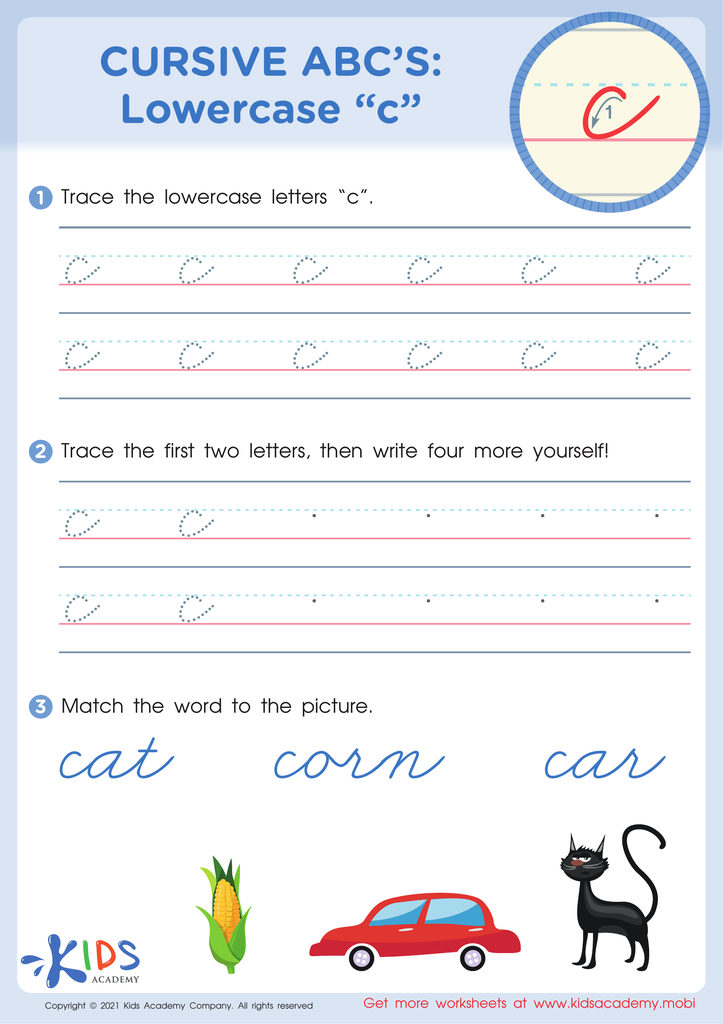
Once your child has successfully printed their letters, help them learn to recognize and write the alphabet in cursive. Struggling? This worksheet is perfect to assist them. Writing is an essential skill for kids to learn, so do all you can to help them. Use these tracing worksheets and guide them as they write the lowercase letter 'c' in cursive.
Cursive ABCs: Lowercase c
Worksheet
Cursive ABCs: Lowercase h

Cursive ABCs: Lowercase h

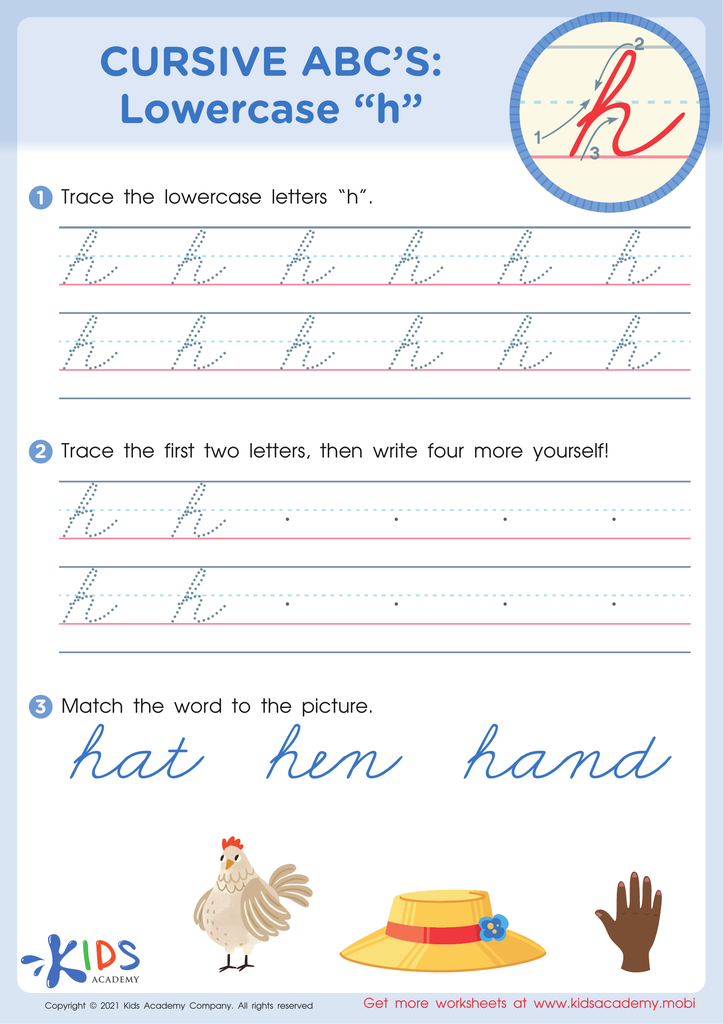
Your children will need more than just reciting the alphabet; they need to learn how to identify and write it. Cursive writing helps with neatness, and these tracing worksheets are great learning aids and offer exercises to practice writing lowercase 'h'. With these, your children get better writing skills and learn new words.
Cursive ABCs: Lowercase h
Worksheet
Cursive ABCs: Uppercase H

Cursive ABCs: Uppercase H

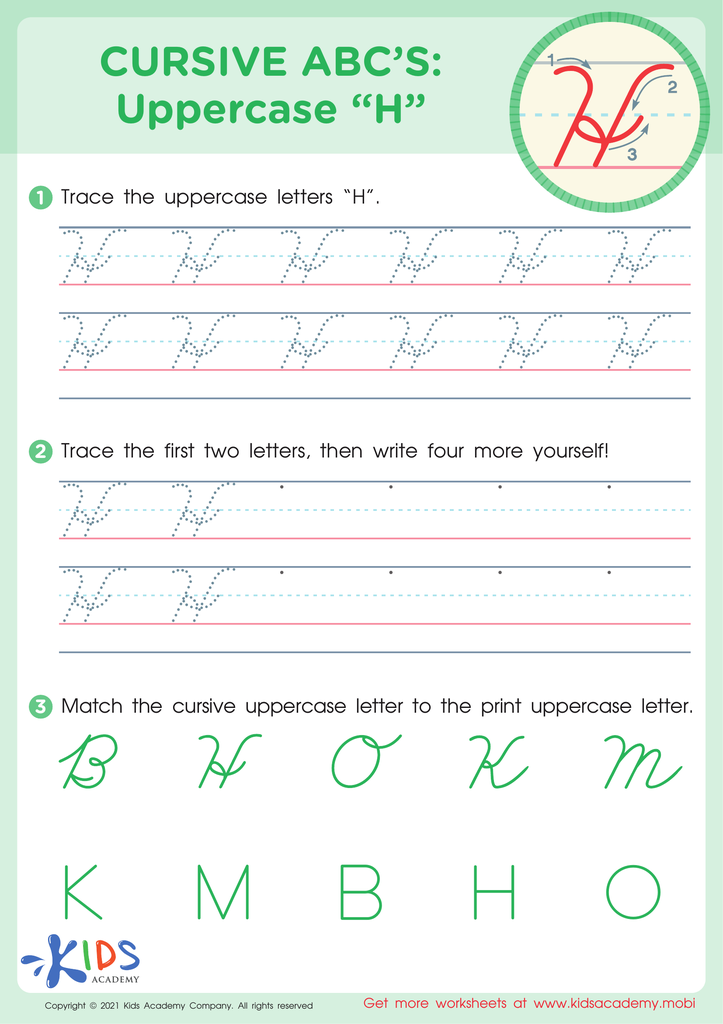
Have your child recite the alphabet and give you words beginning with H. This tracing sheet is perfect to help them improve their handwriting. Guide their hands as they trace the uppercase H, then have them practise writing it alone. At the bottom is an exercise to check their letter recognition.
Cursive ABCs: Uppercase H
Worksheet


Parents and teachers should care about hand-eye coordination in learning cursive for 9-year-olds because it is a fundamental aspect of their overall developmental growth. Hand-eye coordination facilitates the development of fine motor skills, critical for writing legibly and efficiently. When children practice writing in cursive, they engage multiple senses, improving their ability to integrate visual information with motor actions, contributing to smoother, more controlled movements.

Engaging in cursive writing also aids in cognitive development, enhancing skills like memory, attention, and problem-solving. As children decipher and reproduce intricate letter formations, their brain participates in intricate conditioning, stimulating neural pathways involved in reading and comprehension. Furthermore, cursive writing is not just about hand movement; it involves a sequence of linked strokes, promoting neural synchronization and bilateral coordination as both brain hemispheres work together.

Moreover, cursive writing can boost self-esteem and academic confidence. Mastery of a seemingly challenging skill increases their belief in their abilities, encouraging a positive attitude towards learning and schooling in general.

Hence, integrating hand-eye coordination exercises through cursive writing presents significant developmental advantages that go beyond mere penmanship; it supports holistic growth necessary for academic success and everyday functional skills.