Understanding addition Addition & Subtraction Worksheets for 9-Year-Olds
4 filtered results
-
From - To
Help your 9-year-old master addition and subtraction with our comprehensive worksheets! Designed to enhance understanding, these activities focus on developing essential math skills. Each worksheet offers engaging problems that challenge young minds and build confidence. Our collection provides a variety of exercises, including word problems, equations, and fun puzzles, to reinforce learning in an enjoyable way. Perfect for supplementing schoolwork or at-home practice, these worksheets make mastering addition and subtraction a breeze. Equip your child with the arithmetic expertise they need to succeed—explore our selection today and watch their mathematical abilities flourish!
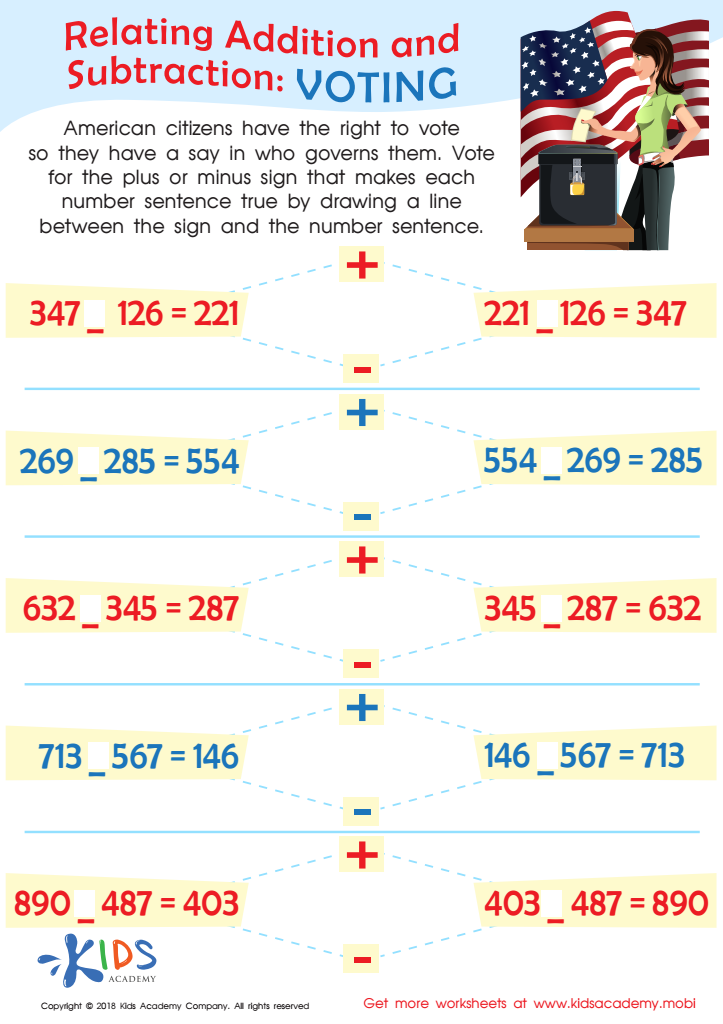
Voting Worksheet
 Assign to My Students
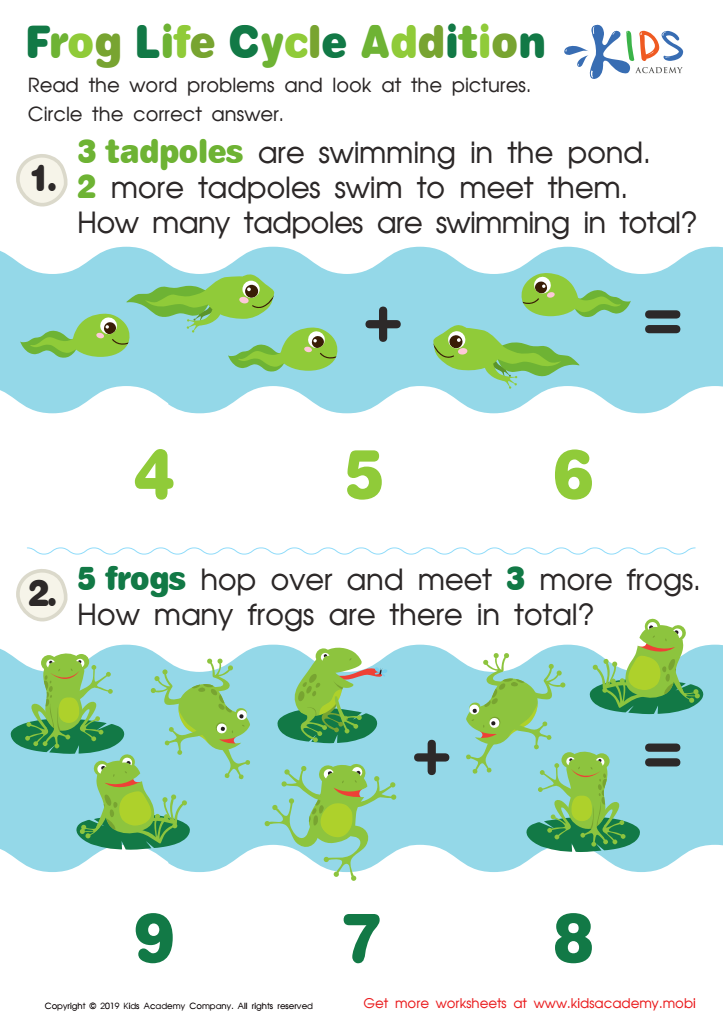
Frog Life Cycle Addition Worksheet








Understanding addition and subtraction is crucial for 9-year-olds because these foundational math skills support their cognitive development and future academic success. At this age, children transition from simple counting to more complex operations which involve critical thinking and problem-solving. When parents and teachers prioritize these skills, they help children develop a strong mathematical foundation that is essential for more advanced concepts such as multiplication, division, and fractions.
Fostering proficiency in addition and subtraction also enhances mental arithmetic abilities. Children learn to perform calculations quickly in their heads, boosting their confidence and overall numeracy skills. This can positively impact their performance in various subjects, by promoting logical reasoning and analytical thinking.
Moreover, understanding these basic math operations helps children in real-life situations. They become adept at handling everyday tasks, such as managing money, measuring ingredients in recipes, or determining time intervals. These practical applications make math relevant and interesting, encouraging children to see value in what they learn.
As such, parents and teachers play a vital role. Delivering consistent practice, positive reinforcement, and real-world math applications enrich a child's educational journey. Additionally, by nurturing a positive attitude towards math early on, they can instill a love for learning and a readiness to tackle new challenges.








