
Fine motor skills development Numbers Worksheets for 9-Year-Olds
3 filtered results
Difficulty Level
Grade
Age
-
From - To
Subject
Activity
Standards
Discover our engaging Fine Motor Skills Development Numbers Worksheets designed specifically for 9-year-olds! These worksheets combine fun with essential skill practice, helping young learners refine their dexterity while mastering numbers. Through a variety of interactive activities, children will strengthen their hand-eye coordination, grip, and control, essential for writing and other tasks. Our user-friendly design ensures that kids remain motivated as they complete exercises that encourage forming numbers, counting, and problem-solving. Ideal for classroom use or at-home practice, these worksheets provide a valuable resource for parents and educators aiming to support fine motor skill development in a playful, educational environment!
Favorites
With answer key
Interactive
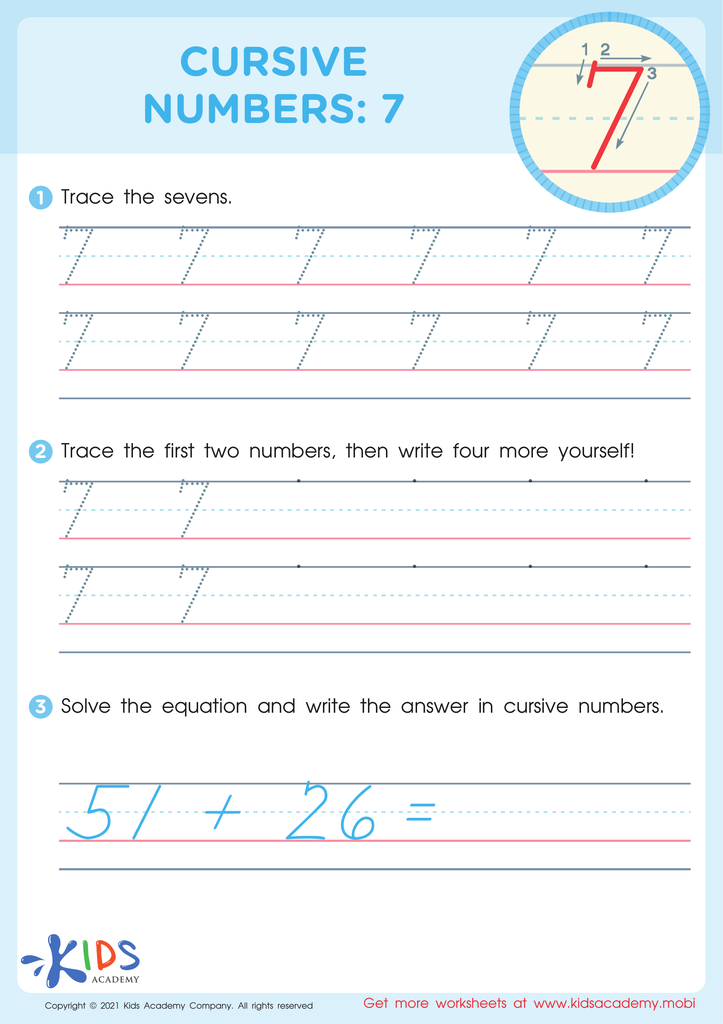
Cursive Numbers: 7 Worksheet
Kids learn best with engaging and easy-to-understand materials. This tracing worksheet is ideal for developing kids' writing skills, with two exercises to help them write the number 7. The first involves tracing the 6s provided and the second asking them to write four cursive 7s independently.
Cursive Numbers: 7 Worksheet
Worksheet
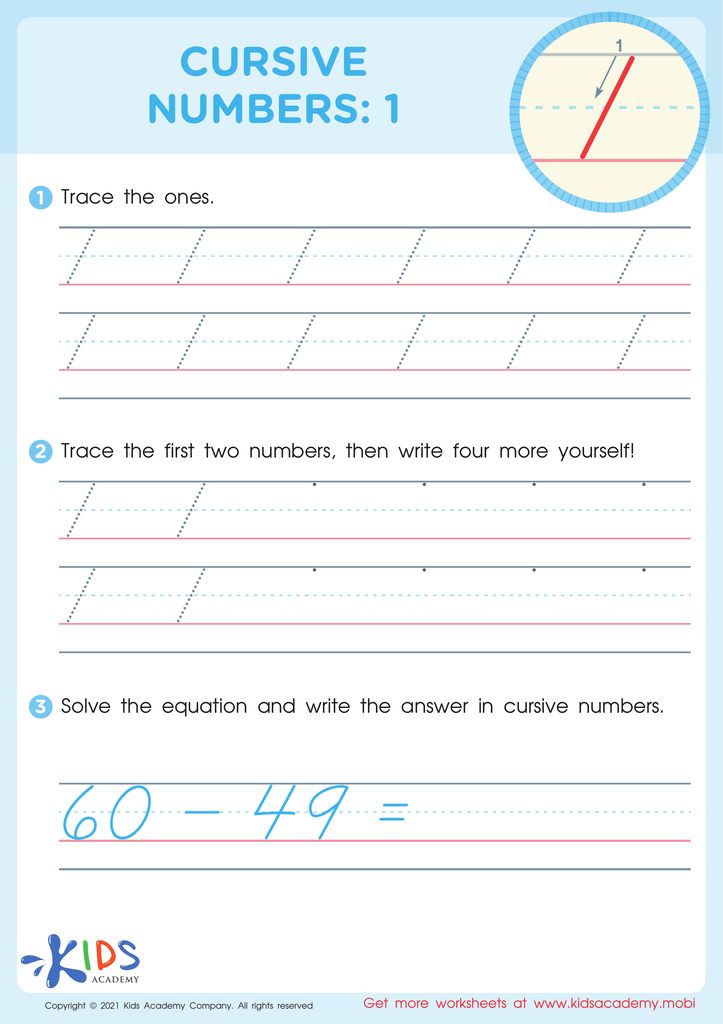
Cursive Numbers: 1 Worksheet
Math and handwriting are connected! Try these traceable worksheets to help your children learn cursive numbers. The tracing lines make it easy to follow, plus there's a simple subtraction exercise at the bottom for them to try. This is perfect for kids who struggle with handwriting and gives them a fun way to practice.
Cursive Numbers: 1 Worksheet
Worksheet
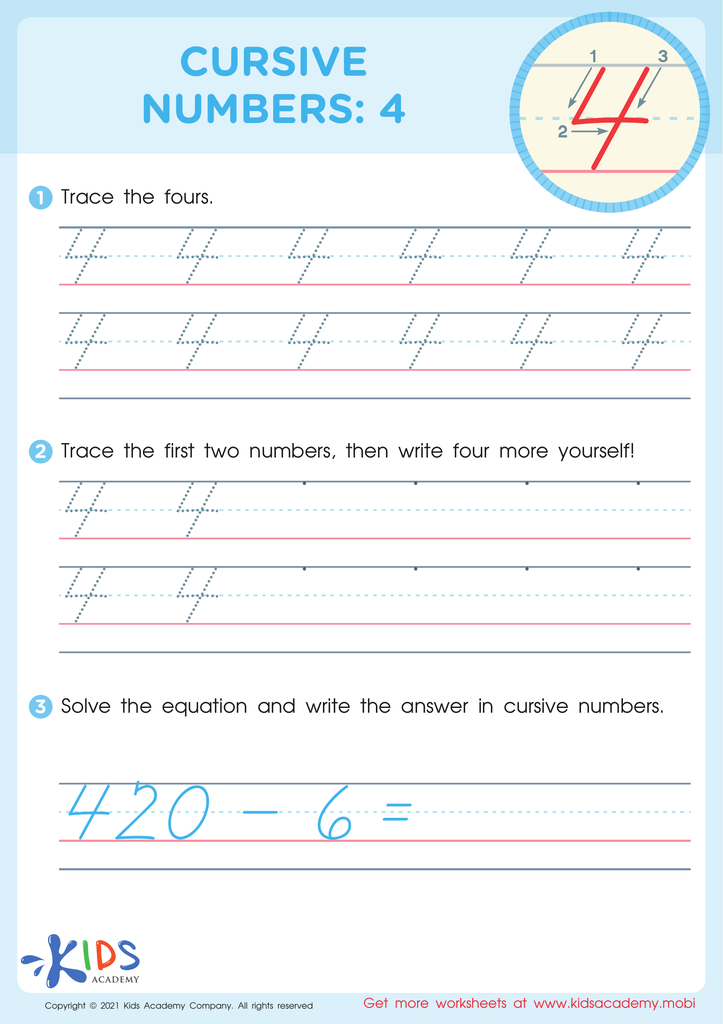
Cursive Numbers: 4 Worksheet
Math is challenging, and teaching cursive alongside it can be overwhelming. Make lessons enjoyable and your child will be more likely to stay engaged. Utilize worksheets to practice tracing the number 4 in cursive. With regular practice, your child can learn to write the number on their own.
Cursive Numbers: 4 Worksheet
Worksheet
Join Kids Academy for Free
Who is primarily going to use this learning content?








Fine motor skills are crucial for 9-year-olds as they significantly impact a child’s ability to engage in everyday activities, academic success, and overall confidence. Mastering these skills enhances a child’s hand-eye coordination, dexterity, and precision in tasks such as writing, drawing, cutting, and manipulating small objects. As children progress into more complex academic subjects, fine motor skills are essential for developing task-specific skills like math, science experiments, and art projects.
Moreover, strong fine motor abilities contribute to a child’s independence, allowing them to perform self-care activities like buttoning clothing, using utensils, and tying shoelaces. This fosters their confidence and encourages them to explore and participate in various physical activities and hobbies.
Parents and teachers should prioritize fine motor skill development since delays can lead to frustration with academic tasks, weakening a child’s self-esteem and motivation. Engaging in activities like puzzles, arts and crafts, and building models not only strengthens these skills but also promotes problem-solving and creativity. Supporting fine motor development provides a strong foundation for lifelong learning, enabling children to navigate their world effectively and enjoyably. Thus, nurturing these skills is an investment in a child’s future success and well-being.








