
Understanding division Math Worksheets for 9-Year-Olds
4 filtered results
Difficulty Level
Grade
Age
-
From - To
Subject
Activity
Standards
"Understanding Division Math Worksheets for 9-Year-Olds" by Kids Academy makes learning division fun and straightforward. Our expertly designed sheets help young learners grasp the core concepts through engaging problems, visual aids, and practical examples. These worksheets build essential skills, like dividing multi-digit numbers and understanding remainders, fostering confidence and foundational knowledge. Perfectly suited for classroom or home use, they align with educational standards, ensuring your child's success in math. Parents and educators love our targeted approach that makes division accessible and enjoyable. Explore our worksheets to empower your 9-year-old with math confidence and proficiency today!
Favorites
With answer key
Interactive
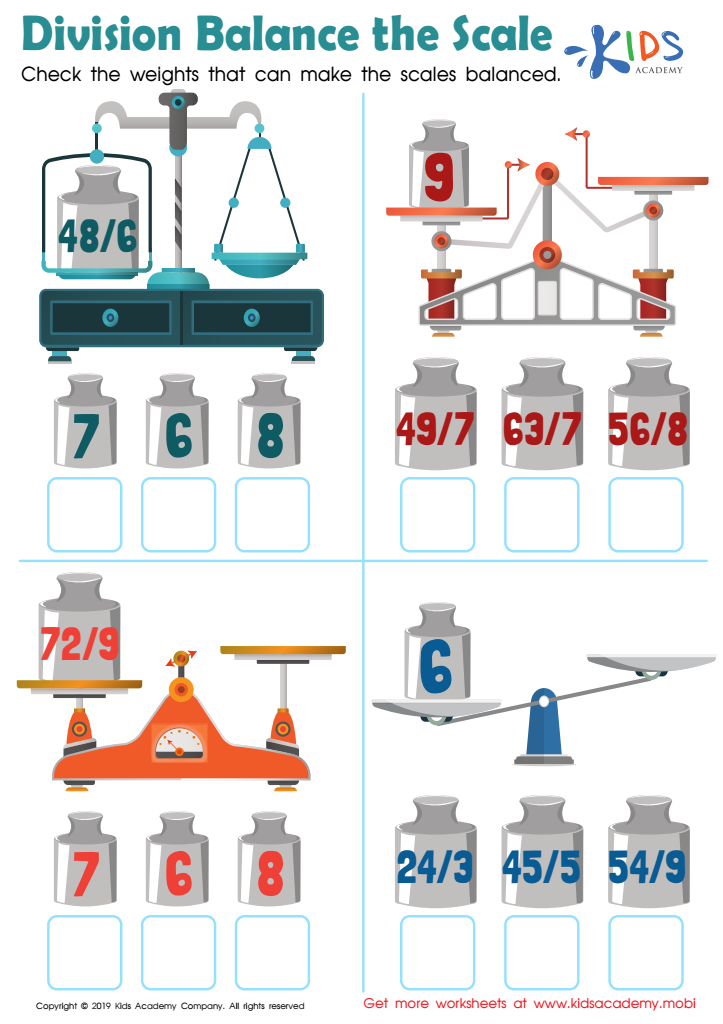
Division Balance the Scale Worksheet
Students can learn math better when they understand the relationships between numbers. This free worksheet helps them practice division: solving problems and matching the correct quotient to balance the scales. Fun visual boxes make it a unique way to engage with the material.
 Assign to My Students
Division Balance the Scale Worksheet
Worksheet
Join Kids Academy for Free
Who is primarily going to use this learning content?







Understanding division is pivotal for 9-year-olds as it lays a strong foundation for their future math education and everyday problem-solving skills. At this age, students are transitioning from basic arithmetic to more complex mathematical concepts, and division is a critical component of this progression.
For one, mastering division helps kids build number sense, which is essential for understanding and working with fractions, ratios, and percents in later grades. These concepts are not only vital for academic success but also for real-life situations, such as budgeting or cooking.
Additionally, division enhances critical thinking and analytical skills. Learning to divide means that students must engage with different problem-solving strategies and understand how to break down complex problems into understandable steps. This nurtures their ability to think logically and methodically, skills that are transferable to other subjects and everyday challenges.
For parents, comprehension of division assists in supporting their child's homework and fostering a positive attitude towards math at home. For teachers, a robust grasp of division enables the implementation of effective teaching strategies that cater to different learning styles, ensuring that no child is left behind.
In essence, a solid understanding of division equips children with foundational math skills, promotes cognitive development, and fosters a love for learning, paving the way for academic and life-long success.








