
Counting skills Reading Worksheets for 9-Year-Olds
5 filtered results
Difficulty Level
Grade
Age
-
From - To
Subject
Activity
Standards
Enhance your 9-year-old's reading and counting skills with our engaging Counting Skills Reading Worksheets! Designed to support young learners, these worksheets blend literacy and numeracy, fostering comprehension through fun counting activities. Children will explore interaction with numbers while improving their reading fluency and vocabulary. Each worksheet features colorful visuals and age-appropriate exercises that captivate and motivate. From counting objects to solving simple math problems presented in reading contexts, these resources provide the perfect way to reinforce essential skills. Help your child excel in multiple subjects while enjoying the process of learning. Download and watch them thrive today!
Favorites
With answer key
Interactive
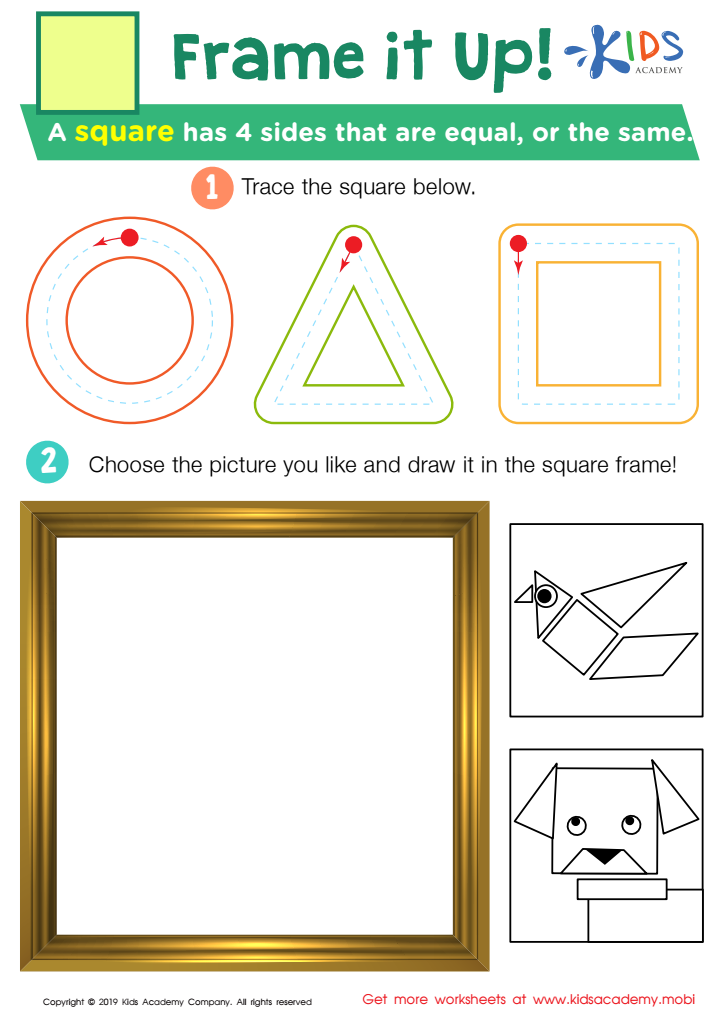
Frame it Up Worksheet
This worksheet helps kids learn the difference between squares and other shapes. It guides them to trace a square and draw a picture inside it. Examples of shapes-based drawings are included. Kids will have fun and clear up any confusion about squares.
 Assign to My Students
Frame it Up Worksheet
Worksheet
Join Kids Academy for Free
Who is primarily going to use this learning content?








Counting skills and reading are foundational abilities crucial for a 9-year-old's overall academic development. First, counting is essential for grasping mathematical concepts, which now integrate more complex ideas like multiplication and division. Mastery of counting equips children with the skills necessary to solve problems, understand order of operations, and apply math in real-life situations, such as budgeting or measuring.
On the other hand, reading is vital for literacy development, fostering imagination, and enhancing comprehension skills. As children explore different genres, they build vocabulary, improve logic, and understand diverse perspectives. Strong reading skills are linked to academic success across all subjects, as reading comprehension underpins learning in history, science, and even art.
Moreover, these skills interconnect; for example, children may encounter math word problems that require both reading and counting proficiency. The development of these intertwined skills not only supports academic performance but also boosts a child's confidence and motivation to learn.
Parents and teachers must prioritize these skills through engaging activities and encouragement. Fostering a supportive environment where children practice counting and reading will cultivate well-rounded learners poised for future educational challenges and successes.








