Filters

5 filtered results

Clear all filters
Favorites
With answer key
Interactive

5 filtered results

Difficulty Level

Grade


Unlock the world of reading with our Phonics Worksheets Activities With Answers! Designed to engage and educate, our comprehensive collection of worksheets is your go-to resource for enhancing phonetic skills. Ideal for both classroom and home use, these activities cover a wide range of phonics topics from basic sound recognition to complex decoding strategies. Each worksheet comes complete with answers, providing instant feedback and support. Whether you're a teacher looking to supplement your curriculum or a parent aiming to boost your child's reading abilities, our Phonics Worksheets Activities With Answers are the perfect tool to achieve literacy success.

Check out this FREE Phonics Trial Lesson for age 8!

Identify Irregular Past Tense Verbs Standard

Favorites
With answer key
Interactive
  • Phonics
  • 8
  • With answer key
Phonics and Word Recognition: Assessment 3 Worksheet

Phonics and Word Recognition: Assessment 3 Worksheet

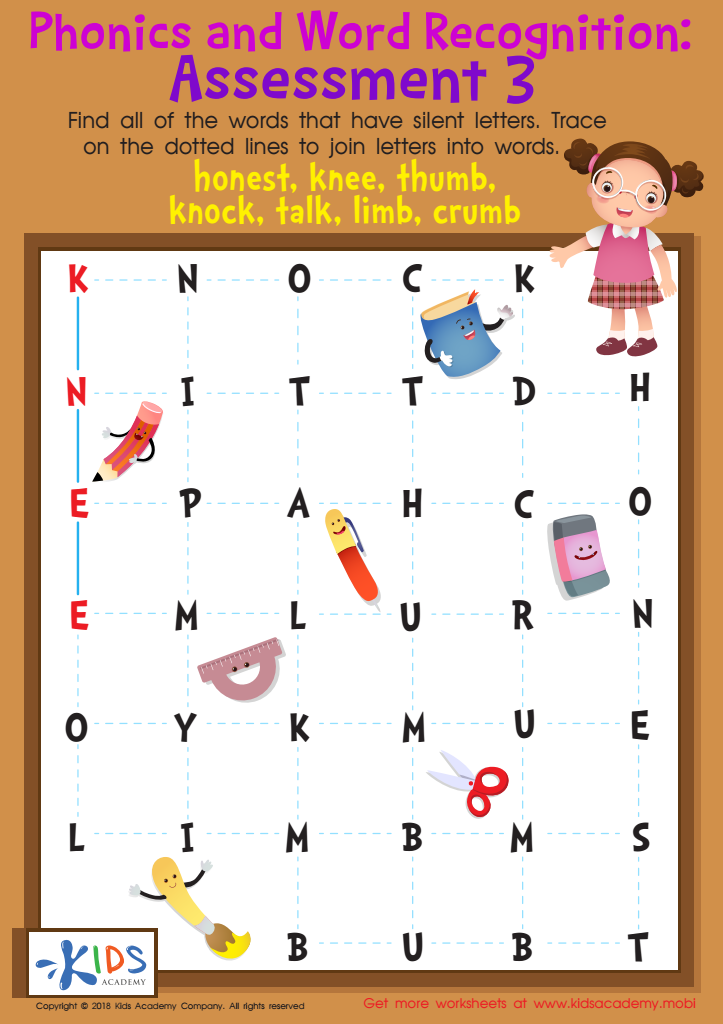
Silent letters can be tricky for kids learning to read and write. Show them how they work with words like 'knee' and 'dumb'. Then, challenge them to come up with their own. Give them a worksheet with silent letters and trace the lines to join the letters into words.
Phonics and Word Recognition: Assessment 3 Worksheet
Worksheet
Phonics and Word Recognition: Assessment 1 Worksheet

Phonics and Word Recognition: Assessment 1 Worksheet
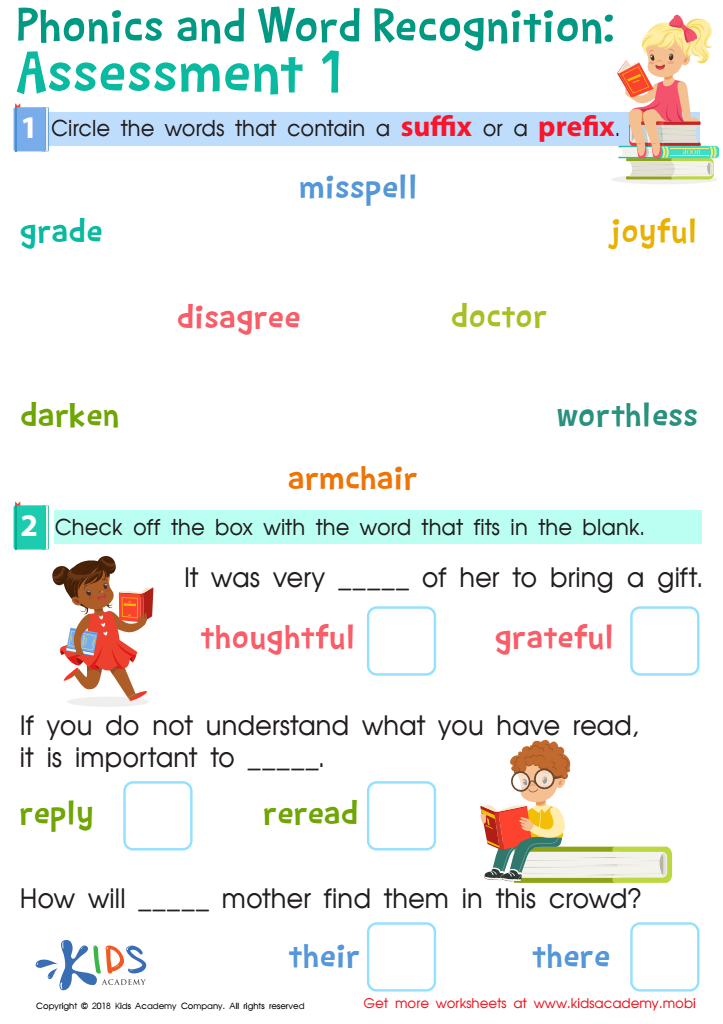
Explain prefixes (words added to start of another word to give it a new meaning) and suffixes (added to end of word to change its meaning) to your kids with examples like 'unhappy' (prefix) and 'forgetful' (suffix). Now, help your child complete this worksheet, including circling words and checking boxes.
Phonics and Word Recognition: Assessment 1 Worksheet
Worksheet
Phonics and Word Recognition: Assessment 1 Worksheet

Phonics and Word Recognition: Assessment 1 Worksheet

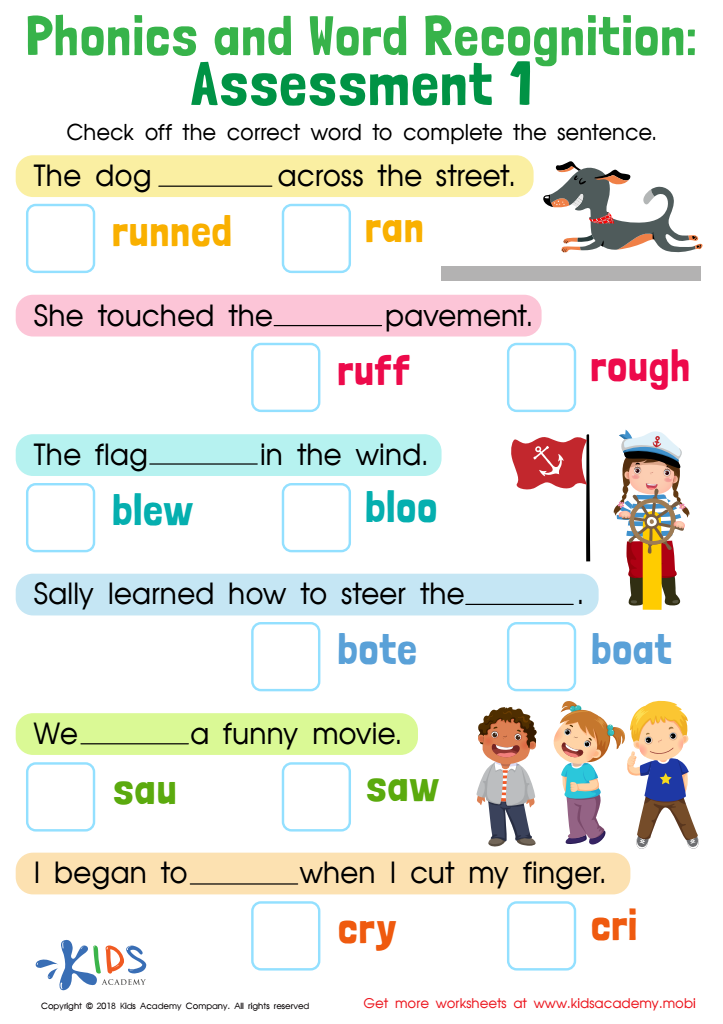
This worksheet tests phonetics and word recognition. Students should be familiar with past tense verbs. Read incomplete sentences, then read multiple options and help students select the correct one.
Phonics and Word Recognition: Assessment 1 Worksheet
Worksheet
Phonics and Word Recognition: Assessment 2 Worksheet

Phonics and Word Recognition: Assessment 2 Worksheet

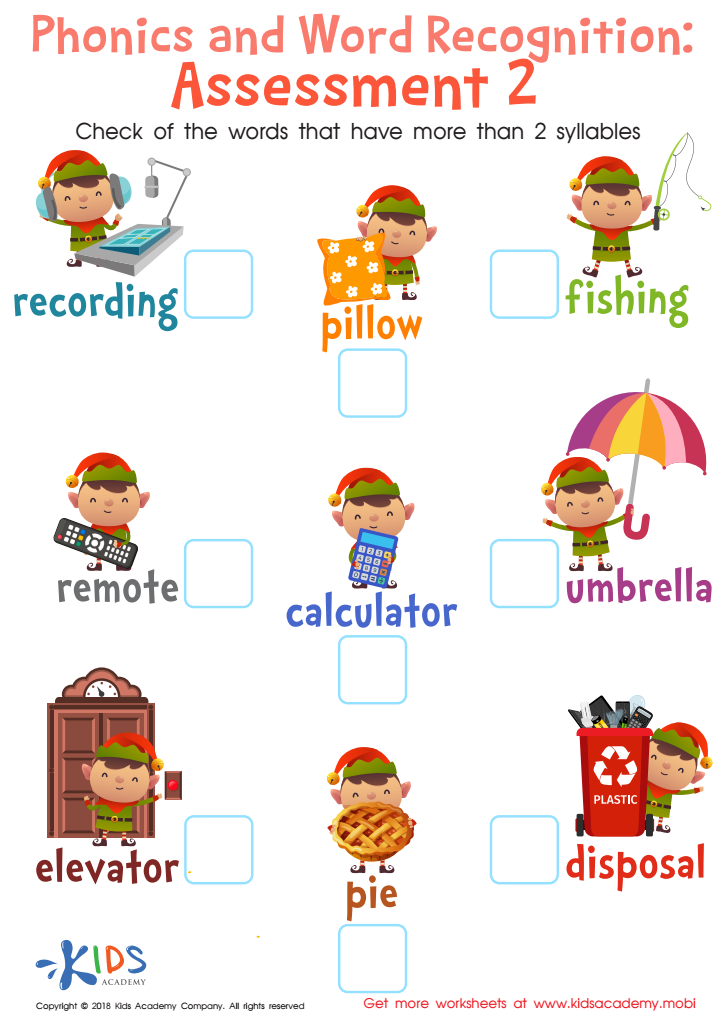
Help your kids learn proper pronunciation by counting syllables. Most words they'll encounter have 1-3 syllables, making them simple to say. Have them repeat the words in your worksheet after you. Focus on longer words with more than two syllables.
Phonics and Word Recognition: Assessment 2 Worksheet
Worksheet
Phonics and Word Recognition: Assessment 2


Phonics and Word Recognition: Assessment 2

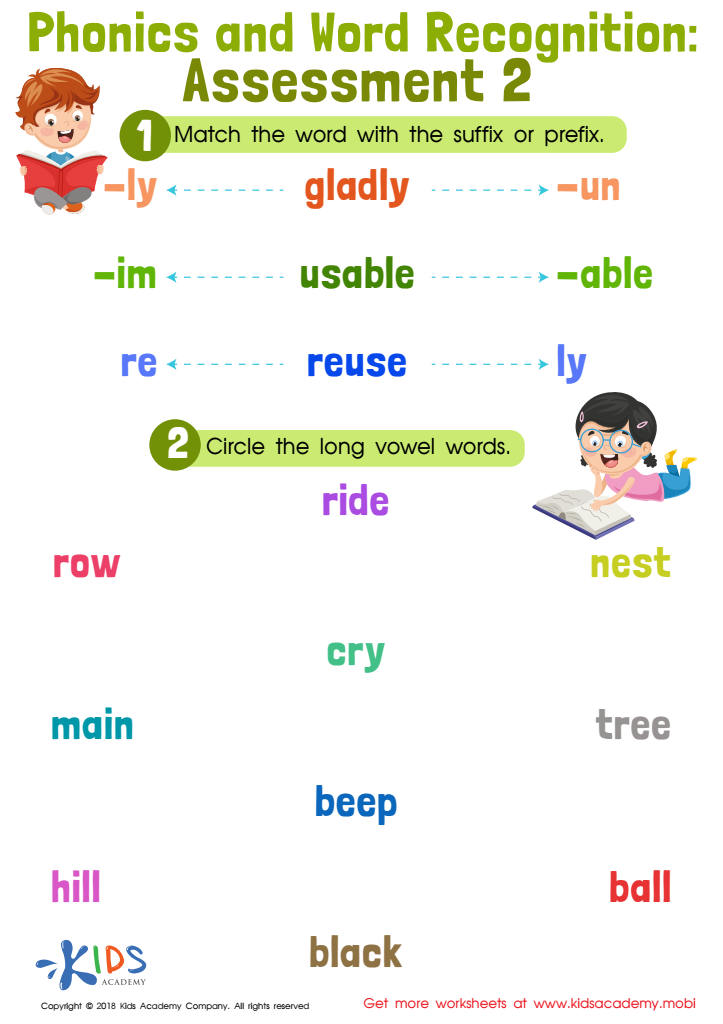
Give kids common examples of suffixes and prefixes, such as "un-," "unhappy," "ness," "happyness." Ask them to match each word in the word recognition exercise to the correct suffix or prefix. Test phonetic understanding by having them circle the long vowel sounds.
Phonics and Word Recognition: Assessment 2

Worksheet


Phonics worksheets activities with answers are an invaluable tool in the journey towards literacy, especially for young learners. These engaging resources are meticulously designed to blend learning with fun, ensuring that the foundational skills in reading and writing are solidified from an early stage. But why exactly are these phonics activities so crucial?

Firstly, phonics is the cornerstone of reading. It involves the relationship between sounds and their corresponding letters or letter groups, which is essential for decoding words. Phonics worksheets activities with answers provide a structured way for students to practice these relationships, making the process of learning to read more systematic and less daunting. Through repetitive practice, students become familiar with the sounds, which in turn, enhances their reading fluency and comprehension.

Moreover, these worksheets come with answers, offering immediate feedback to learners. This aspect is particularly beneficial as it helps students to identify their mistakes and learn from them, fostering a growth mindset. The presence of answers also aids teachers and parents in effectively guiding the learning process, ensuring that correct phonetic principles are reinforced.

Additionally, phonics worksheets activities are designed to cater to various learning styles. Whether a child is a visual, auditory, or kinesthetic learner, these activities incorporate elements that appeal to all, making learning inclusive and accessible. From matching exercises and word puzzles to fill-in-the-blanks and sentence construction, each activity is crafted to engage learners actively and encourage them to explore the sounds of the language in multiple contexts.

In conclusion, phonics worksheets activities with answers are not just another educational resource; they are a crucial building block in the foundation of literacy. By providing structured, engaging, and adaptable learning experiences, they play a pivotal role in developing proficient readers and writers, making them an indispensable tool in educational settings.