Easy Tracing Shapes Worksheets Activities With Answers for Ages 3-4
2 filtered results
-
From - To
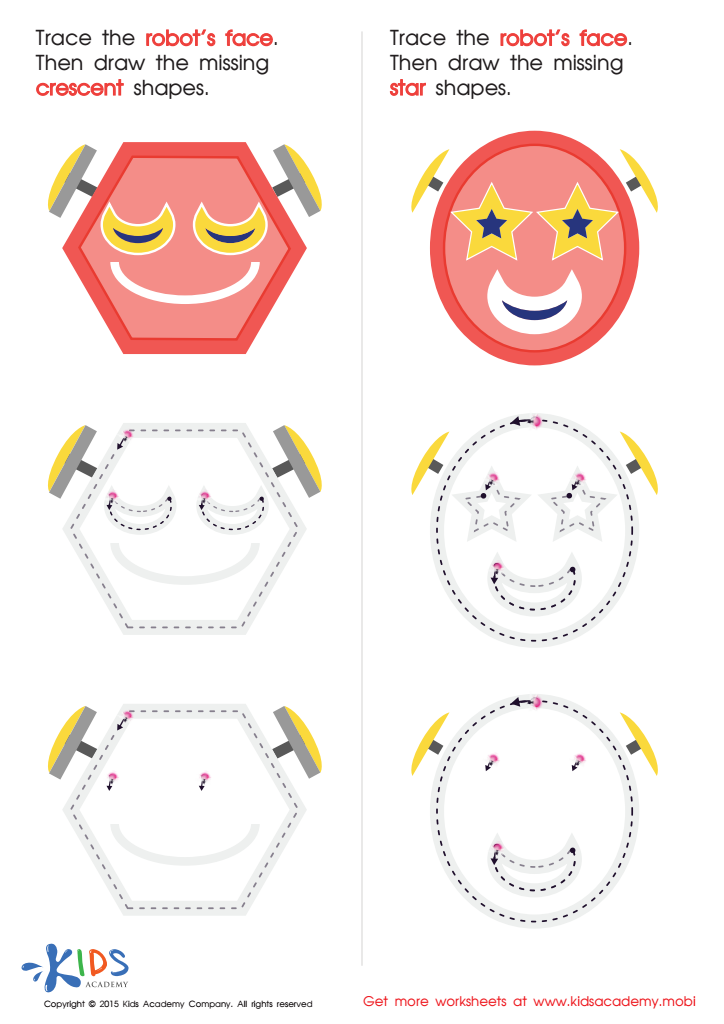
Composing a Robot's Face of Crescents And Stars Worksheet
 Assign to My Students
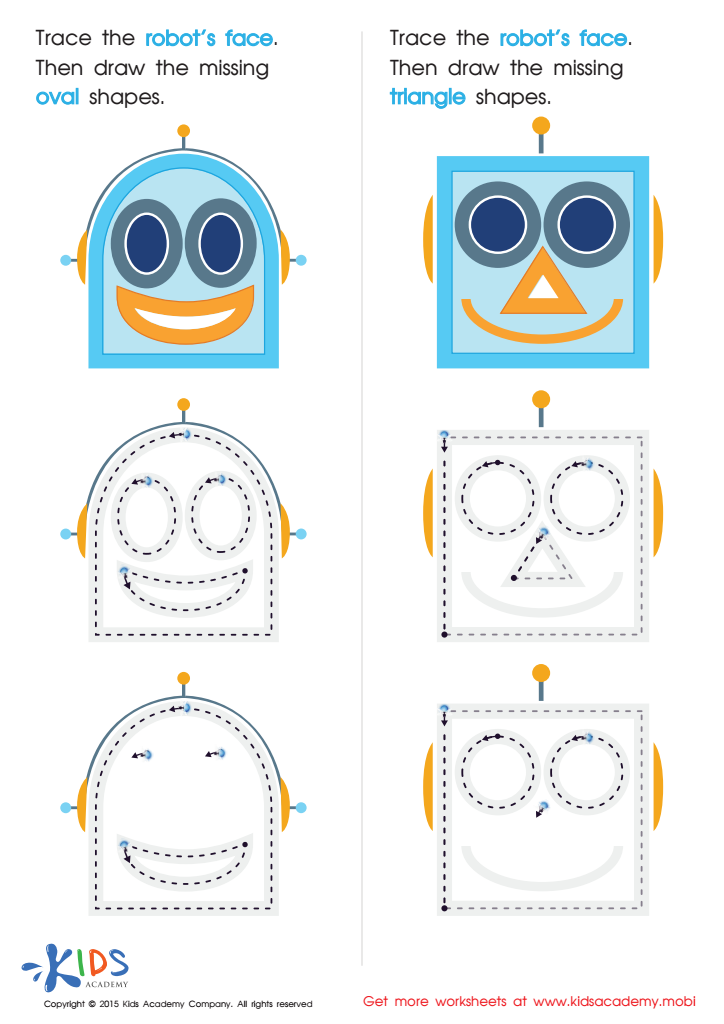
Drawing Ovals And Triangles with Fun Printable








Easy Tracing Shapes Worksheets Activities With Answers are a fundamental tool in the early development of young learners. These activities are not just about drawing lines; they're a cornerstone for building fine motor skills, recognizing geometric shapes, and laying down the basics of mathematical concepts. Let's delve into why these simple yet effective tools are invaluable in the educational journey of children.
First and foremost, Easy Tracing Shapes Worksheets Activities offer a structured way for children to engage with shapes. By tracing over lines, kids learn to identify circles, squares, triangles, and more, which are critical for mathematical reasoning and spatial awareness. These basic geometric shapes are everywhere in our environment, and recognizing them is the first step in understanding the world around us.
Moreover, these activities come with answers, providing immediate feedback to learners. This feature is crucial for self-learning and correction. It encourages children to assess their work independently and understand the correct forms of shapes. This feedback loop reinforces learning and boosts confidence, making the educational journey enjoyable and rewarding.
Tracing shapes also develops fine motor skills. The act of holding a pencil and guiding it along specific paths strengthens hand-eye coordination, control, and precision. These skills are essential not only for writing but also for other daily activities such as tying shoelaces or buttoning clothes. Early mastery of these skills sets a solid foundation for more complex tasks in the future.
Furthermore, Easy Tracing Shapes Worksheets Activities With Answers are designed to be engaging. They often incorporate colorful illustrations and themes that capture the attention of young minds, making learning fun. This engagement is crucial in retaining interest and ensuring that the learning process is not seen as a chore but as an enjoyable activity.
In summary, Easy Tracing Shapes Worksheets Activities With Answers are invaluable in the educational toolkit for young learners. They lay the groundwork for mathematical understanding, develop essential motor skills, provide immediate feedback for learning, and keep education fun and engaging. Starting with these simple activities, we pave the way for our children to succeed in more complex academic and life skills.








