
Easy Three Letter Words Phonics Worksheets Activities With Answers for 4-Year-Olds
1 filtered results
Difficulty Level
Grade
Age
-
From - To
Subject
Activity
Standards
Introducing our Easy Three Letter Words Phonics Worksheets Activities With Answers, a comprehensive collection designed to reinforce early reading skills in young learners. This engaging packet offers a plethora of activities centered around three-letter words, making phonics practice both fun and effective. Each worksheet is meticulously crafted to enhance your child's understanding of letter sounds and their combinations, paving the way for fluent reading. Our activities are tailored to encourage independent learning, and with answers provided, children can self-check their work, fostering confidence and autonomy in their learning journey. Ideal for home or classroom use, these worksheets are a must-have in your educational toolkit.
Favorites
With answer key
Interactive
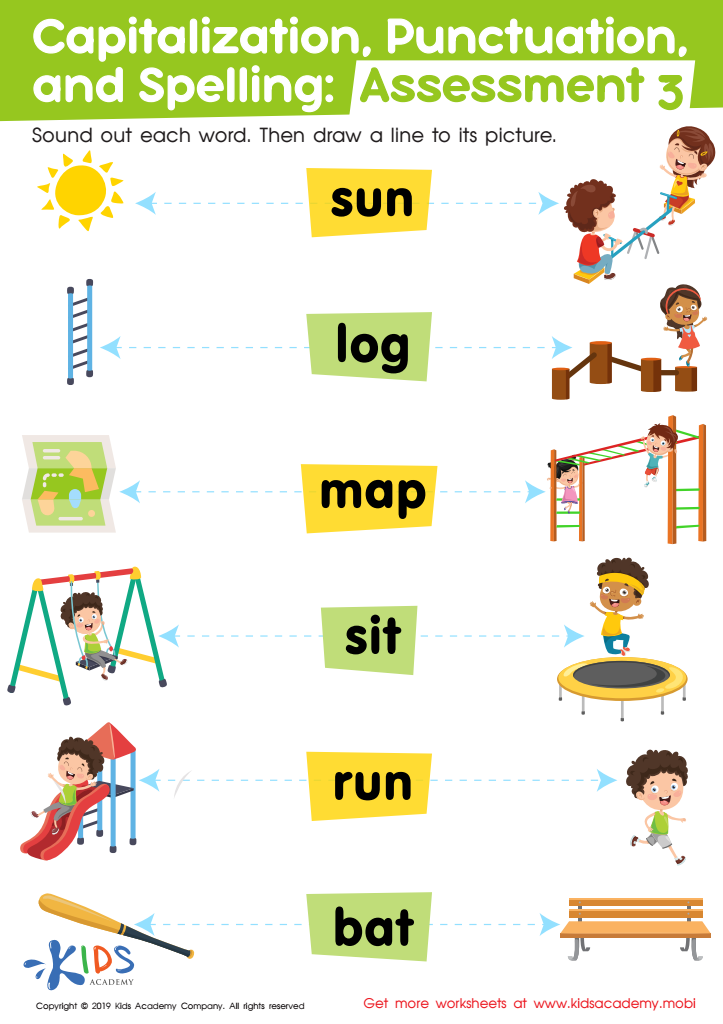
Capitalization. Punctuation. Spelling. Assessment 3 Worksheet
Before starting this worksheet, have your kids spell some simple words. Correct if wrong and show the right spellings. Then, ask them to link the pictures to the words you read out. Spelling is key for a good writer, and kids need to know how to spell to read texts easily.
 Assign to My Students
Capitalization. Punctuation. Spelling. Assessment 3 Worksheet
Worksheet
Join Kids Academy for Free
Who is primarily going to use this learning content?








Easy Three Letter Words Phonics Worksheets Activities with Answers are an exceptionally useful tool in the foundational stages of reading and writing for young learners. These activities are specifically designed to simplify the learning process, allowing children to grasp the basic building blocks of the English language efficiently and effectively. By focusing on three-letter words, children can quickly learn to decode and spell, gaining confidence in their reading abilities.
One of the primary reasons these worksheets are so beneficial is that they break down the learning process into manageable sections. Phonics, the method of teaching reading by correlating sounds with symbols in an alphabetic writing system, can be complex. However, by concentrating on three-letter words, learners can easily understand the relationship between sounds and letters, a fundamental skill in reading. This focused approach helps in improving their phonemic awareness, which is crucial for reading fluency and comprehension.
Moreover, the inclusion of answers with these activities provides immediate feedback, a key element in the learning process. This feature allows learners to independently correct their mistakes, fostering a sense of autonomy and responsibility for their learning. It also helps educators and parents to quickly assess a child’s understanding and progress, making it easier to identify areas that may need more attention.
Easy Three Letter Words Phonics Worksheets Activities with Answers also make learning enjoyable. These activities often include engaging exercises such as matching games, fill-in-the-blanks, and word puzzles, making the learning process fun and interactive. This not only keeps children motivated but also enhances their cognitive abilities, such as memory and problem-solving skills.
In summary, Easy Three Letter Words Phonics Worksheets Activities with Answers are a vital resource in early childhood education. They simplify the learning process, provide immediate feedback, and make learning engaging, thus laying a solid foundation for reading and writing skills. By incorporating these activities into the educational curriculum, educators and parents can significantly enhance the literacy development of their learners.








