Upper & Lowercase Letters Worksheets for Ages 3-8 - Page 3
50 filtered results
-
From - To
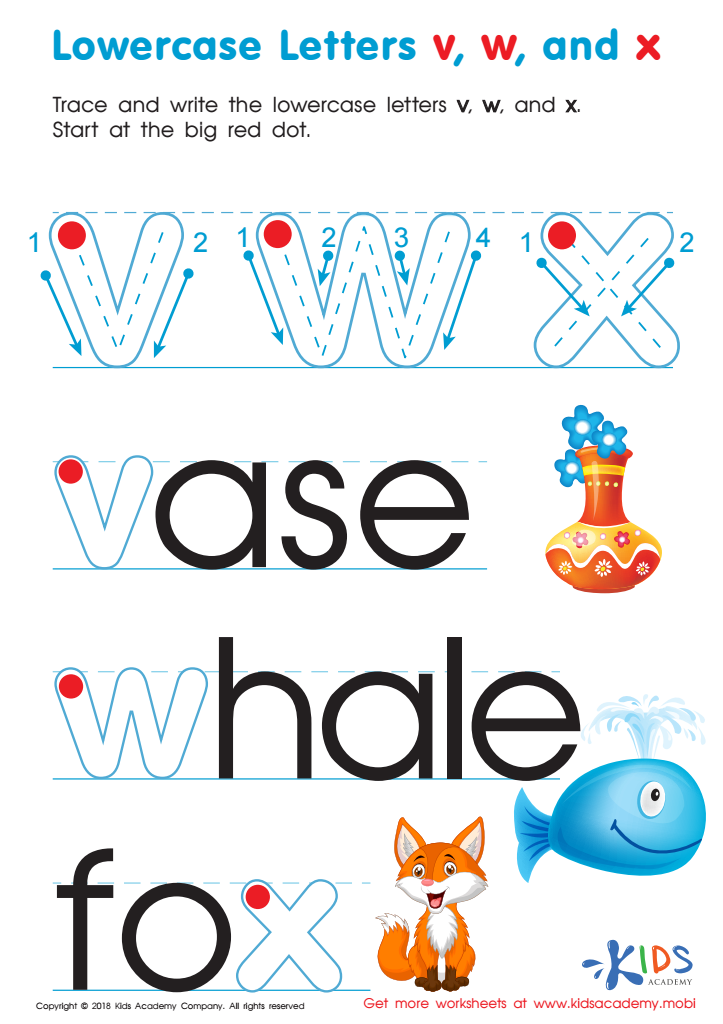
Lowercase Letters v w x Worksheet
 Assign to My Students






Uppercase Letters V, W, and X Worksheet






Parents and teachers play a vital role in early childhood development, and understanding the importance of teaching both uppercase and lowercase letters for ages 3-8 is crucial. Children in this age group are in the formative stages of their literacy development, and learning the alphabet in its entirety builds a strong foundation for reading and writing skills.
Uppercase letters are typically easier for young children to recognize and write because of their uniform size and straight lines. They are often introduced first due to this simplicity. However, lowercase letters are more prevalent in written text, presenting the need for children to become familiar with them to read effectively. Mastery of both forms enhances a child's ability to identify words accurately and improve fluency.
Introducing both uppercase and lowercase letters also supports cognitive development. It enhances visual discrimination skills, as children learn to recognize and differentiate between letter forms. This ability is essential for reading comprehension and writing.
Furthermore, recognizing and writing both letter cases promotes fine motor development. Manipulating writing tools to create different letter shapes refines children's hand-eye coordination and dexterity. This groundwork is indispensable as they progress in their academic journey.
Overall, focusing on both uppercase and lowercase letters equips young learners with critical skills, fostering confident, capable readers and writers ready to engage with more complex texts in the future.







