Numbers up to 100 Worksheets for Ages 4-7 - Page 3
50 filtered results
-
From - To
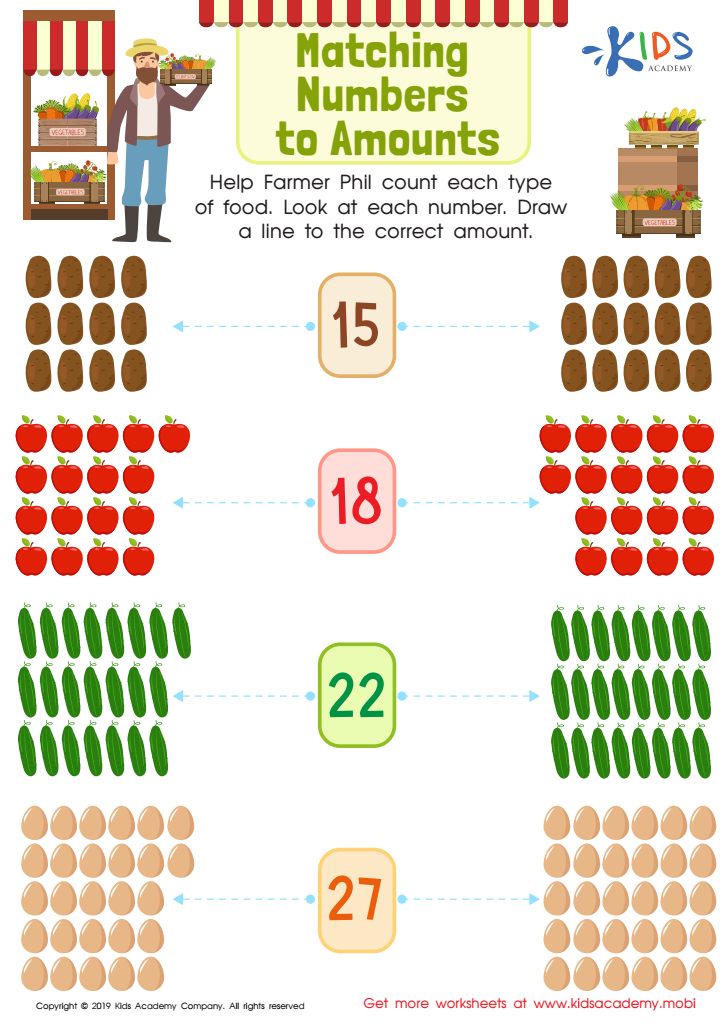
Matching Numbers to Amounts Worksheet
 Assign to My Students

Counting on the City Skyline: Dot-to-Dot Worksheet








Understanding numbers up to 100 is crucial for children aged 4-7 as it forms the foundation for essential mathematical skills and number sense. At this age, children are at a developmental stage where they begin to grasp basic concepts of counting, adding, and subtracting. By learning numbers up to 100, they start recognizing numerical patterns and relationships.
Mastering up to 100 also helps in developing critical cognitive skills such as memory, attention, and problem-solving. It allows children to understand the sequence of numbers, place value, and the concept of greater than or less than. This numerical foundation is essential for more complex mathematical concepts they'll encounter later in school.
Additionally, familiarity with numbers up to 100 enhances daily life skills. Children become capable of managing simple transactions, understanding time, measuring quantities, and grasping the concept of calendars. These practical applications make math relevant and useful.
For parents and teachers, ensuring children are comfortable with numbers up to 100 can foster a positive attitude toward math, reducing anxiety and building confidence. Early success in math sets the stage for future academic achievement and a lifelong appreciation of math. Therefore, focusing on this numeric range is pivotal in a child's educational journey and overall development.