Extra Challenge Numbers 11–20 Worksheets for Ages 3-8
3 filtered results
-
From - To
Boost your child’s number recognition and counting skills with our "Extra Challenge Numbers 11–20 Worksheets for Ages 3-8." Designed to engage young learners, these worksheets offer a variety of activities that make learning fun and effective. Kids will enjoy tracing, writing, and counting exercises tailored to enhance their understanding of numbers 11 through 20. Perfect for both classroom and at-home practice, these worksheets aim to build a strong mathematical foundation while keeping kids entertained. Support your child’s early math journey and watch their confidence grow with our expertly crafted number worksheets.
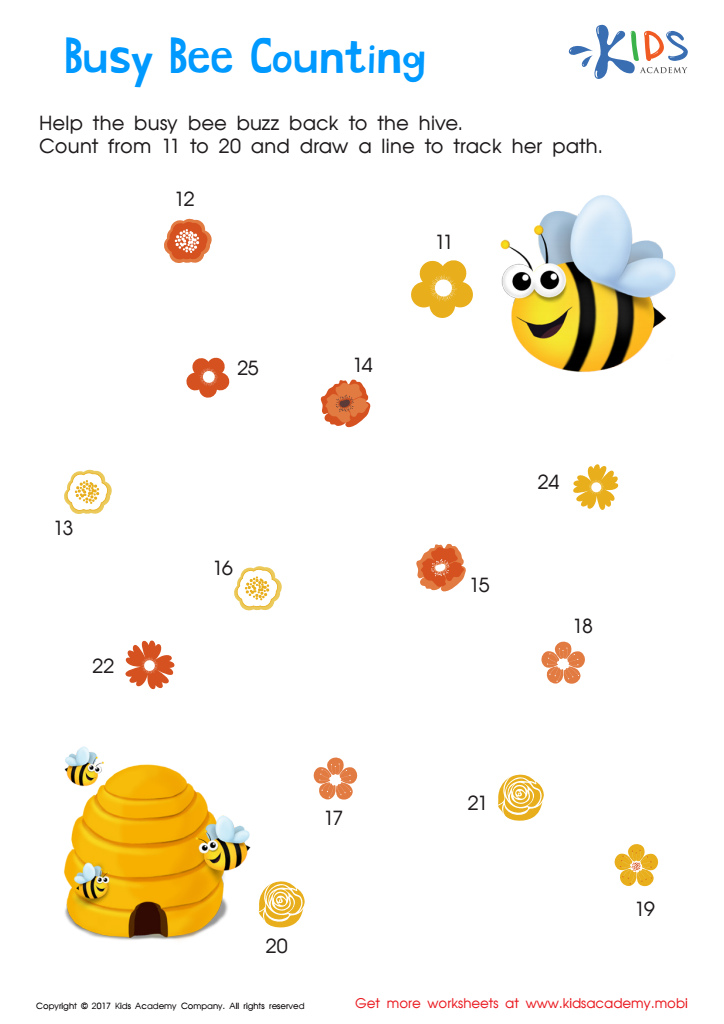
Ordering 11–20: Busy Bee Counting Worksheet
 Assign to My Students
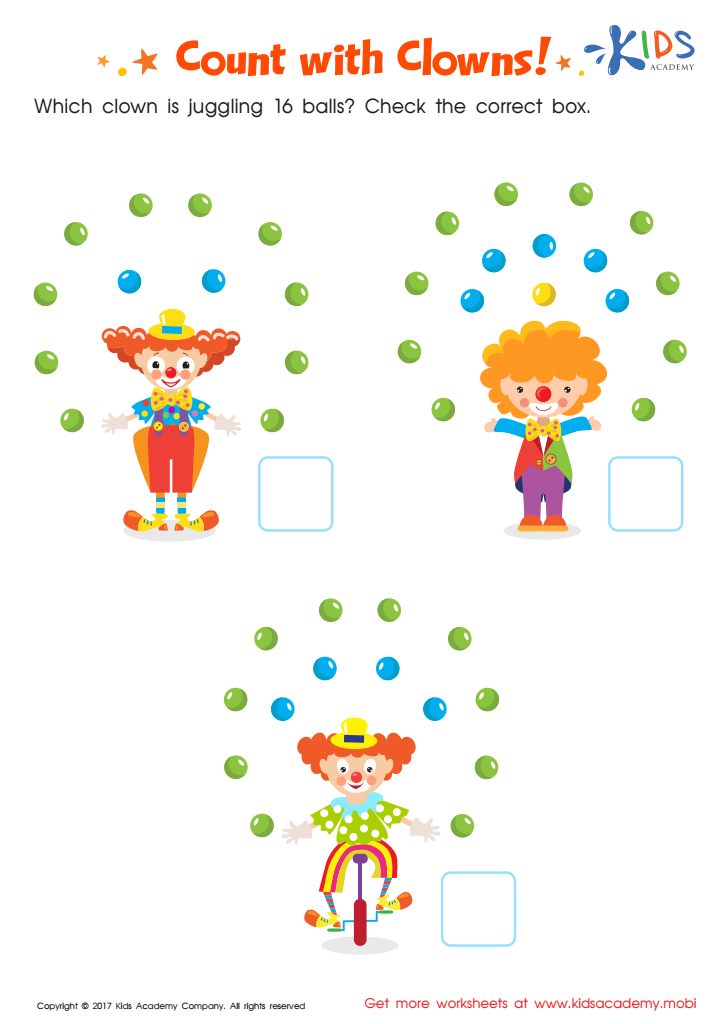
Count with Clowns Worksheet



Extra Challenge Numbers 11–20 are crucial for children aged 3-8, representing an essential bridge in early numerical learning. At this developmental stage, children transition from identifying and counting basic numbers (1-10) to understanding larger quantities and more complex mathematical concepts.
Firstly, mastering numbers 11-20 reinforces a child's counting skills, setting a foundation for all future math learning. It aids in their numerical fluency, essential for addition, subtraction, and place value understanding. Recognizing patterns in these numbers can also introduce basic concepts of tens and units, which are critical for arithmetic operations and more advanced math topics.
Moreover, challenges focusing on these numbers promote problem-solving and cognitive development. By tackling engaging activities, children enhance their memory, concentration, and logical thinking. This period is an optimal time for brain development, making it crucial to introduce stimulating and educational activities.
Parents and teachers who support this aspect of learning help build a child's confidence and competence in mathematics, laying a groundwork for academic success. Math-related skills are integral to a child's daily life, influencing activities ranging from telling time to managing money. Encouraging children to embrace number challenges instills a love for learning and an ease with numerical concepts, ensuring they are prepared for more complex mathematical ideas in the future.