Extra Challenge Time Word Problems Worksheets for 6-Year-Olds
2 filtered results
Difficulty Level
Grade
Age
-
From - To
Subject
Activity
Standards
Introducing our Extra Challenge Time Word Problems educational worksheets, expertly crafted for children aged six years old! These engaging worksheets are designed to develop your child's critical thinking and problem-solving skills through fun and challenging scenarios. Each sheet is meticulously tailored to enhance your young learner's understanding of time concepts, encouraging them to apply their knowledge in practical situations. Watch as your child delights in mastering new skills with our vibrant, thought-provoking exercises. Perfect for home or classroom use, these worksheets are an essential tool for fostering a love of learning and building a strong educational foundation.
Favorites
With answer key
Interactive
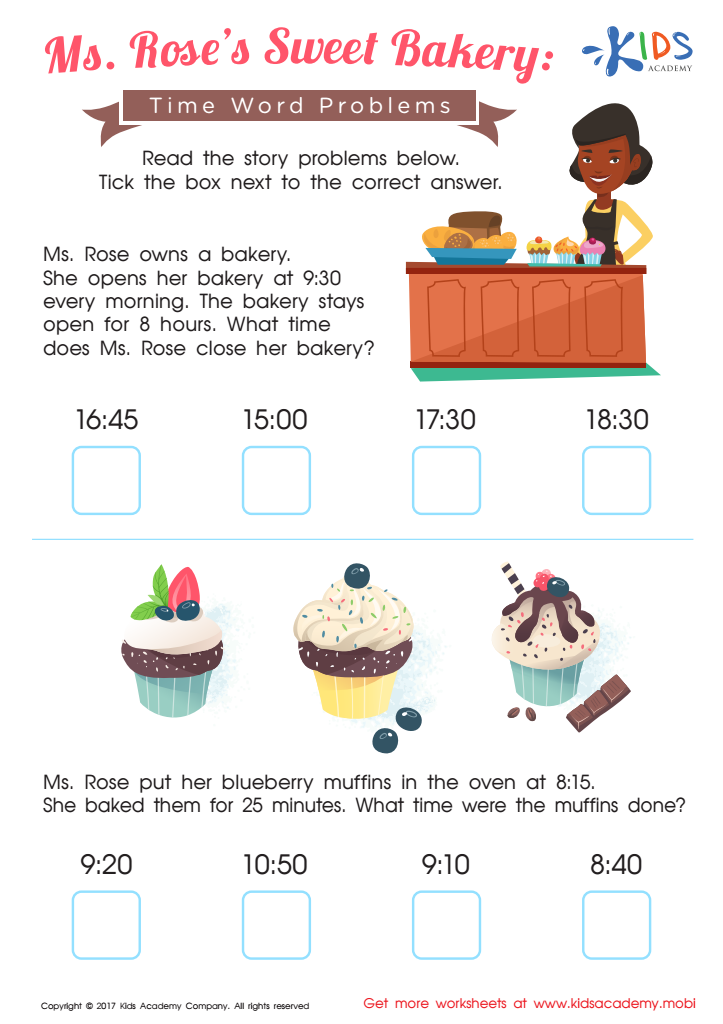
Ms. Roseв's Sweet Bakery Time Worksheet
Help your child understand the 24-hour clock using this fascinating telling time word problems worksheet: Sweet Bakery! Widely known as "military time", this skill isn't taught in school but is important for your kid to master.
 Assign to My Students
Ms. Roseв's Sweet Bakery Time Worksheet
Worksheet
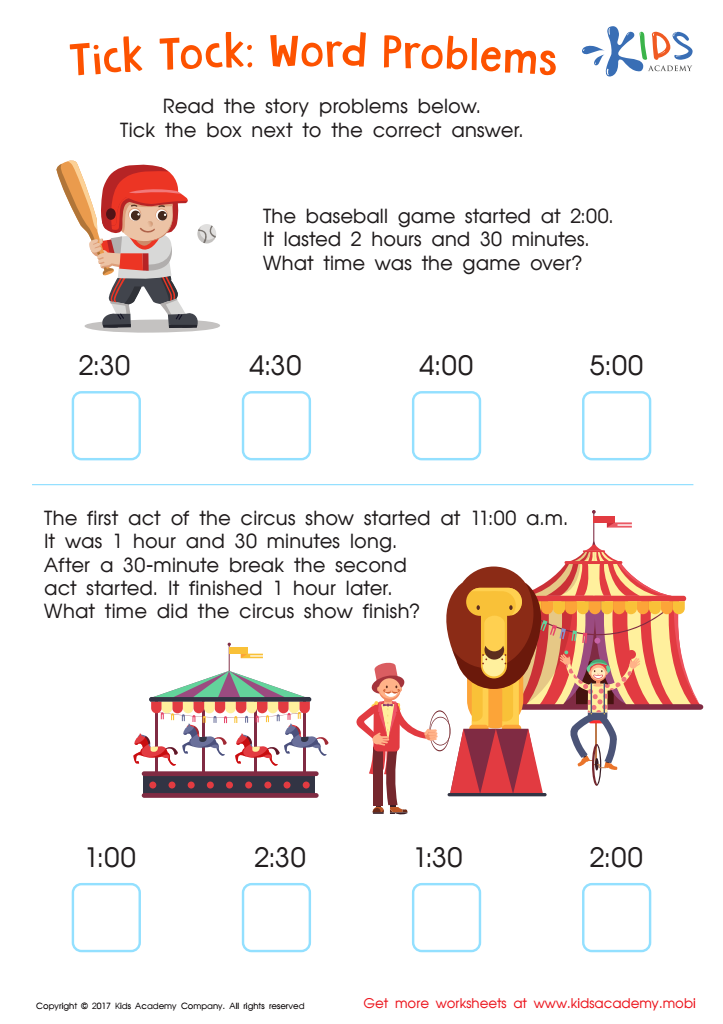
Tick Tock Word Problems Time Worksheet
Mix math and fun with this telling time word problems worksheet! Your child will love solving the events' finishing times using the vivid colors and joyful illustrations. Tick Tock!
Tick Tock Word Problems Time Worksheet
Worksheet
Join Kids Academy for Free
Who is primarily going to use this learning content?


.jpg)





Extra Challenge worksheets on Time Word Problems are a valuable resource in the realm of educational printables, especially designed for six-year-old children. These worksheets not only enhance the learning experience but also align perfectly with the developmental needs and capabilities of young learners at this critical age.
Understanding time is a fundamental skill that every child needs to master. It is not just about learning to read the clock; it involves comprehending the abstract concept of time, which can be challenging for young minds. Time Word Problems worksheets are specifically crafted to break down these complex ideas into simpler, relatable problems that a six-year-old can understand and solve.
One of the major benefits of these worksheets is their ability to integrate real-life scenarios. For instance, problems may involve situations like calculating the time taken for a school bus trip or figuring out the duration of a lunch break. This not only makes the math problem more engaging but also helps children see the practical relevance of what they are learning. By applying math skills to everyday situations, children can develop a deeper understanding and appreciation of time management from an early age.
Moreover, the Extra Challenge aspect of these worksheets ensures that children are not just passively working through problems but are actively engaged and challenged. This stimulates their thinking and problem-solving skills. As educational printables, these worksheets are designed with appealing graphics and child-friendly interfaces, making learning a visually stimulating and interactive experience. This is crucial in maintaining the attention and interest of young learners, who can easily be distracted.
Additionally, working on Time Word Problems helps in enhancing a child's numeracy skills. It involves arithmetic operations like addition and subtraction, and in some cases multiplication and division, depending on the complexity of the problem. This repeated practice helps in solidifying their math fundamentals while simultaneously learning about time.
Another key advantage of these worksheets is the flexibility they offer in terms of usage. They can be used in various settings - be it in a classroom, as a part of homeschool curriculum, or even for additional practice at home. This adaptability makes educational printables an excellent tool for parents and educators alike, seeking to reinforce learning in a structured yet flexible manner.
Furthermore, the challenge provided by these worksheets encourages children to think critically and develop patience and perseverance as they work through each problem. These are invaluable life skills that go beyond mere academic learning and contribute to the overall development of a child.
In conclusion, Extra Challenge worksheets on Time Word Problems are an essential part of educational printables for six-year-olds. They not only aid in the acquisition of fundamental time concepts but also foster critical thinking, enhance numeracy skills, and connect mathematical principles to real-life scenarios. These worksheets are meticulously designed to engage young minds through challenges that are appropriate for their developmental stage, ensuring that learning remains fun and effective.
The interactive nature of these educational printables also plays a crucial role in promoting self-learning. Children are encouraged to independently navigate through the problems, which boosts their confidence and self-reliance in problem-solving. This is particularly important as these skills are foundational for academic success across all subjects.
In the classroom setting, teachers can utilize these worksheets to cater to varied learning speeds and styles. They provide an excellent way to differentiate instruction, ensuring that all students, regardless of their initial comfort with the concepts of time, can advance at their own pace. For more advanced students, these challenges serve to deepen their understanding and prevent boredom, while for those who might be struggling, they offer a structured and incremental learning path.
Parents find these printables equally useful. They serve as a resource for engaging children in educational activities at home. Especially on days when outdoor activities are limited, these worksheets can be a lifesaver, keeping children productively occupied. They also offer parents a direct way to get involved in their child’s mathematical learning and to observe and support their progress.
Moreover, the design of these worksheets often incorporates colorful elements, playful themes, and characters that children find appealing. This not only makes the learning process enjoyable but also helps in retaining young learners' attention longer than traditional worksheets might.
Lastly, the feedback mechanism inherent in these worksheets, where children can immediately see the results of their problem-solving efforts, is highly beneficial. It enables both learners and educators to identify areas of strength and those needing improvement. For children, this can be very motivating, as they can see tangible progress in their abilities to solve increasingly complex problems.
In essence, Extra Challenge worksheets on Time Word Problems bridge the gap between theoretical knowledge and practical application, making them an indispensable tool in the early educational journey of children. They cultivate a holistic set of skills that are vital not only for academic success but also for personal growth and lifelong learning.