Number Recognition Easy Numbers Worksheets for Ages 4-7 - Page 4
75 filtered results
-
From - To

Counting on the City Skyline: Dot-to-Dot Worksheet
 Assign to My Students
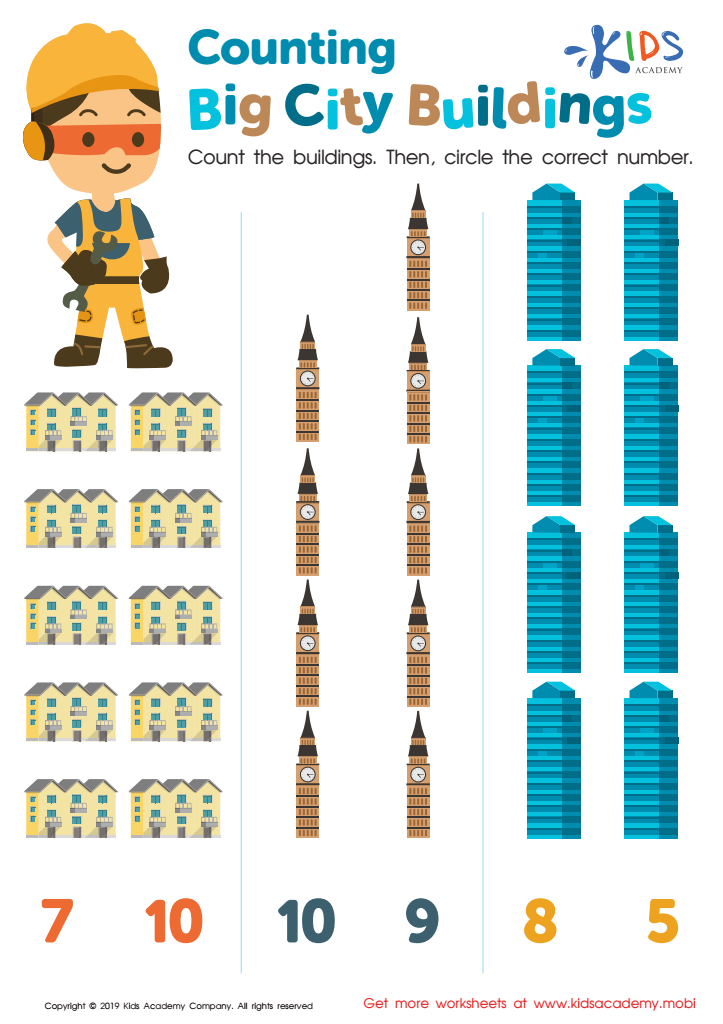
Counting Big City Buildings Worksheet

Night Sky Numbers Worksheet








Number recognition is a foundational skill that significantly impacts a child’s early education, particularly for ages 4-7. Understanding numbers is more than just being able to read them; it sets the stage for mathematical proficiency, problem-solving, and logical thinking, all crucial abilities in everyday life and future learning.
For parents and teachers, fostering number recognition at this stage supports cognitive development. Young children are naturally curious, and engaging with numbers can stimulate their brains, enhancing memory and attention span. Recognizing numbers helps kids comprehend the notion of quantity, which is fundamental for addition, subtraction, and further mathematical concepts. This early exposure to numbers builds confidence, making children feel more capable in their academic journey.
Additionally, strong number recognition skills contribute directly to a child's success in other areas. Many aspects of language development, such as following a sequence, reinforce mathematical understanding. Activities involving numbers, like counting objects or identifying numerals in the environment, also offer hands-on learning that can help improve fine motor skills.
In sum, parents and teachers should prioritize number recognition for young children to provide a solid educational foundation. This encourages a positive relationship with learning and sets the stage for continued academic success. Facilitating engaging and playful experiences with numbers can make learning enjoyable and effective, nurturing a lifelong love for math and learning.








