
Money management skills Easy Worksheets for 4-Year-Olds
3 filtered results
Difficulty Level
Grade
Age
-
From - To
Subject
Activity
Standards
Introducing "Money Management Skills Easy Worksheets for 4-Year-Olds!" These engaging and educational worksheets from Kids Academy are designed to help young children start understanding the basics of money management in a fun and simple way. Perfectly tailored for preschoolers, these worksheets promote early financial literacy through interactive exercises and colorful visuals. They cover foundational concepts like identifying coins and bills, recognizing values, and understanding basic spending and saving. By incorporating these worksheets into your child's routine, you're setting the stage for responsible financial habits right from the start. Discover our free printable resources today!
Favorites
With answer key
Interactive
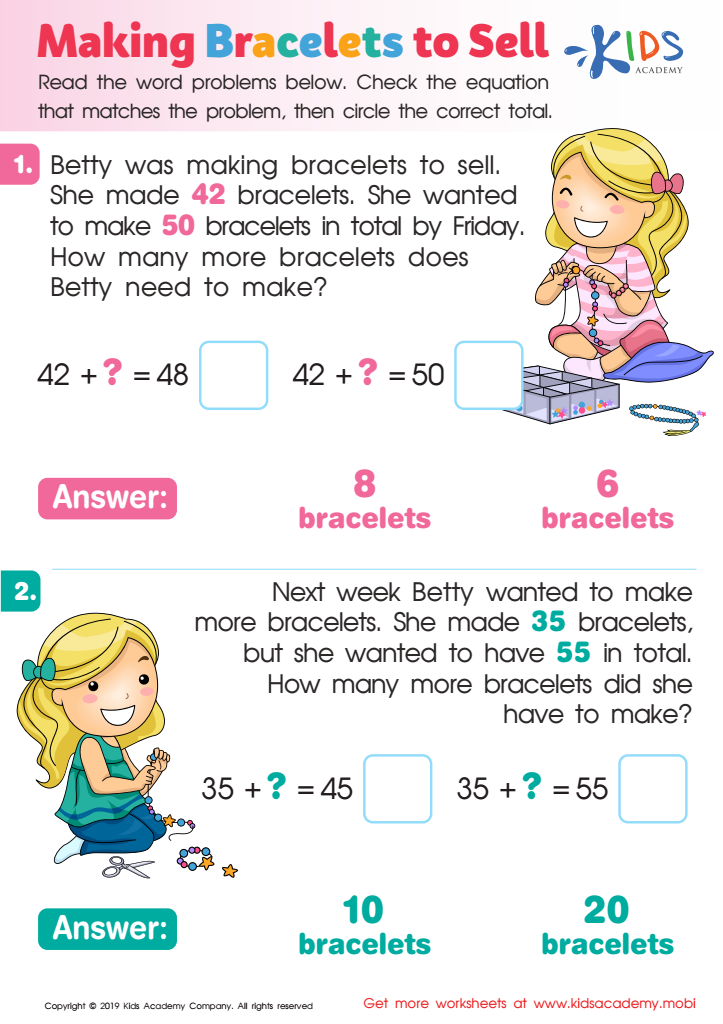
Making Bracelets to Sell Worksheet
Got kids who love crafting? This worksheet will be right up their alley! Let them use their creative and problem-solving skills to check equations and decide the correct total. It's just like making beads into a bracelet but on paper! Print out this downloadable PDF and get ready for a fun craft session.
 Assign to My Students
Making Bracelets to Sell Worksheet
Worksheet
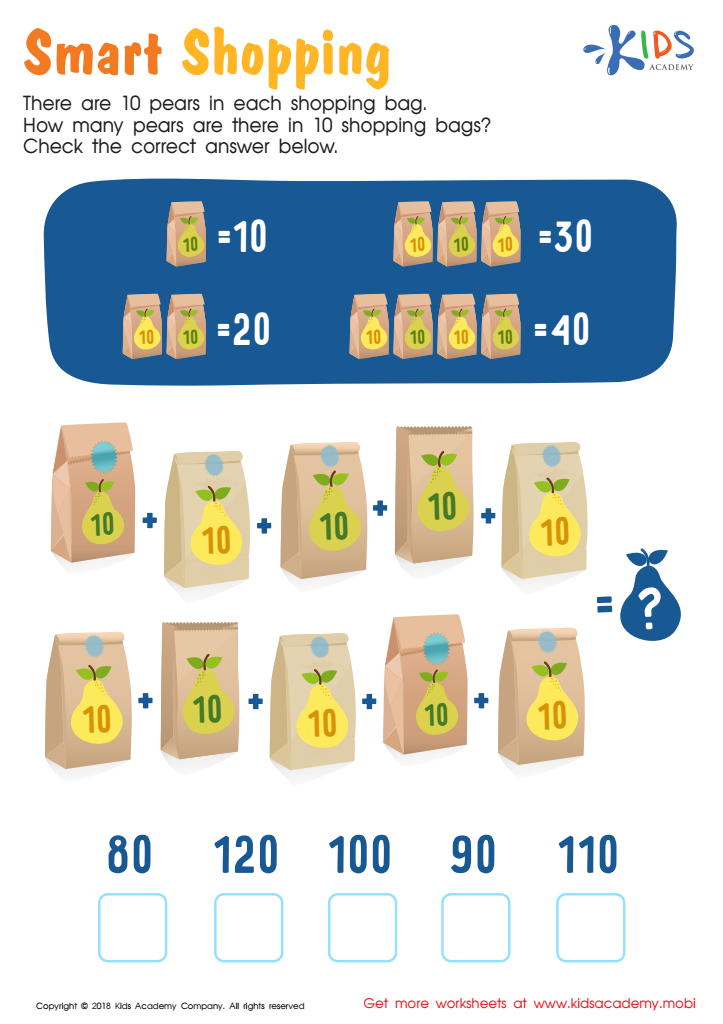
Smart Shopping: Trade Tens for a Hundred Worksheet
Use this worksheet to test counting skills: each bag has 10 pears. Ask your child how many pears are in 10 bags. Guide them as they count through the printout and check the answer below. See if they got it right!
Smart Shopping: Trade Tens for a Hundred Worksheet
Worksheet
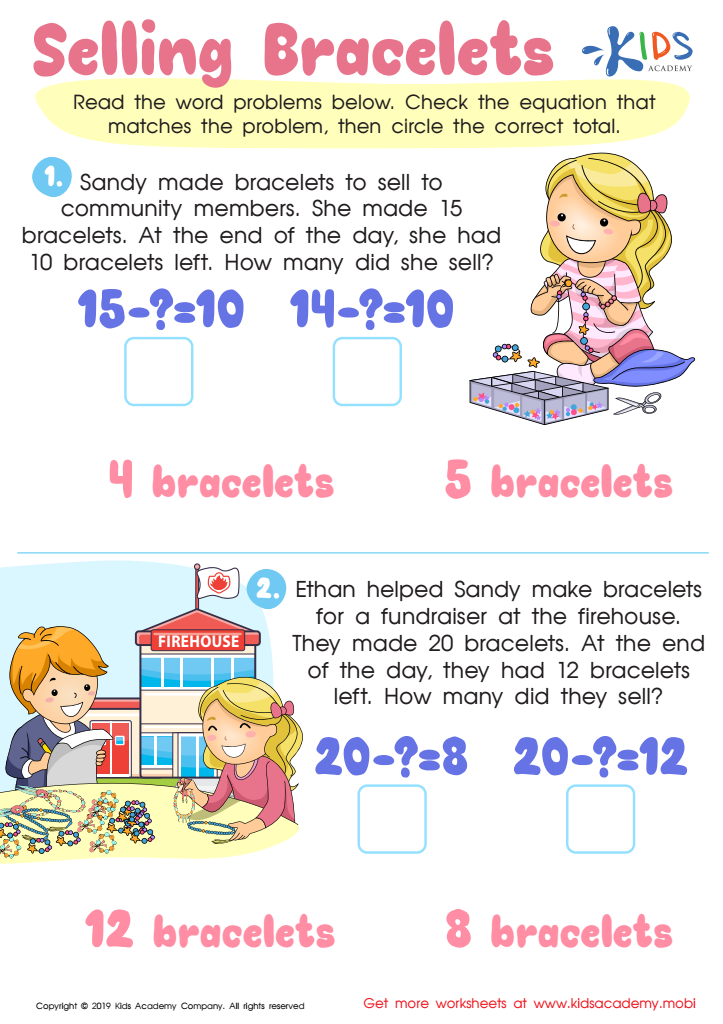
Selling the Bracelets Worksheet
Engage your kids with learning by making it fun! Try this creative worksheet: your kids can practice subtraction while making bracelets. Download the pdf; read the two word problems to them and help them choose the correct total. Have fun! (80 words)
Selling the Bracelets Worksheet
Worksheet
Join Kids Academy for Free
Who is primarily going to use this learning content?


.jpg)




Teaching money management skills to 4-year-olds is a fundamental step toward fostering lifelong financial literacy. At this tender age, children are incredibly receptive and can begin to grasp basic concepts that pave the way for more complex financial understanding in the future. Parents and teachers play crucial roles in introducing these concepts early to establish a solid foundation.
Understanding the value of money, even in its simplest form, helps young children distinguish between needs and wants. For instance, when parents or teachers explain that money is exchanged for goods and services, kids learn to appreciate what they have and begin to make informed choices. Simple activities, like pretend shopping or saving coins in a piggy bank, can instill essential principles of budgeting and saving.
Moreover, early money management skills contribute to developing mathematical abilities and decision-making skills, critical competencies in academic environments and life. By incorporating activities that involve counting coins or making small financial decisions, children practice arithmetic skills and learn the benefits of thoughtful decision-making.
Additionally, teaching these skills promotes a sense of responsibility and confidence. As children start to understand money's role, they gain independence in their interactions and grow more aware of the economic aspects of daily life. Consequently, they feel more empowered to handle real-world financial situations as they grow.








