
Basic Math Skills Easy Geometry Worksheets for Ages 5-6
3 filtered results
Difficulty Level
Grade
Age
-
From - To
Subject
Activity
Standards
Introduce your child to the fun world of geometry with our "Basic Math Skills Easy Geometry Worksheets for Ages 5-6." These engaging worksheets are designed to help young learners grasp foundational geometric concepts through hands-on activities. Children will learn to identify, trace, and sort shapes while developing critical thinking and fine motor skills. Each worksheet is crafted to be age-appropriate, ensuring that learning is enjoyable and accessible for young minds. Perfect for both classroom use and at-home practice, our easy geometry worksheets provide a strong mathematical foundation that will benefit your child for years to come.
Favorites
With answer key
Interactive
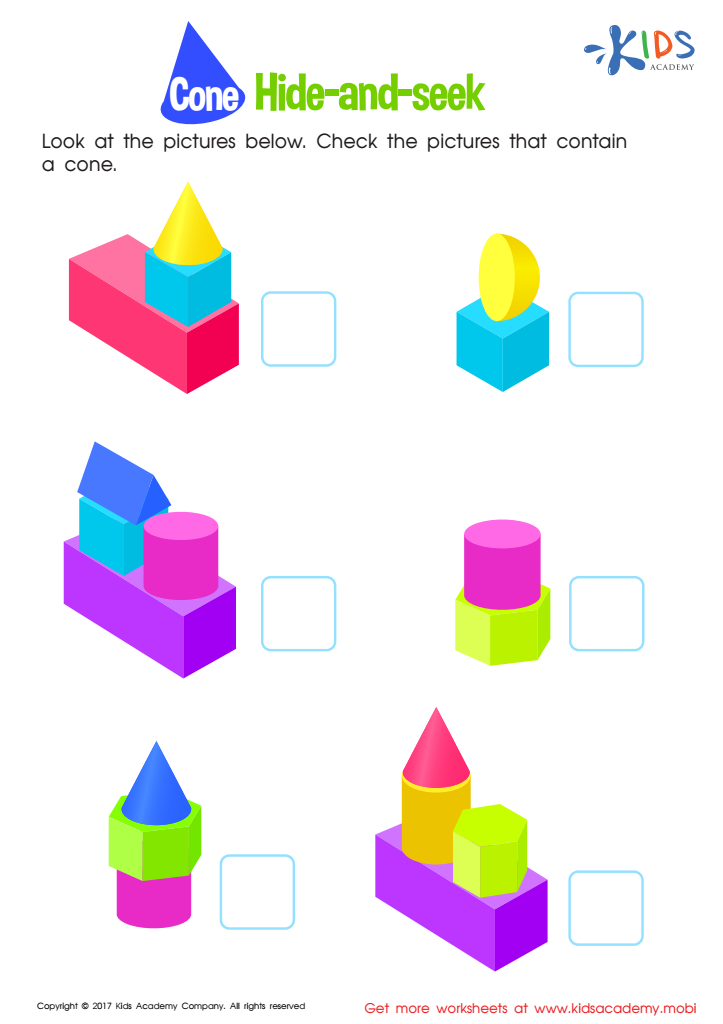
Cone Hide-and-Seek Worksheet
Prior to starting this worksheet, quiz your kid on shapes. If they gave quite a few, you've done well! This pdf will teach them more about cones; show them the pictures in the printout and have them identify which ones contain a cone.
 Assign to My Students
Cone Hide-and-Seek Worksheet
Worksheet











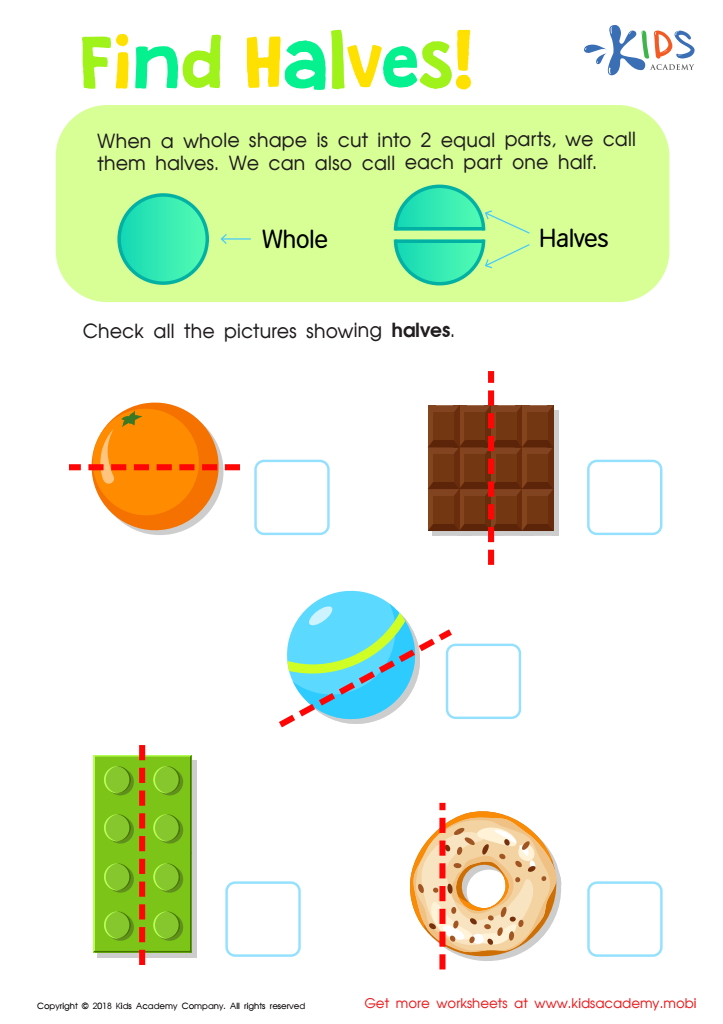
Find Halves Worksheet
If your child can tell you what two, three and four equal parts are called, give yourself a pat on the back! If not, this worksheet can help. Halves are two equal parts of a whole shape. Check the pictures in this printable pdf to help your child understand.
Find Halves Worksheet
Worksheet
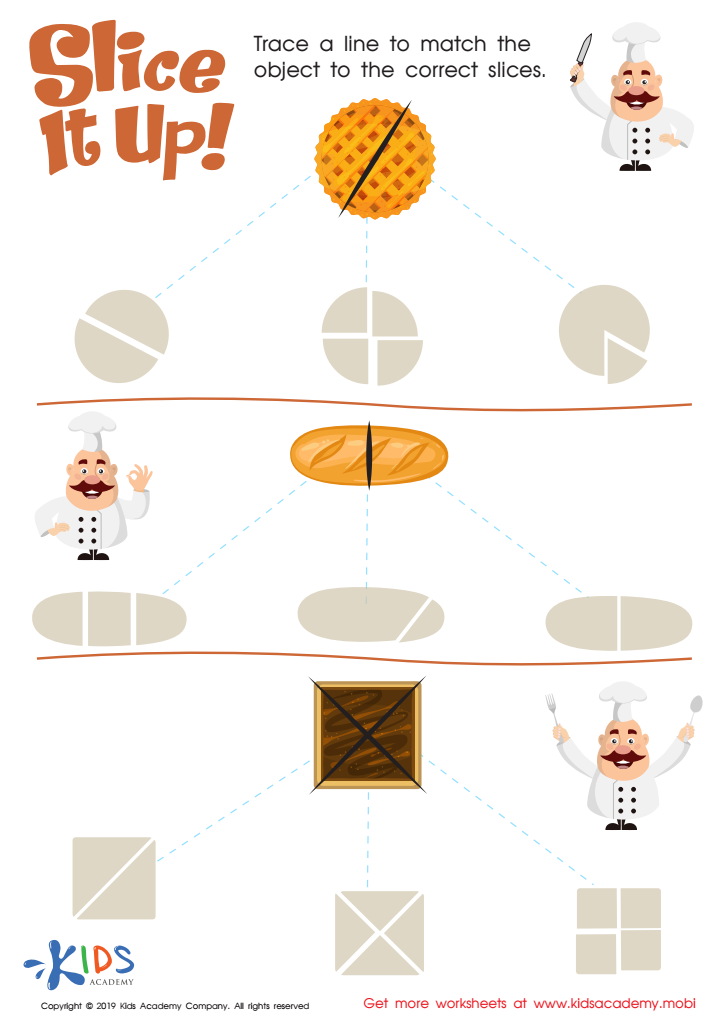
Slice It Up Worksheet
Try this fun math, reading and writing worksheet with your kids! They will love the colorful activities that perfect coordination and tracing. Engaging learning exercises help keep young minds sharp and boost skills. With these worksheets, your kids will be academically ahead of the curve!
Slice It Up Worksheet
Worksheet
Join Kids Academy for Free
Who is primarily going to use this learning content?








Basic math skills are foundational for a child’s future academic success and daily life functioning. For children aged 5-6, mastering early geometry concepts, such as shapes and spatial awareness, is crucial. At this developmental stage, kids are extraordinarily receptive and curious, making it a prime time to introduce fundamental mathematical ideas.
Parents and teachers should care about incorporating easy geometry into early math skills for several reasons. First, understanding shapes and their properties boosts children’s visual perception abilities, which are critical for tasks like reading and writing. It also enhances problem-solving skills and logical thinking. When children learn to sort and classify objects, recognize patterns, and understand spatial relationships, they gain tools that will help them in subjects beyond math, including science, art, and physical activities.
Secondly, early exposure to geometry can foster a positive attitude towards math. Engaging and hands-on activities make math fun and less daunting, paving the way for a child's eagerness to tackle more complex mathematical concepts as they grow older. Activities like building blocks, drawing shapes, and puzzles not only make learning enjoyable but also encourage persistence and concentration.
In summary, focusing on easy geometry for young children establishes a strong foundation for both academic growth and everyday problem-solving skills, making it an invaluable component of early education.








