Identifying shapes Easy Worksheets for Ages 6-7
3 filtered results
-
From - To
Enhance your child's learning with our "Identifying Shapes Easy Worksheets" tailored for children aged 6-7. These engaging worksheets from Kids Academy are designed to make shape recognition fun and effortless. Featuring colorful and interactive activities, children will easily learn to identify and differentiate between various shapes such as circles, squares, triangles, and more. Our carefully curated exercises not only build foundational geometry skills but also promote critical thinking and problem-solving. Perfect for classroom use or at-home practice, these worksheets ensure children develop essential learning skills in an enjoyable way. Download today and empower your child's educational journey!
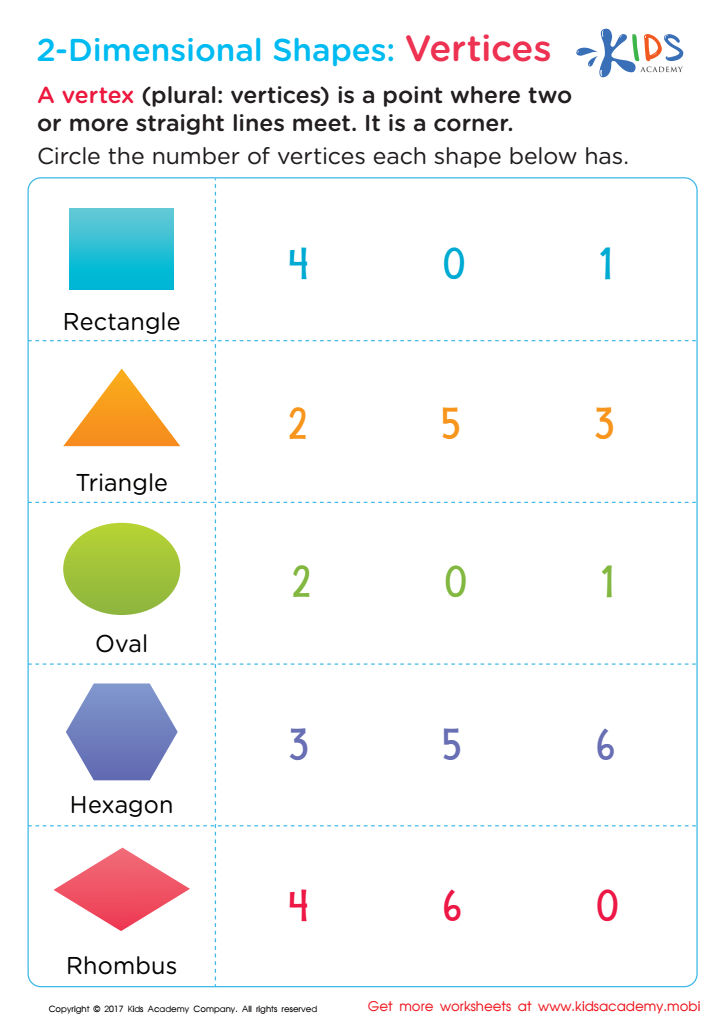
Two–Dimensional Shapes: Vertices Printable
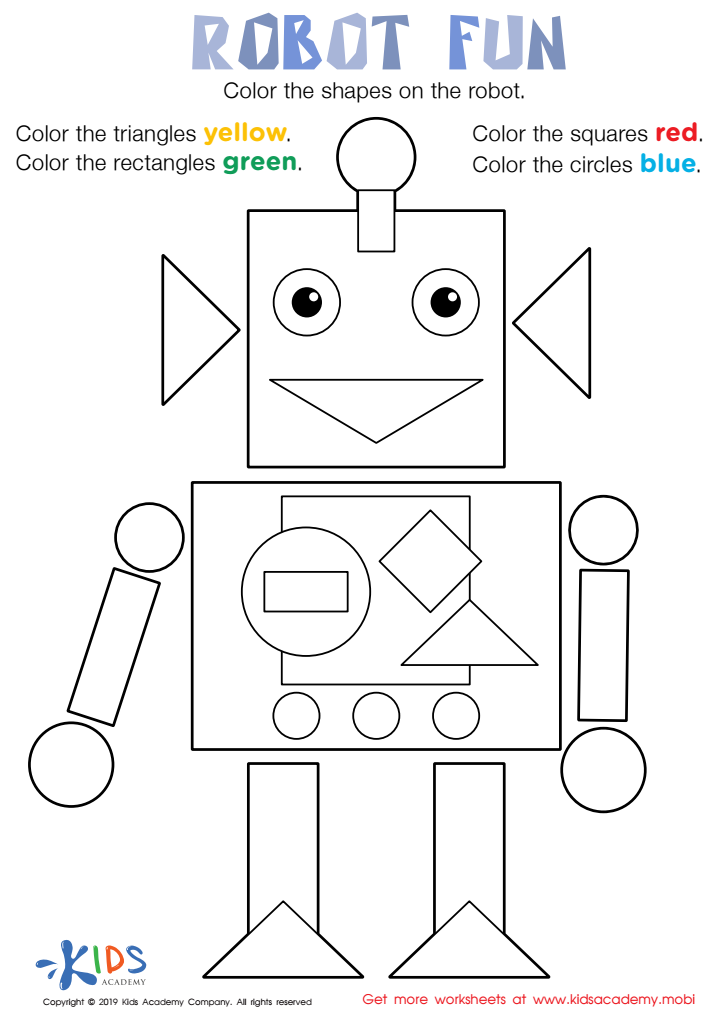
Robot Fun Worksheet
 Assign to My Students
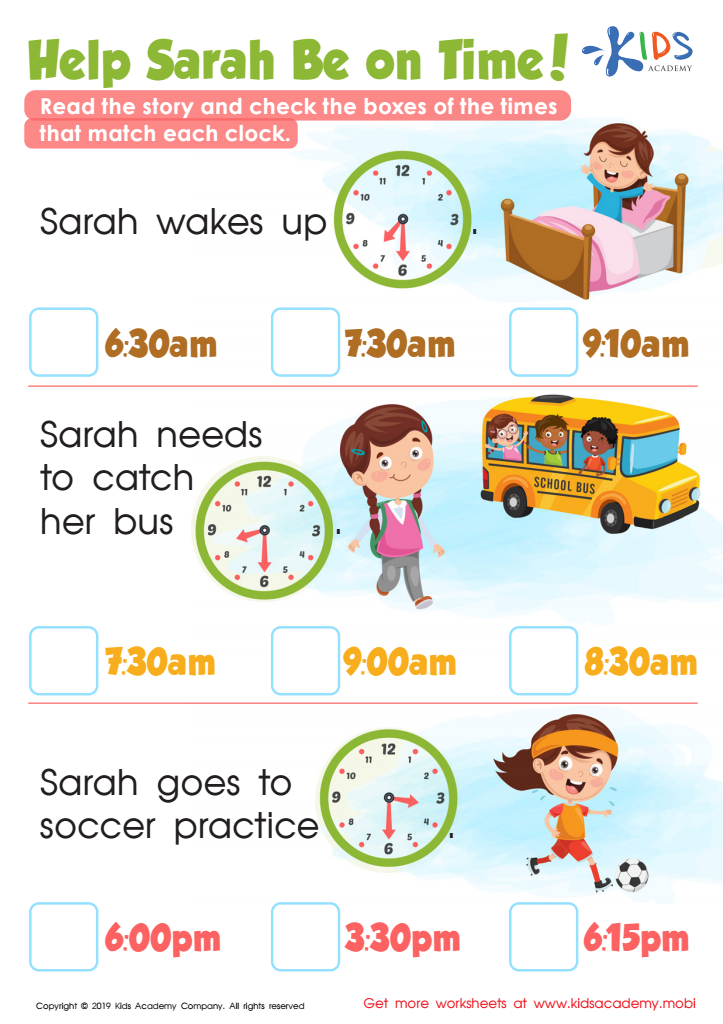
Help Sarah Be on Time! Worksheet








Identifying shapes is a foundational skill for children aged 6-7 that has widespread benefits for their cognitive and academic development. At this stage, kids are building basic geometry skills that contribute to the overall mathematics curriculum. Recognizing shapes enhances their spatial awareness—an essential ability that helps them understand the physical world and an early precursor to geometry, a subject critical in various fields such as physics, engineering, and art.
Moreover, shape identification supports language development as children learn to label and describe different shapes, enhancing their vocabulary and communication skills. It also aids in problem-solving and logical thinking since kids begin to understand how shapes fit together to form more complex structures. Engaging in activities that involve identifying, sorting, and describing shapes can improve children’s fine motor skills by requiring them to manipulate and draw shapes.
For teachers and parents, encouraging shape recognition exercises can be interactive and enjoyable, thus enhancing children's motivation and engagement in learning. Activities like playing with blocks, drawing, or sorting everyday objects can make learning shapes a fun and meaningful part of children’s lives. This not only lays the groundwork for advanced mathematical concepts but also fosters a positive attitude toward learning and exploration.








