
Identifying shapes Easy Worksheets for Ages 6-8
3 filtered results
Difficulty Level
Grade
Age
-
From - To
Subject
Activity
Standards
Unlock the exciting world of geometry for your 6-8-year-olds with our "Identifying Shapes Easy Worksheets." Our carefully designed worksheets make learning fun and interactive, helping young learners effortlessly recognize and name different shapes. Perfect for this age group, each activity progressively builds essential geometry skills through engaging exercises. Children will enjoy colorful, hands-on tasks that improve their spatial understanding and cognitive abilities. Ideal for teachers and parents looking to enhance learning at home or in the classroom! Bring a love for math into your child’s life while developing critical foundational skills with our delightful worksheets.
Favorites
With answer key
Interactive
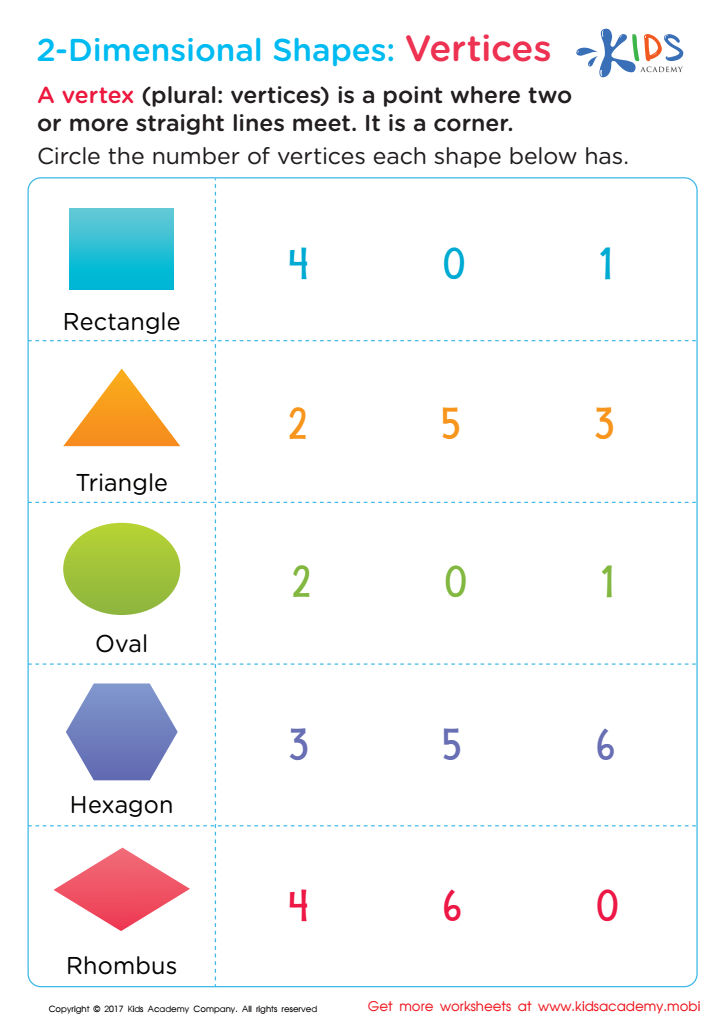
Two–Dimensional Shapes: Vertices Printable
This colorful worksheet teaches kids geometry by introducing them to two-dimensional shapes and vertices. Kids can practice counting vertices and learn an important new math term in an easy to understand way. Boost your child's knowledge of geometry today!
Two–Dimensional Shapes: Vertices Printable
Worksheet
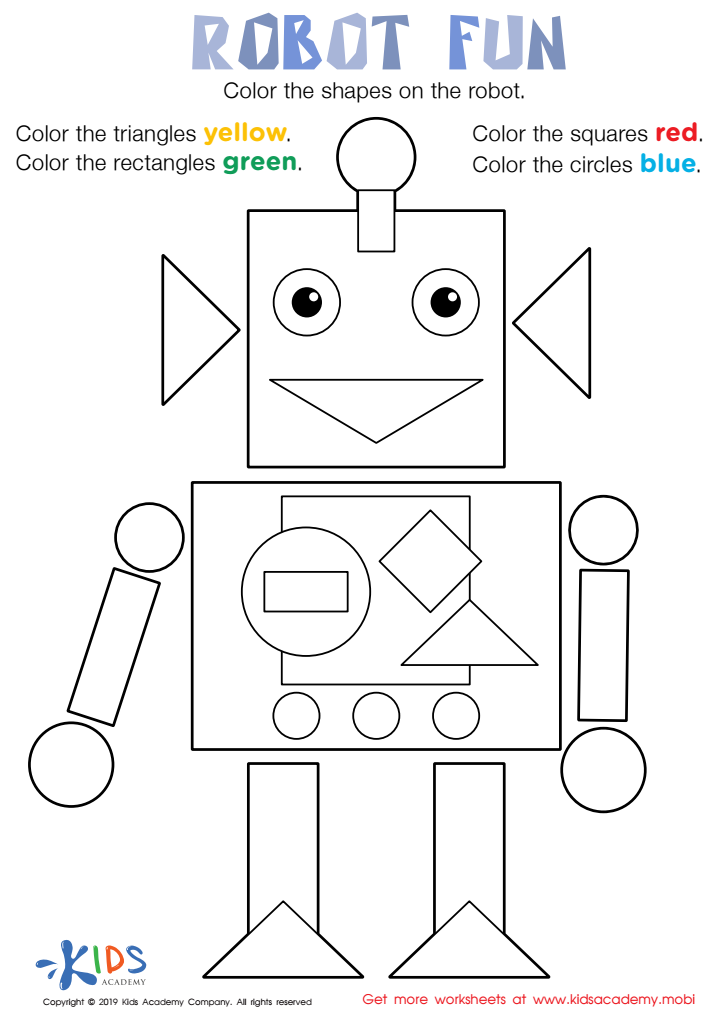
Robot Fun Worksheet
Help your child learn about basic shapes with this fun robot worksheet! Kids practice identifying circles, squares, rectangles and triangles, then color each shape according to directions. Make math practice enjoyable with this coloring page that teaches all four basic shapes - it's an important math skill!
Download (PDF)
 Assign to My Students
Assign to My Students
Robot Fun Worksheet
Worksheet
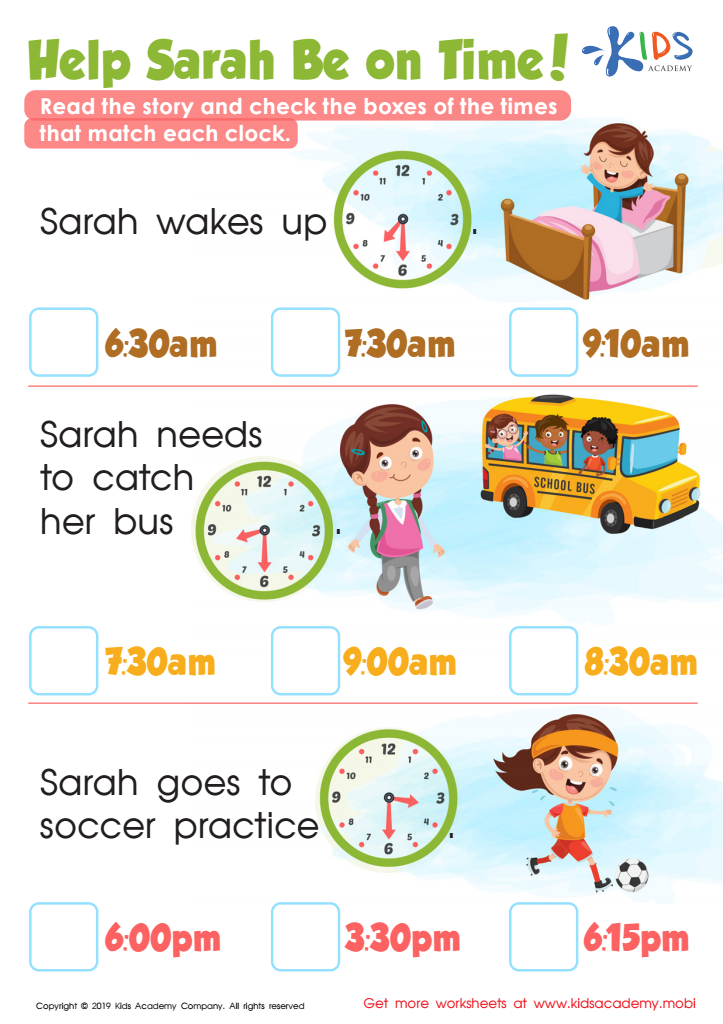
Help Sarah Be on Time! Worksheet
Humans are social creatures and need to be punctual for things to run smoothly. For instance, a meeting with a friend requires a time to be agreed upon. Ask your kids what else needs to be punctual. Then, show them the worksheet and read the accompanying story. Get them to match clocks with the correct times.
Help Sarah Be on Time! Worksheet
Worksheet
Join Kids Academy for Free
Who is primarily going to use this learning content?







Identifying shapes is a fundamental skill that parents and teachers should prioritize for children aged 6-8. Early shape recognition plays a crucial role in cognitive development and lays the groundwork for more complex mathematical concepts. Understanding shapes helps kids develop spatial awareness, which is essential for understanding the world around them and performing everyday tasks, such as navigating spaces and organizing objects.
Shapes are also a cornerstone of early geometry education, setting the stage for more advanced topics like symmetry, fractions, and problem-solving skills. When children recognize and name shapes, they begin to distinguish attribute differences, enhancing their critical thinking and analytical abilities. These skills are transferable across various subjects, including art, where shapes form the basic building blocks of design and composition.
Moreover, shape recognition supports literacy development. For children who are learning to read, recognizing and distinguishing shapes helps in identifying letters and numbers, which consist of a combination of shapes and lines. Activities involving shapes often include following directions, improving listening skills and attention span.
By focusing on shape identification, parents and teachers empower children with the tools necessary for academic success and everyday life, fostering a well-rounded development. Therefore, introducing and nurturing shape recognition in early childhood education is essential for building a strong educational foundation.








