Understanding patterns Easy Multiplication Worksheets for Ages 6-8
4 filtered results
-
From - To
Unlock your child's potential with our "Understanding Patterns: Easy Multiplication Worksheets for Ages 6-8" at Kids Academy. Designed meticulously for young learners, these worksheets simplify complex multiplication concepts through engaging, pattern-based activities. Each page encourages students to recognize and predict patterns, building a strong mathematical foundation. Perfect for kids aged 6-8, these exercises not only enhance multiplication skills but also foster critical thinking and problem-solving abilities. Parents and educators will love watching their children confidently navigate the world of numbers and grow their mathematical mastery progressively and joyously. Prepare your child for a brighter mathematical future today!
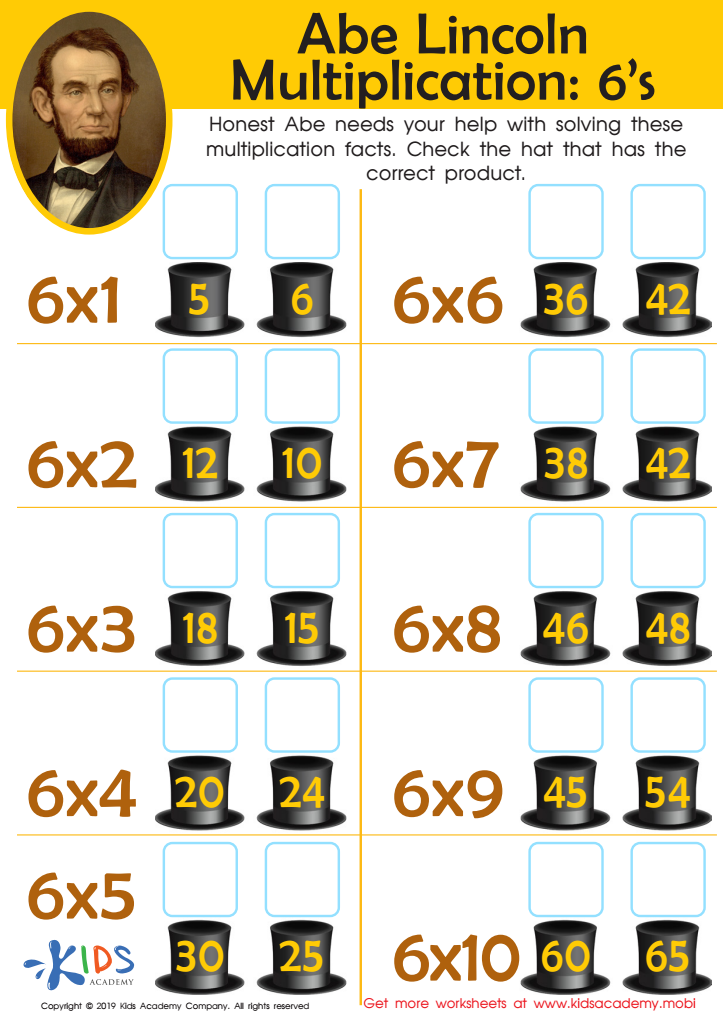
Abe Lincoln Multiplication: 6’s Worksheet
 Assign to My Students








Understanding patterns and easy multiplication for ages 6-8 lays a crucial foundation for future mathematical learning and everyday problem-solving skills. During this developmental stage, children's brains are highly receptive to learning new concepts, and grasping patterns helps them recognize relationships and predict outcomes. Patterns are the building blocks of algebra and higher-level math, and exposing children to them early fosters logical thinking and analytical skills.
By introducing easy multiplication during these formative years, parents and teachers can help demystify what can later become an intimidating subject. For most children, multiplication becomes easier when it's connected to patterns—such as understanding that 4x3 is the same as adding four three times (4+4+4). Recognizing these repetitive structures makes it easier for children to internalize multiplication facts, laying a solid basis for division, fractions, and many other mathematical principles.
Furthermore, mastering these foundational skills boosts children's confidence and enthusiasm for math, promoting a growth mindset where they feel empowered to tackle more challenging problems. Relevant and engaging multiplication exercises also bridge classroom learning and real-life applications, enabling children to understand the practicality of math in their daily lives, whether it’s through playing games, solving puzzles, or managing simple tasks such as grouping objects.
Altogether, a focus on patterns and multiplication enriches a child's cognitive toolkit, fostering both academic success and a curiosity-driven approach to learning.








