Counting skills Easy Subtraction Worksheets for Ages 7-8
3 filtered results
Difficulty Level
Grade
Age
-
From - To
Subject
Activity
Standards
Introducing our "Counting Skills Easy Subtraction Worksheets for Ages 7-8"! Perfectly designed to reinforce early math skills, these worksheets make learning subtraction a breeze. Tailored for young learners, each sheet provides engaging exercises that develop counting proficiency and subtraction understanding. Bright visuals and friendly layouts make these tasks enjoyable and educational, boosting confidence and competence in basic arithmetic. Ideal for home or school use, our worksheets support Grade 2 math standards. Turn subtraction practice into fun learning sessions! Explore a world where mastering math becomes both easy and exciting. Visit now and download to start enhancing your child’s math journey today!
Favorites
With answer key
Interactive
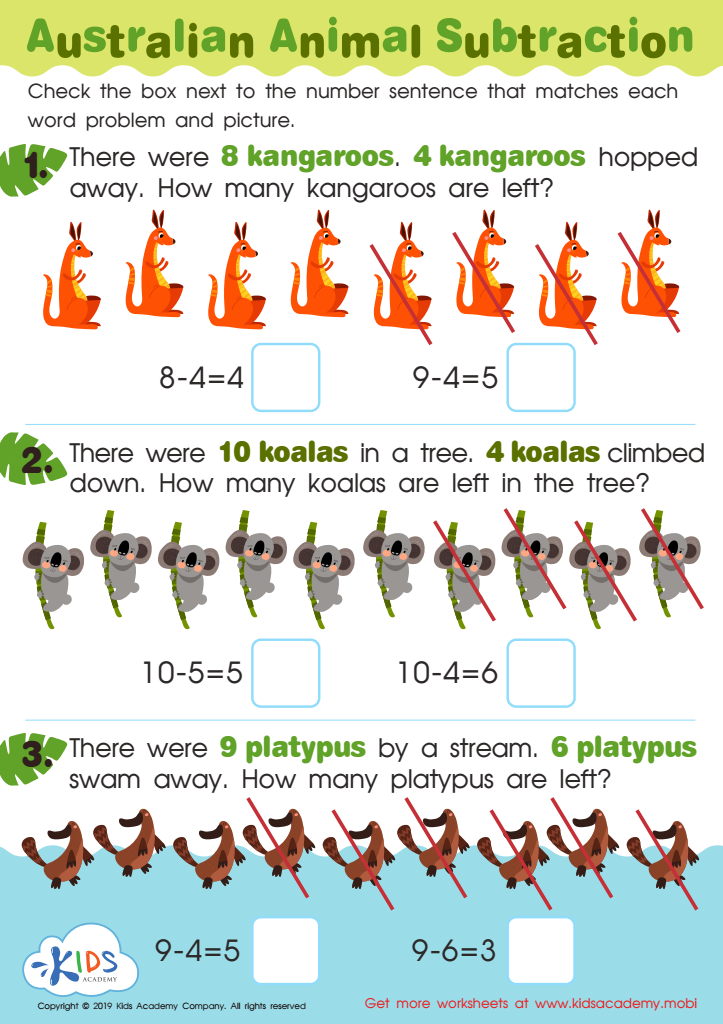
Australian Animal Subtraction Worksheet
Test your child's wildlife knowledge. Ask them to name animals indigenous to Australia or other countries. Show them the animals in this worksheet and have them match each word problem and picture with the correct number sentence.
 Assign to My Students
Australian Animal Subtraction Worksheet
Worksheet
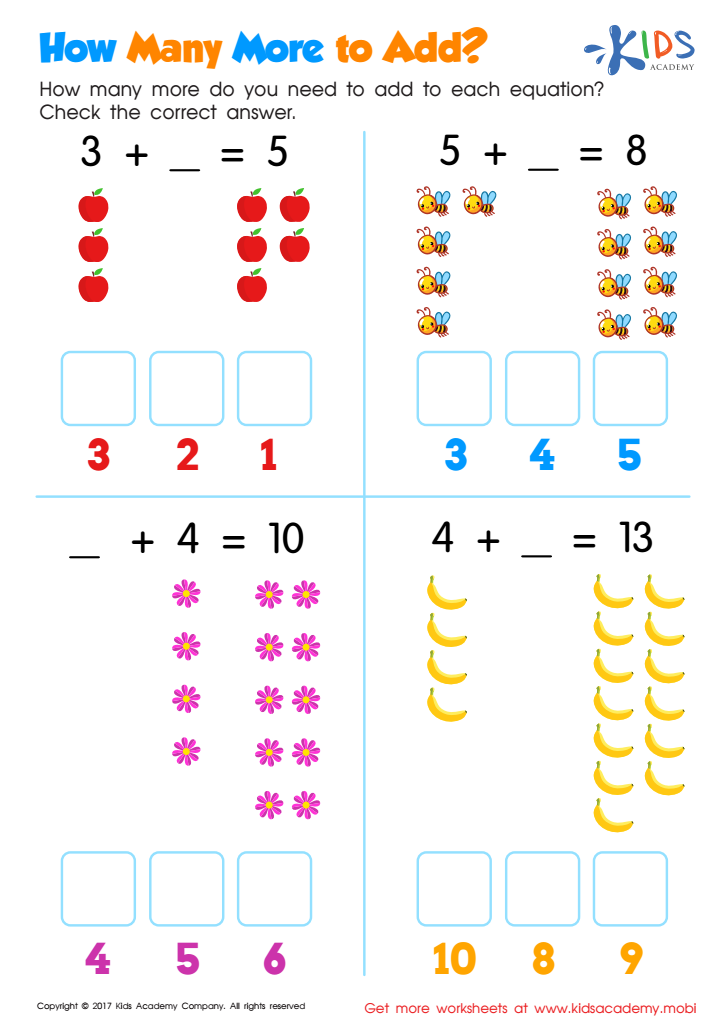
How Many More to Add Worksheet
Sharpen your child's math skills with this pdf worksheet. Help them figure out how many apples, bees, flowers and bananas are needed to reach the answer given. The possible answers are provided at the bottom of the boxes. Have some fun doing some addition and subtraction magic together and get those math skills sharpened!
How Many More to Add Worksheet
Worksheet
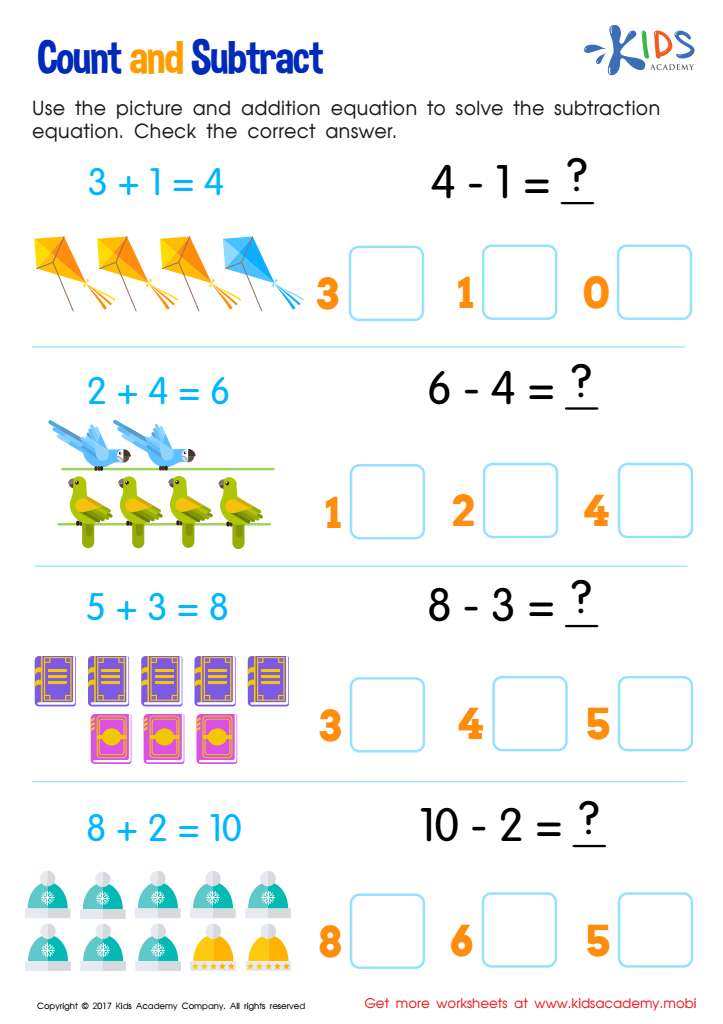
Count and Subtract Worksheet
This worksheet helps your child learn math via colorful pictures and equations. Count the items together, adding and subtracting as necessary. Your child will be challenged to get the correct total, thereby developing their math skills.
Count and Subtract Worksheet
Worksheet
Join Kids Academy for Free
Who is primarily going to use this learning content?





.jpg)


Counting skills and easy subtraction are crucial foundations for children aged 7-8, and both parents and teachers play a significant role in nurturing these abilities. First, counting is fundamental to many aspects of mathematics and everyday life. It helps children understand number sequences, recognize patterns, and establish number sense, which is integral to performing more complex mathematical operations later on. By solidifying counting skills early, children build confidence and fluency in math.
Easy subtraction, on the other hand, introduces children to the concept of taking away or reducing quantities, which is essential for problem-solving and logical thinking. Understanding subtraction helps kids make sense of the relationships between numbers, see how numbers can be manipulated, and develop critical thinking skills.
Moreover, fostering proficiency in these areas can boost children's self-esteem and academic success, reducing the likelihood of math anxiety. Parents and teachers should leverage engaging activities, real-life scenarios, and consistent practice to help children grasp these concepts. For example, using objects like toys or fruits to demonstrate subtraction can make the learning process tangible and enjoyable. Consequently, emphasizing counting and easy subtraction in early education can enable a smoother transition to more advanced mathematical concepts, equipping children with essential tools for lifelong learning.