
Number Recognition Easy Matching Worksheets for Ages 7-9
4 filtered results
Difficulty Level
Grade
Age
-
From - To
Subject
Activity
Standards
Welcome to our "Number Recognition Easy Matching Worksheets" designed specifically for children ages 7-9! These engaging worksheets help young learners master number recognition in a fun and interactive way. Featuring colorful illustrations and age-appropriate exercises, kids will enjoy matching numbers with corresponding images, reinforcing their mathematical skills. Our carefully curated activities promote cognitive development while keeping students motivated and excited to learn. Perfect for at-home practice or classroom use, these worksheets make number learning easy and enjoyable. Download today to support your child’s educational journey and watch their confidence in numbers grow! Ideal for educators and parents alike.
Favorites
With answer key
Interactive
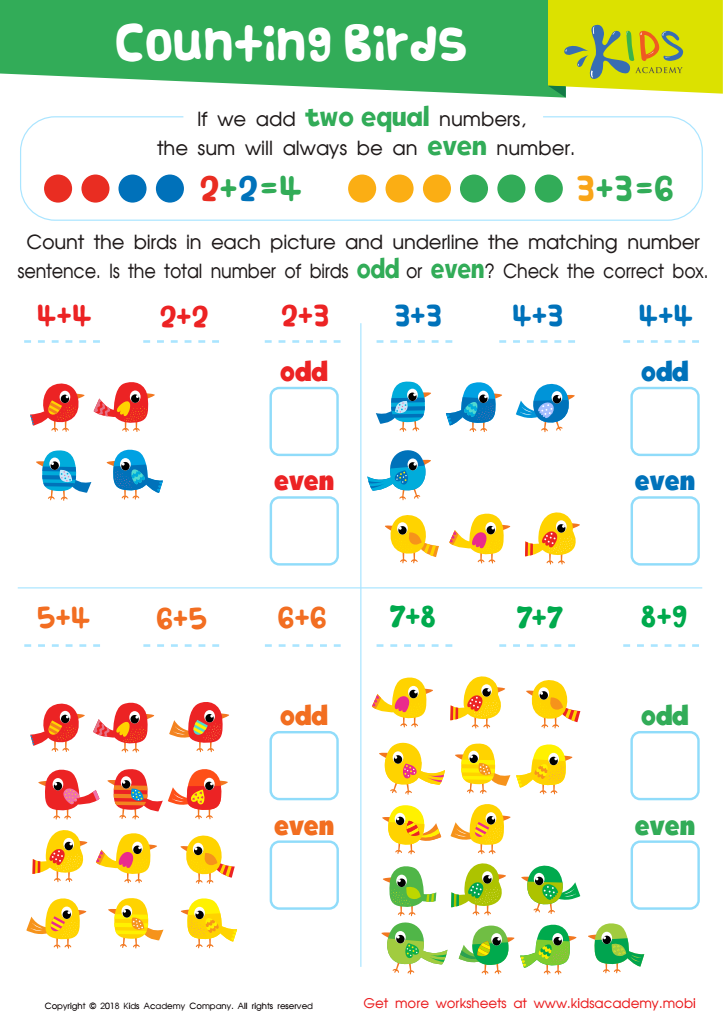
Counting Birds Worksheet
Help your child count and underline the matching number sentence in the worksheet. Ask them if the total number of birds in each picture is odd or even, then check the correct box. When two equal numbers are added, the sum is always an even number (e.g. 2+2=4, 4+4=8, both divisible by 2).
 Assign to My Students
Counting Birds Worksheet
Worksheet
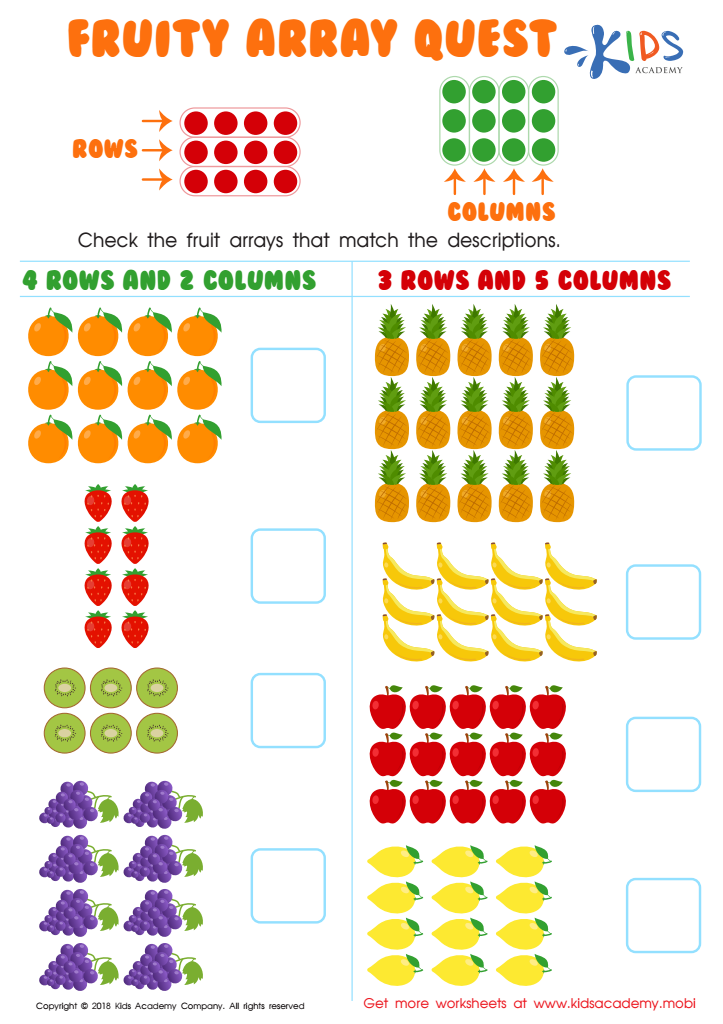
Fruity Array Quest Worksheet
Explain rows (horizontal) and columns (vertical) to your child before starting the worksheet. Show them the picture and the arrows indicating direction. Your child should be able to answer the questions easily after that. Help them match the fruit arrays that match the descriptions.
Fruity Array Quest Worksheet
Worksheet
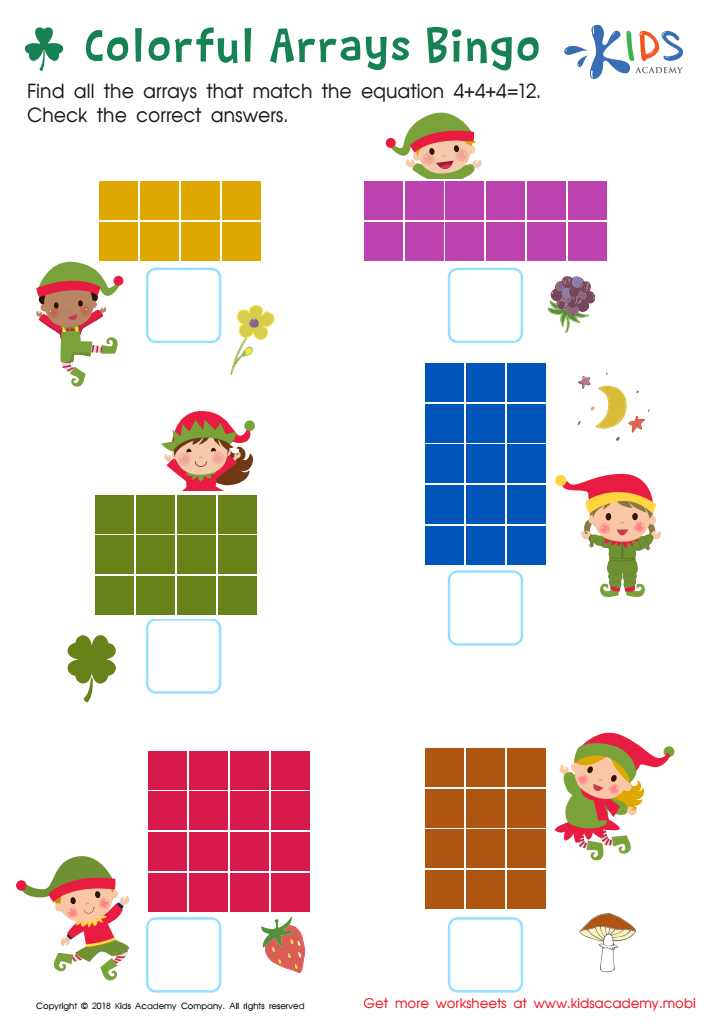
Colorful Arrays Bingo Worksheet
This worksheet stimulates thinking about arrays and how to represent them. Instruct students to count the 6 arrays and find which ones sum up to 12. Ask them to check the answers for accuracy.
Colorful Arrays Bingo Worksheet
Worksheet
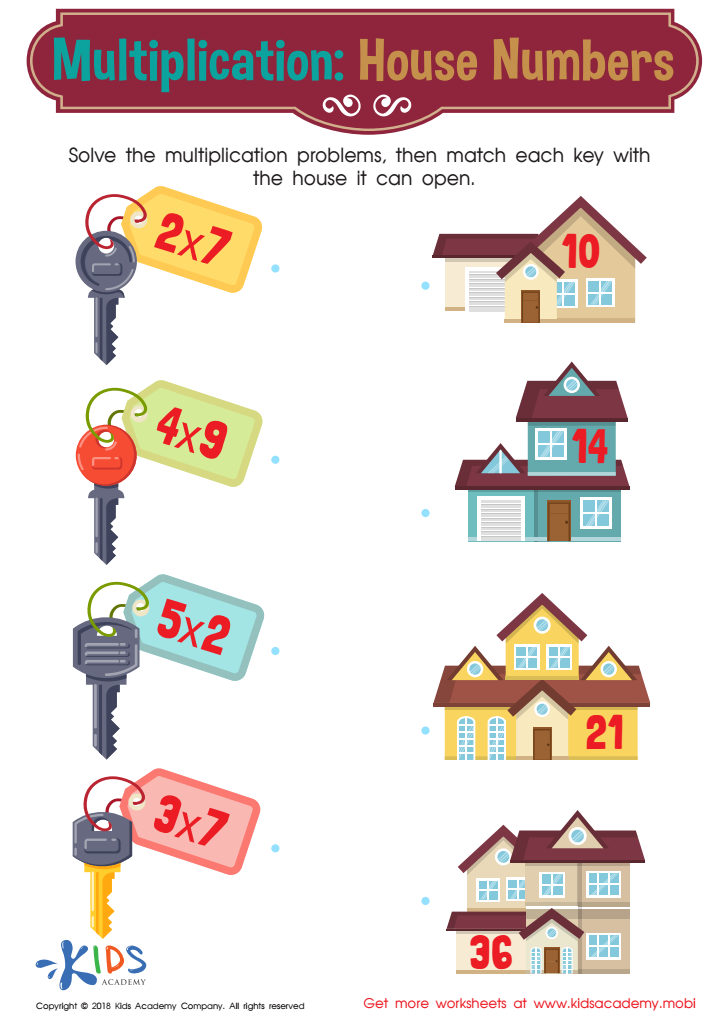
House Numbers Worksheet
This multiplication worksheet is perfect for grade 3 students to sharpen their math skills! Each problem unlocks the door to a house on the page - can they figure out which key fits which door? By solving each problem, they'll boost their multiplication skills and have fun along the way.
House Numbers Worksheet
Worksheet
Join Kids Academy for Free
Who is primarily going to use this learning content?








Number recognition and easy matching are foundational skills in early mathematics education that are particularly vital for children aged 7-9. During this developmental stage, children are transitioning from basic number understanding to more complex mathematical concepts. Proficient number recognition fosters confidence and fluency in reading and writing numbers, which is essential for further mathematical learning.
Parents and teachers should prioritize this skill as it enhances children's ability to engage with math in everyday situations, like telling time, managing money, or measuring ingredients for a recipe. Furthermore, easy matching activities encourage cognitive development by fostering critical thinking and pattern recognition. These exercises can help children make connections between quantities and their symbolic representations, reinforcing their understanding of numbers.
Additionally, strong number recognition skills directly support arithmetic operations, positioning students for success in more advanced math topics in later grades. Incorporating fun and engaging activities, like games or visual aids, can transform learning into an enjoyable experience, encouraging children to develop a positive relationship with math. For these reasons, nurturing number recognition and matching skills should be a key focus for parents and educators alike, setting the stage for lifelong mathematical competence.








