
Shape Recognition Easy Worksheets for 8-Year-Olds
11 filtered results
Difficulty Level
Grade
Age
-
From - To
Subject
Activity
Standards
Discover our engaging Shape Recognition Easy Worksheets specially designed for 8-year-olds! These worksheets provide a fun and interactive way for children to learn about different shapes, helping to enhance their critical thinking and observation skills. Featuring colorful illustrations and diverse activities, kids will enjoy identifying, matching, and categorizing shapes while boosting their confidence in geometry. Ideal for both classroom and at-home learning, our printable resources promote creativity and cognitive growth. Encourage your child's love for learning with our easy-to-use worksheets that make shape recognition an enjoyable journey. Start shaping your child's understanding of geometry today!
Favorites
With answer key
Interactive
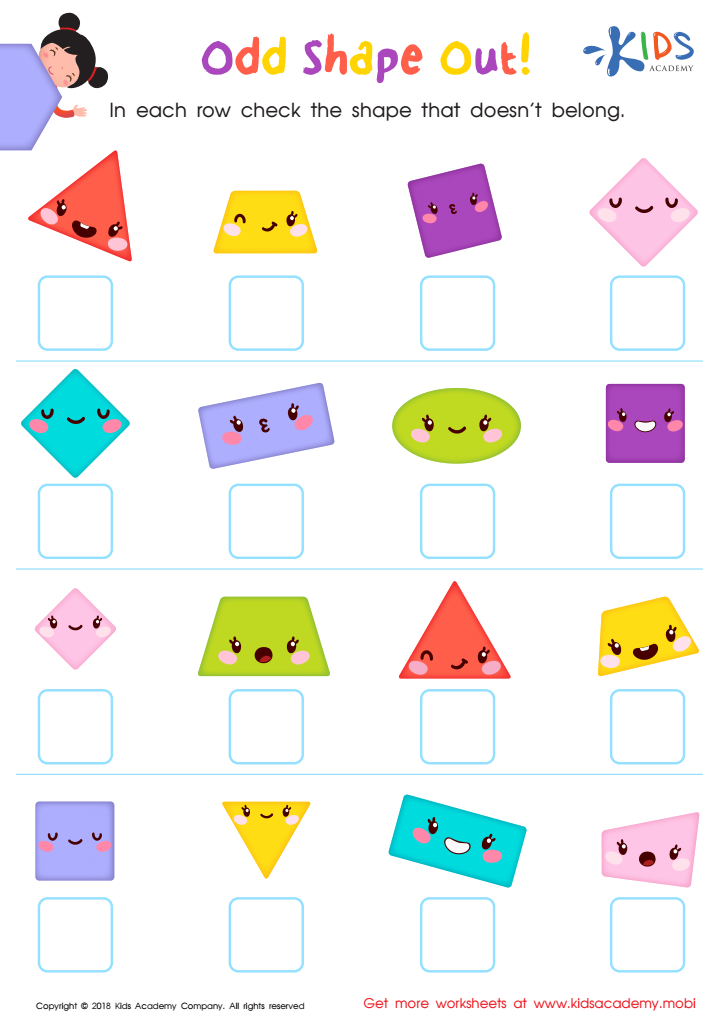
Odd Shape Out Worksheet for Grade 3
Time to test your child's shape knowledge! With this worksheet, help them find the odd shape out in each row and check the box under it. Print out the pdf and look through it with them – each row has four brightly colored shapes. See if they can spot any differences among them and then check the box below the shape that does not belong.
Odd Shape Out Worksheet for Grade 3
Worksheet
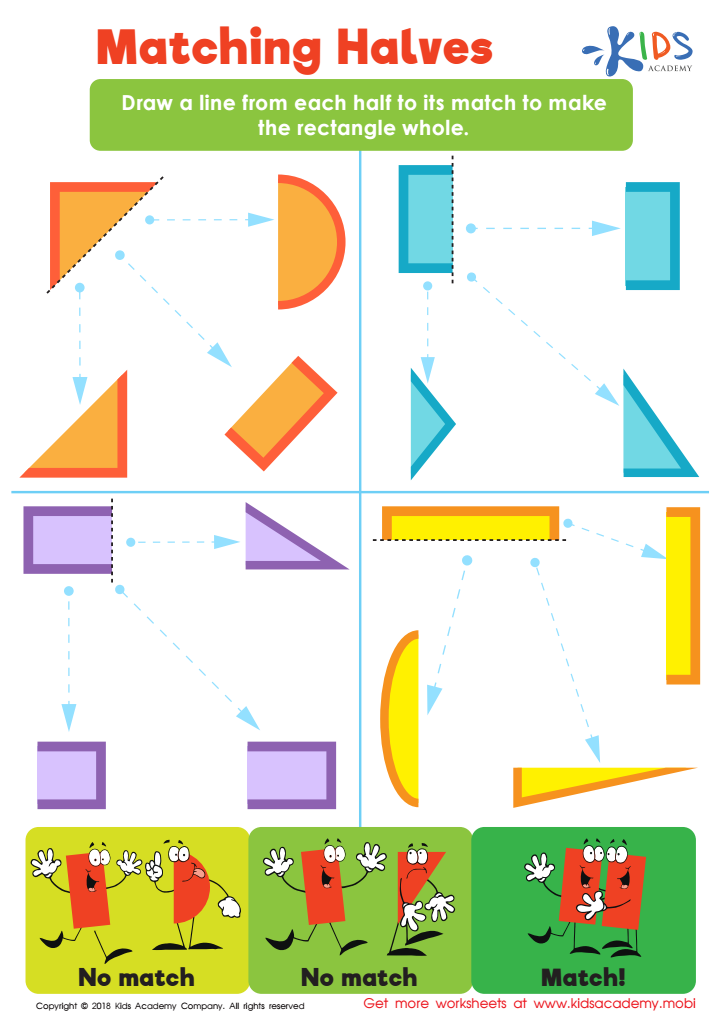
Matching Halves Worksheet
See how your child fares in matching two halves to form a complete rectangle. Provide them with four options, and ask them to draw a line connecting the two correct halves. Put their shape knowledge to the test with this simple worksheet!
Matching Halves Worksheet
Worksheet
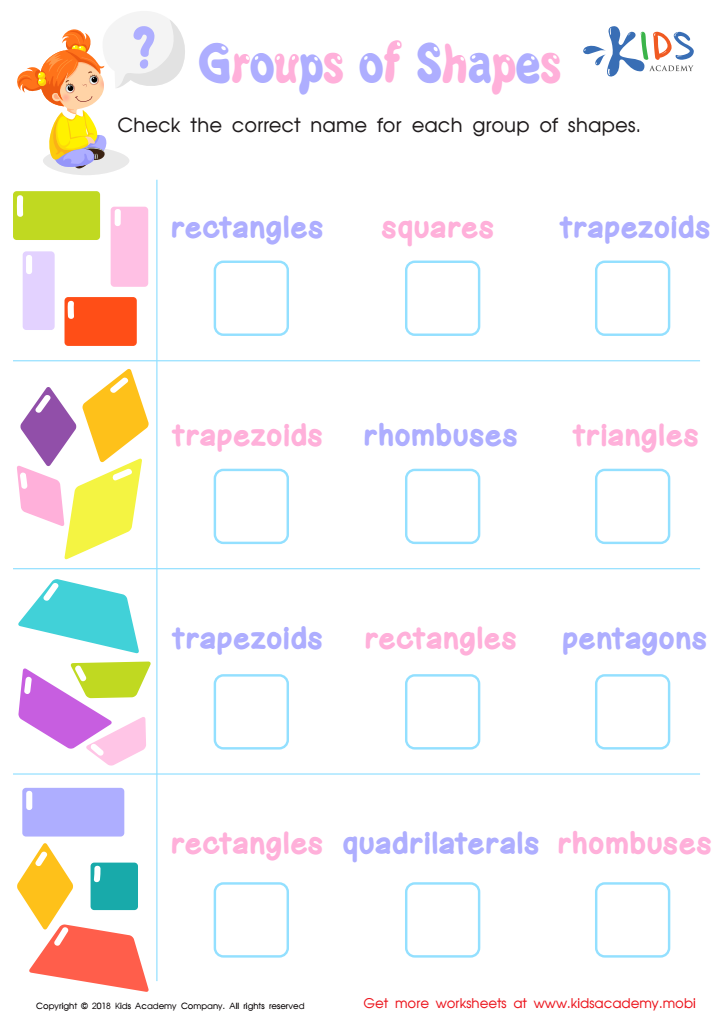
Groups of Shapes Worksheet
Can your child identify and name shapes? Help them learn the unique features of each and have them check the correct name for each group in the colorful pictures on this worksheet.
Groups of Shapes Worksheet
Worksheet
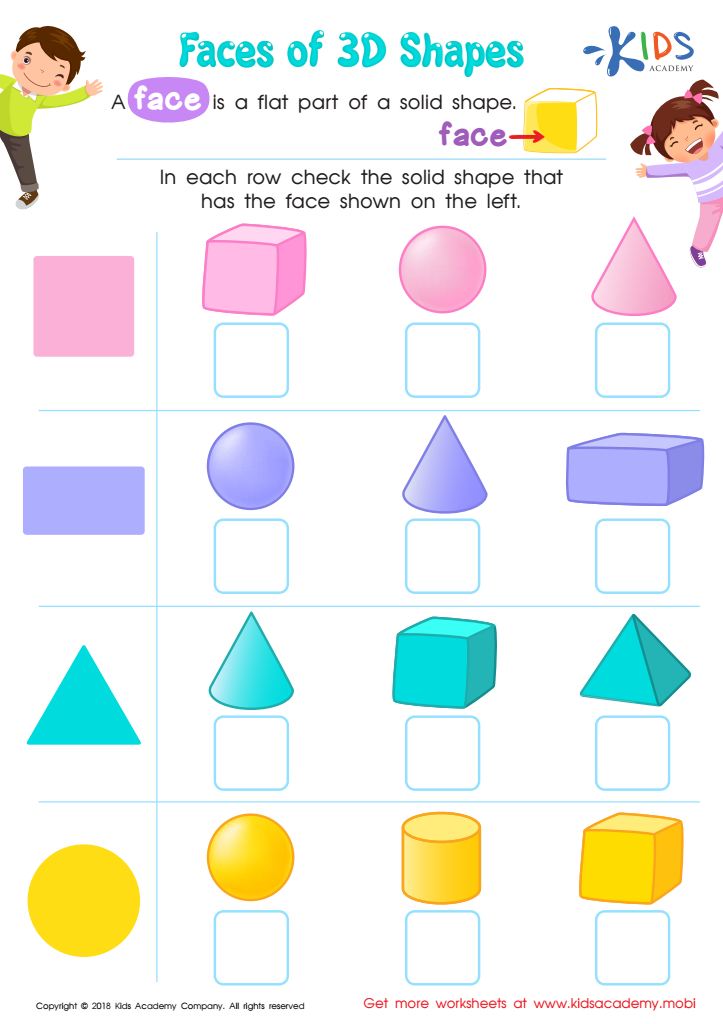
Faces of 3D Shapes Worksheet
Point at random body parts and ask your child to name them. Point to their face and ask them to identify it. Use this worksheet to show how "face" doesn't just refer to body parts - it can also mean the flat surface of a solid shape. Check the picture to find the matching solid shape for each face shown.
Faces of 3D Shapes Worksheet
Worksheet
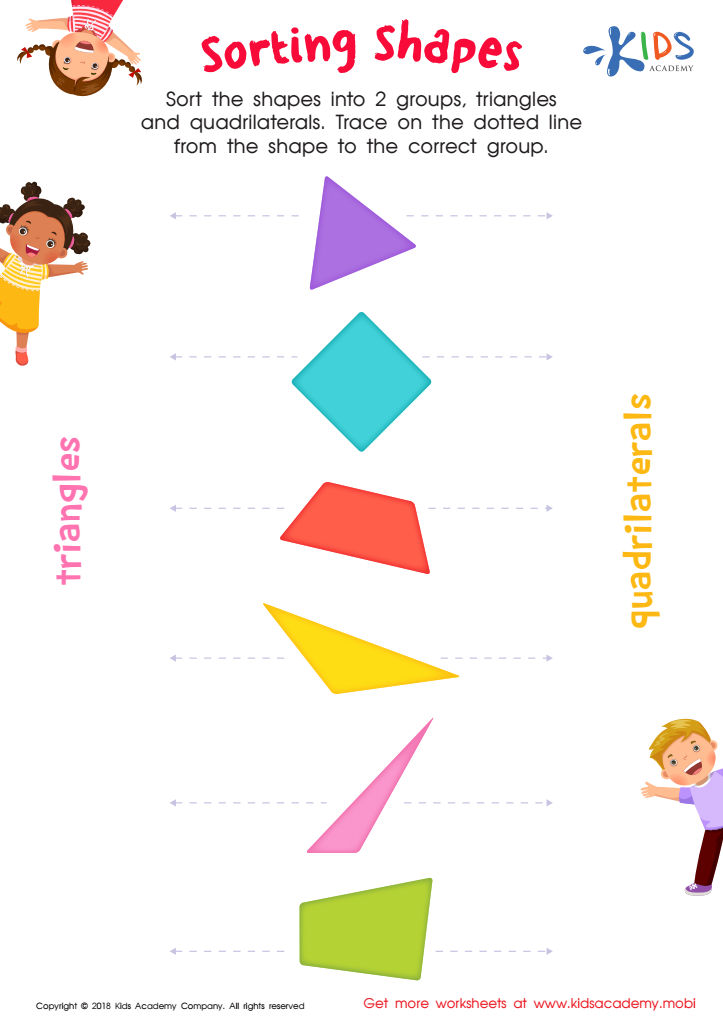
Sorting Shapes Worksheet
Before beginning, ensure your child is familiar with quadrilaterals (4 sides) and triangles (3 sides). This tracing exercise is easy: sort the shapes into the two groups and trace the dotted lines to the correct group.
Sorting Shapes Worksheet
Worksheet
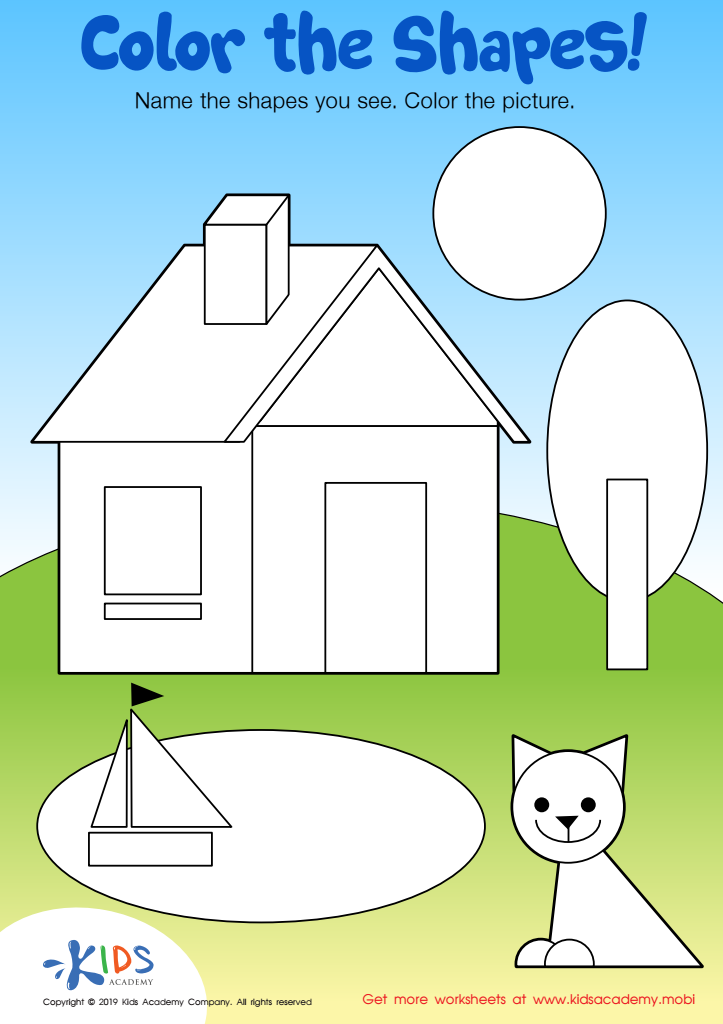
Color the Shapes Worksheet
Help your student master shape identification with this fun worksheet. Ask them to name the shapes in the picture, then color it! Ask questions like "How many squares do you see?" and "How many triangles?" to extend the learning. Identify squares, circles, triangles and rectangles with this enjoyable coloring page.
Download (PDF)
 Assign to My Students
Assign to My Students
Color the Shapes Worksheet
Worksheet
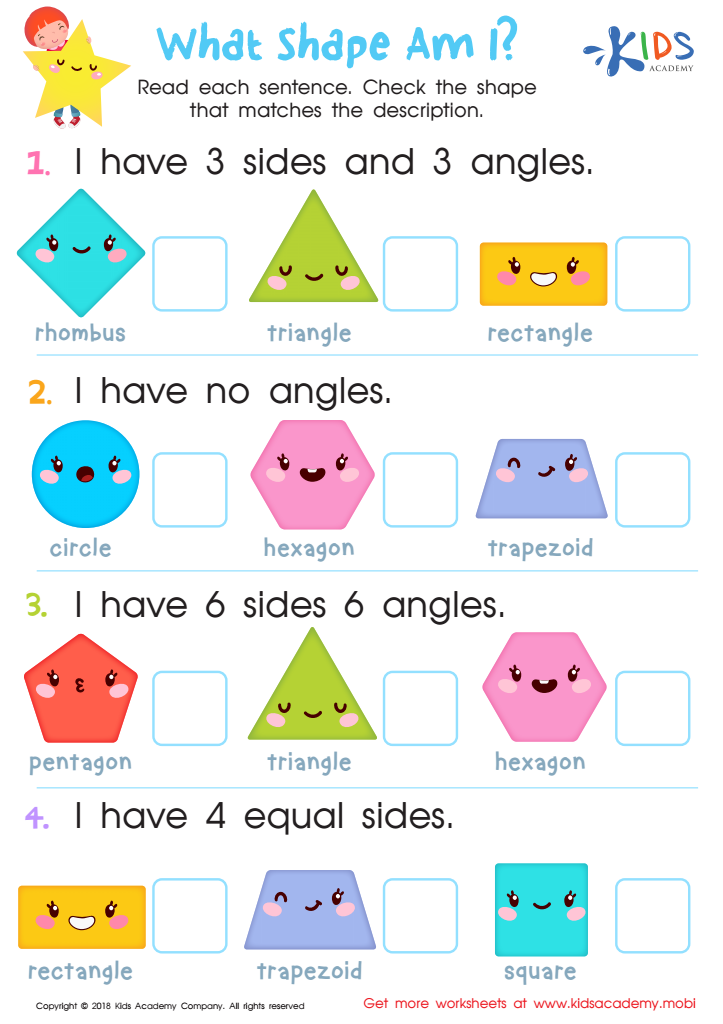
What Shape Am I? Worksheet
Help your child read each sentence in this colorful worksheet. Have them identify the shapes described and check the boxes. To prepare, ask simple questions like "How many sides does a triangle have?" and "Which shape has 4 equal sides?" Your child will become more skilled at shapes by the end of this activity.
What Shape Am I? Worksheet
Worksheet
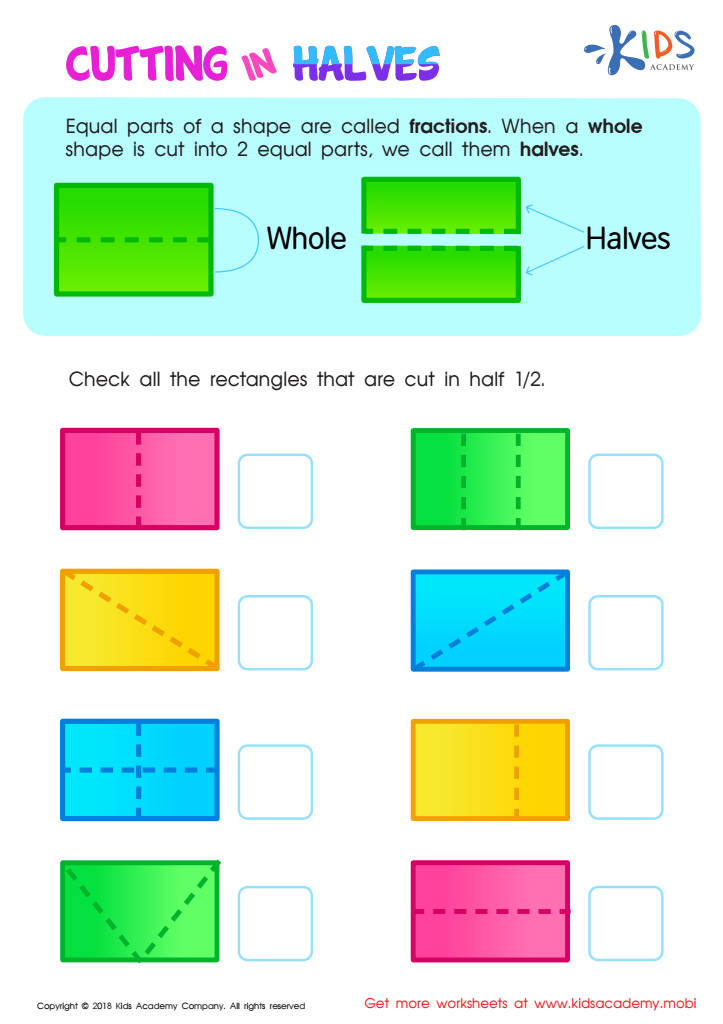
Cutting in Halves Worksheet
Show your child how to divide a whole shape, like a square, into smaller pieces to become fractions. Point out when a shape is divided into two equal parts, it's called a half. Look at the worksheet together, and identify all rectangles that are cut in half (½).
Cutting in Halves Worksheet
Worksheet
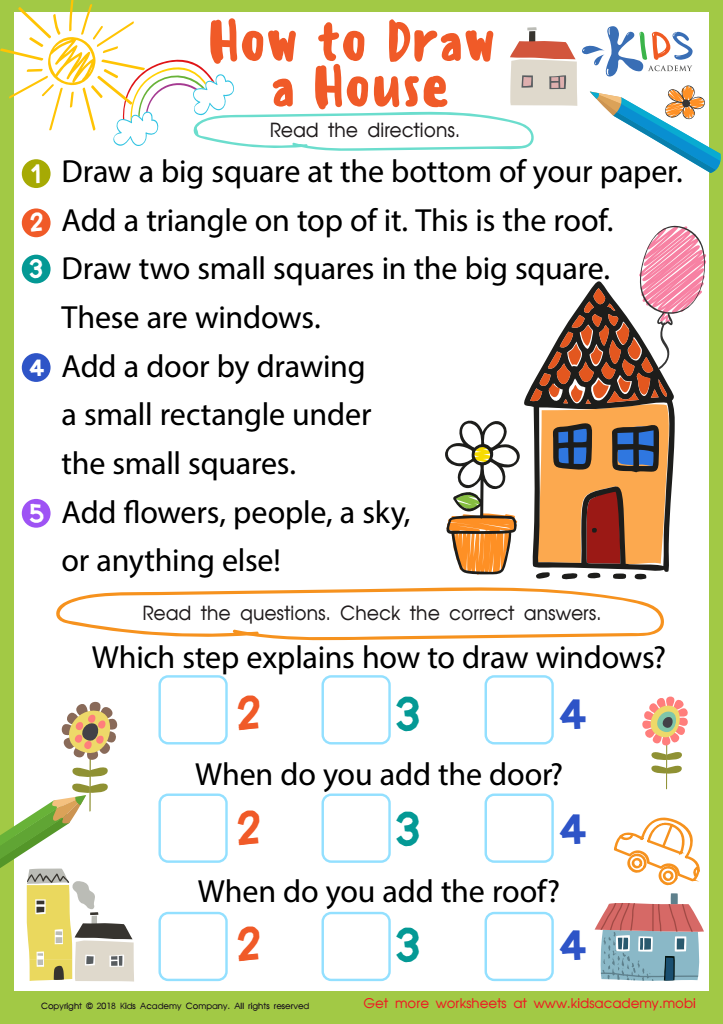
How to Draw House Worksheet
Does your child love to draw? Why not try teaching them some easy tricks? Get them to follow directions on this worksheet and learn how to draw a house. Read the questions at the end and ensure they get the answers right. Your kids will surely love it!
How to Draw House Worksheet
Worksheet
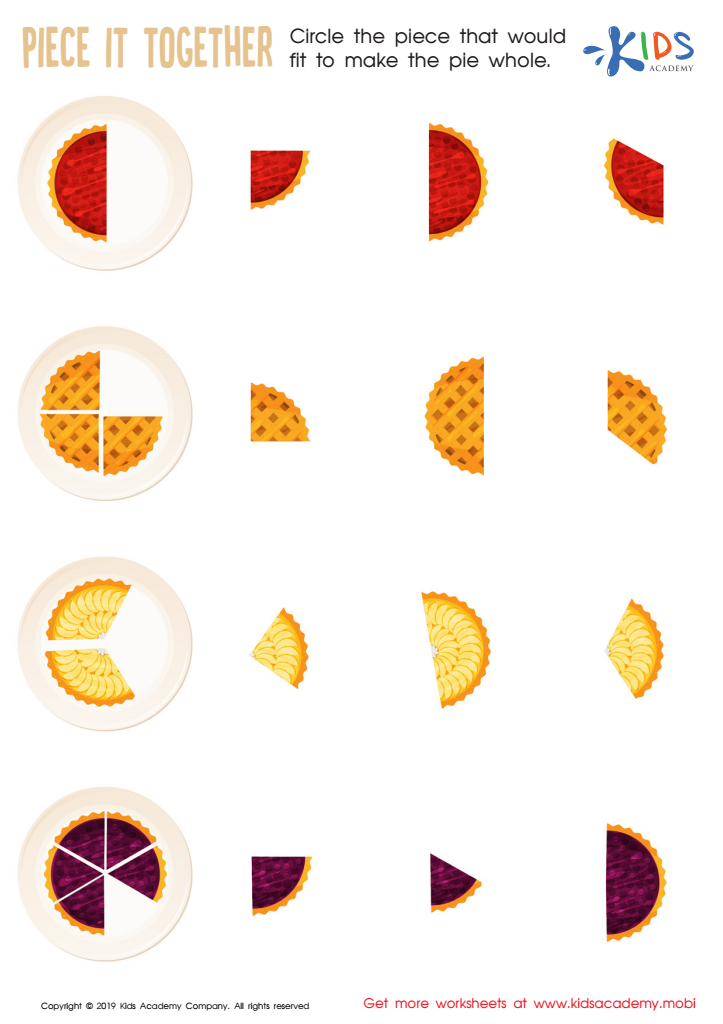
Piece it together Worksheet
Help your kids learn fractions! Even if they're not eager, teach them as they get older. Teachers will provide enough lessons and homework, but you can go a step further. Look at a worksheet with your kids and help them circle the piece that would make the pie whole.
Piece it together Worksheet
Worksheet
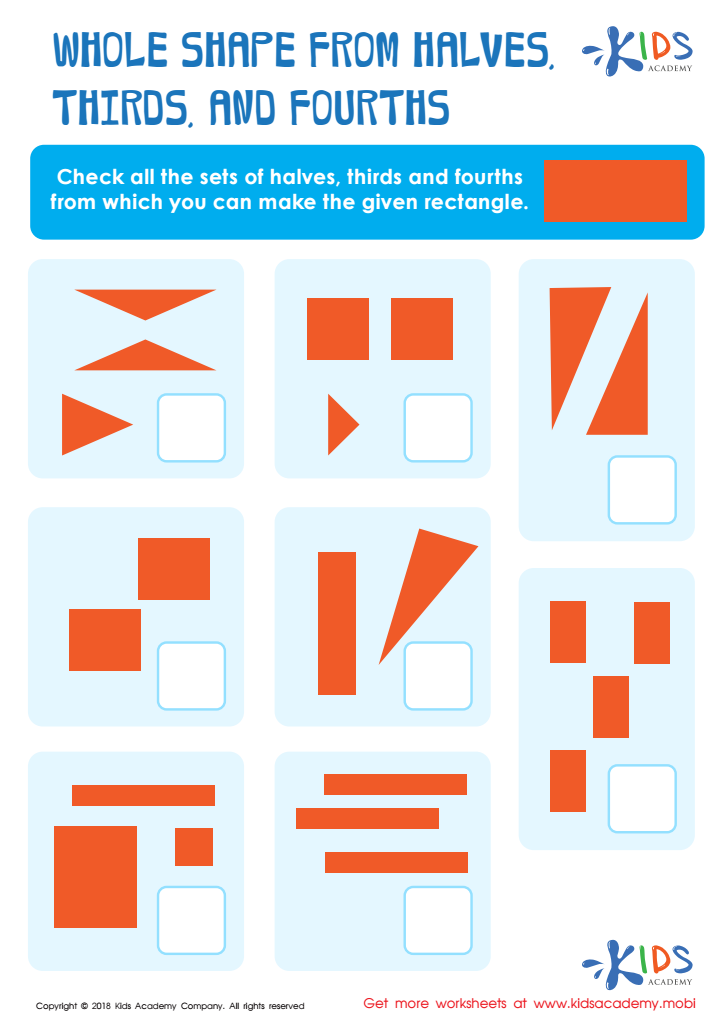
Whole Shape from Halves, Thirds and Fourths Worksheet
Explain to your students that they can make a new shape by combining halves, thirds, and fourths of a shape. Show them the worksheet with the rectangle at the top and ask them to find which sets of halves, thirds, and fourths make it. Have them check all the correct sets.
Whole Shape from Halves, Thirds and Fourths Worksheet
Worksheet
Join Kids Academy for Free
Who is primarily going to use this learning content?






Shape recognition is a fundamental skill in early childhood education that lays the groundwork for various cognitive processes. For 8-year-olds, mastering shape recognition cultivates critical thinking and spatial awareness, which are essential for problem-solving and understanding the world around them. It enhances their ability to categorize and differentiate objects, promoting observational and analytical skills.
In daily life, shape recognition is vital; it assists children in reading, writing, and even mathematics. Recognizing shapes helps them understand geometric concepts, leading to a better grasp of more advanced mathematical concepts later on, such as area and perimeter. Additionally, strong shape recognition abilities contribute to artistic skills, allowing children to create and comprehend visual arts.
For parents and teachers, nurturing shape recognition ensures that children are well-prepared for future learning. It offers the chance to create engaging activities that make learning enjoyable while fostering a love for exploration and discovery. Encouraging this skill socially can also enhance children's communication proficiency as they learn to describe and discuss their observations with others. Investing time in developing shape recognition ultimately supports a child’s holistic development, setting a strong foundation for lifelong learning.








