
Shape Recognition Easy Worksheets for 9-Year-Olds
4 filtered results
Difficulty Level
Grade
Age
-
From - To
Subject
Activity
Standards
Discover our engaging Shape Recognition Easy Worksheets designed specifically for 9-year-olds! These fun and interactive resources help children master essential geometry skills while enhancing critical thinking and visual perception. Our worksheets incorporate a variety of activities, from identifying shapes to applying them in real-life contexts, making learning enjoyable and effective. Perfect for classroom use or at-home practice, these printable worksheets support your child's growth and confidence in recognizing and manipulating shapes. With clear instructions and colorful illustrations, they're sure to captivate young learners’ attention. Foster a strong foundation in math today with our age-appropriate shape recognition resources!
Favorites
With answer key
Interactive
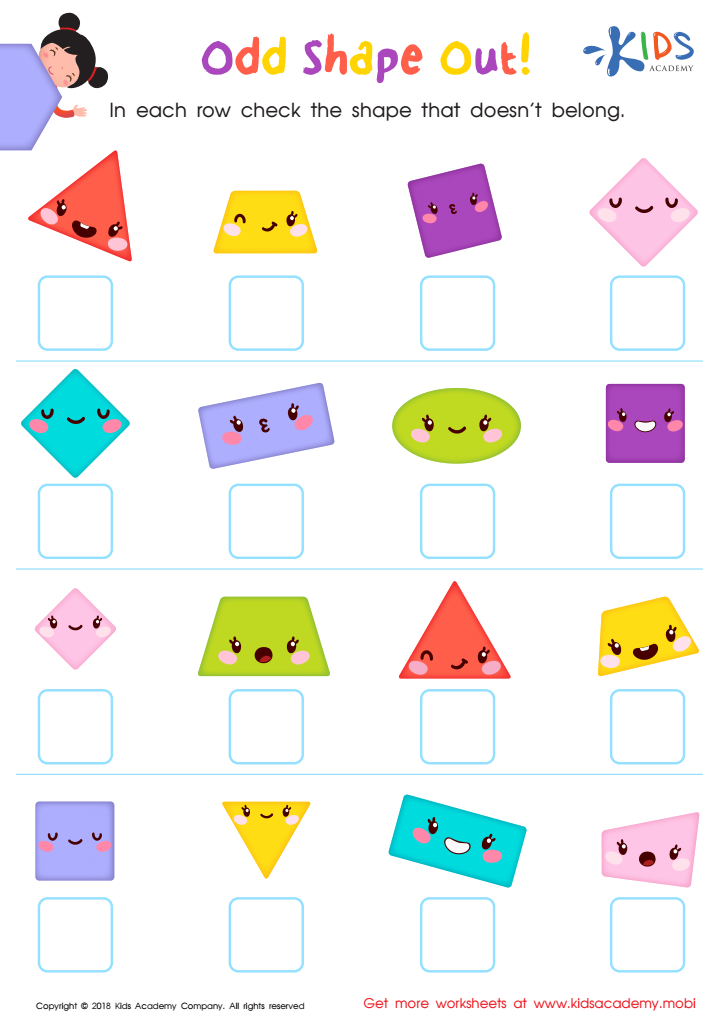
Odd Shape Out Worksheet for Grade 3
Time to test your child's shape knowledge! With this worksheet, help them find the odd shape out in each row and check the box under it. Print out the pdf and look through it with them – each row has four brightly colored shapes. See if they can spot any differences among them and then check the box below the shape that does not belong.
Odd Shape Out Worksheet for Grade 3
Worksheet
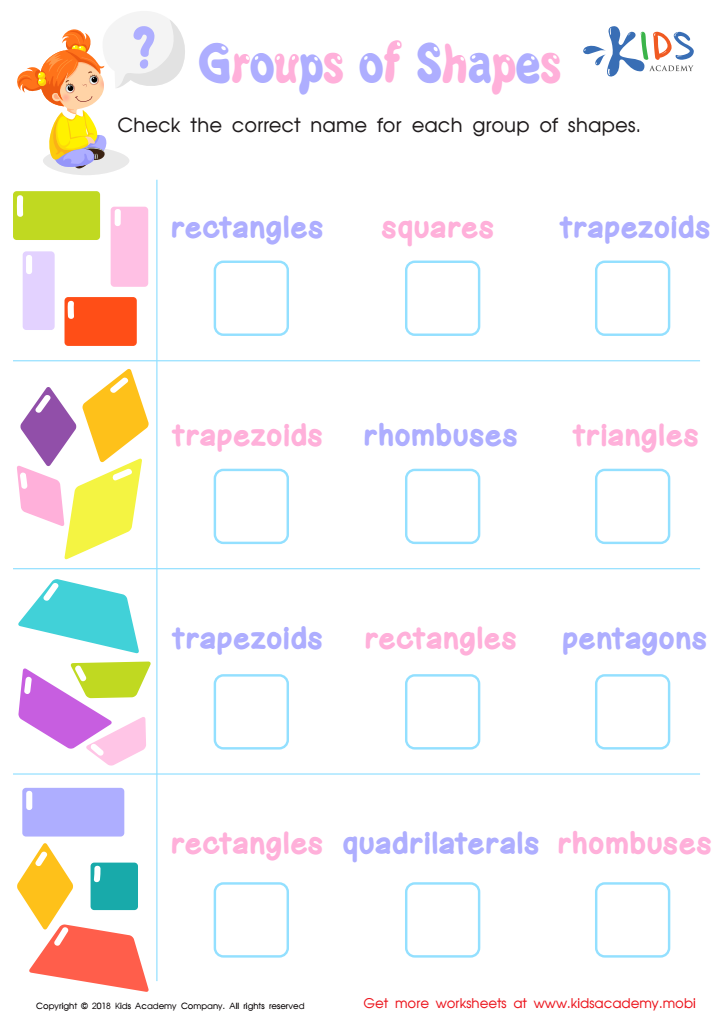
Groups of Shapes Worksheet
Can your child identify and name shapes? Help them learn the unique features of each and have them check the correct name for each group in the colorful pictures on this worksheet.
Groups of Shapes Worksheet
Worksheet
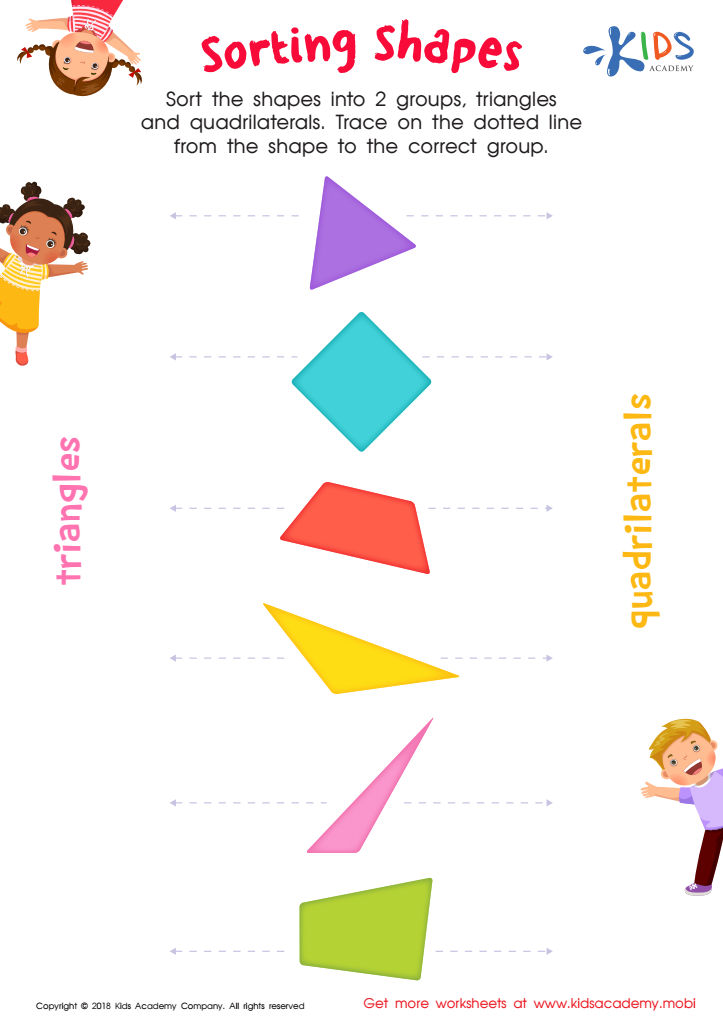
Sorting Shapes Worksheet
Before beginning, ensure your child is familiar with quadrilaterals (4 sides) and triangles (3 sides). This tracing exercise is easy: sort the shapes into the two groups and trace the dotted lines to the correct group.
Sorting Shapes Worksheet
Worksheet
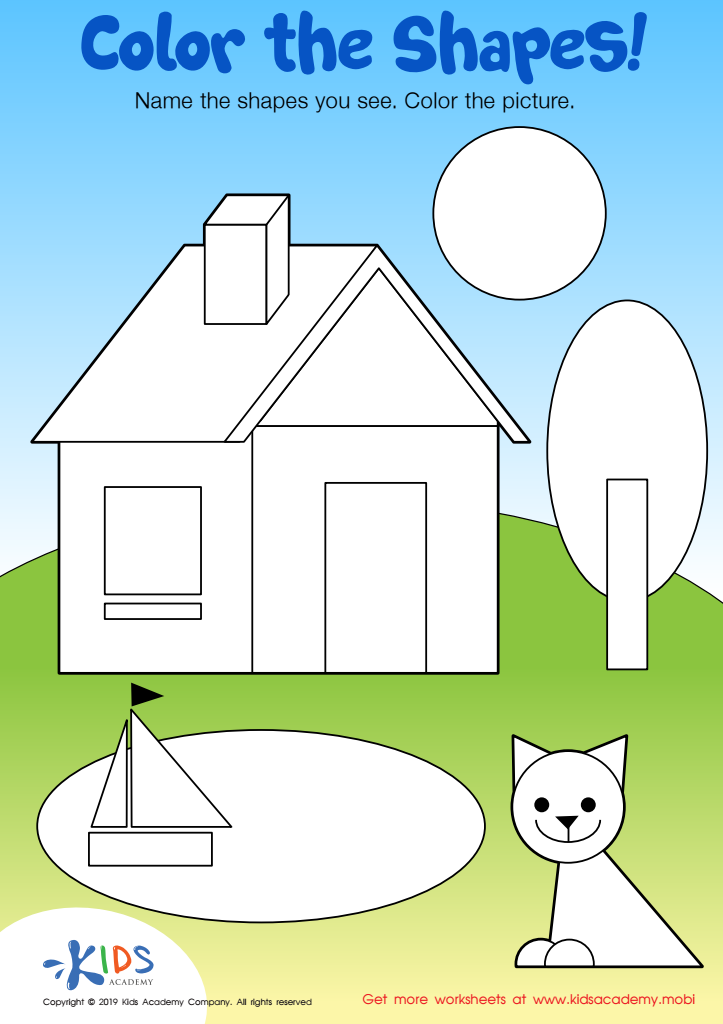
Color the Shapes Worksheet
Help your student master shape identification with this fun worksheet. Ask them to name the shapes in the picture, then color it! Ask questions like "How many squares do you see?" and "How many triangles?" to extend the learning. Identify squares, circles, triangles and rectangles with this enjoyable coloring page.
Download (PDF)
 Assign to My Students
Assign to My Students
Color the Shapes Worksheet
Worksheet
Join Kids Academy for Free
Who is primarily going to use this learning content?







Shape recognition is a crucial developmental milestone for 9-year-olds, laying the foundation for advanced mathematical and spatial reasoning skills. It helps children identify, classify, and understand various geometric shapes, enhancing their ability to visualize and manipulate objects in 2D and 3D spaces.
When parents and teachers prioritize shape recognition, they facilitate critical cognitive development, which is essential for problem-solving and analytical thinking. This skill also supports the understanding of more complex mathematical concepts, such as area, perimeter, and volume, as children progress in their education.
Moreover, shape recognition plays a vital role in everyday life, from understanding architecture to navigating spaces and planning artwork. By emphasizing this skill, adults foster creativity and spatial awareness, which are valuable in fields such as art, engineering, and science.
Additionally, engaging in shape recognition can strengthen fine motor skills, as children often manipulate physical shapes during activities. When parents and teachers incorporate fun, hands-on activities—like building structures or participating in shape-focused games—they make learning enjoyable, which can increase a child's enthusiasm for mathematics and problem-solving.
Ultimately, fostering shape recognition not only supports academic achievement but also empowers children to engage with their environment confidently and creatively.








