Basic Math Skills Easy Fractions of Shapes Worksheets
4 filtered results
Difficulty Level
Grade
Age
-
From - To
Subject
Activity
Standards
Explore our engaging Basic Math Skills Easy Fractions of Shapes Worksheets designed for young learners! These printable resources help children understand and visualize fractions through interactive activities that involve various shapes. Our worksheets simplify fractional concepts, making learning fun and approachable. Students will practice identifying, coloring, and creating fractions to build their confidence in math. Perfect for homeschooling or classroom use, these worksheets foster essential skills while encouraging critical thinking. Help your child develop a strong mathematical foundation with our thoughtfully designed exercises that emphasize hands-on learning through shapes and fractions. Get started today and watch their skills soar!
Favorites
With answer key
Interactive
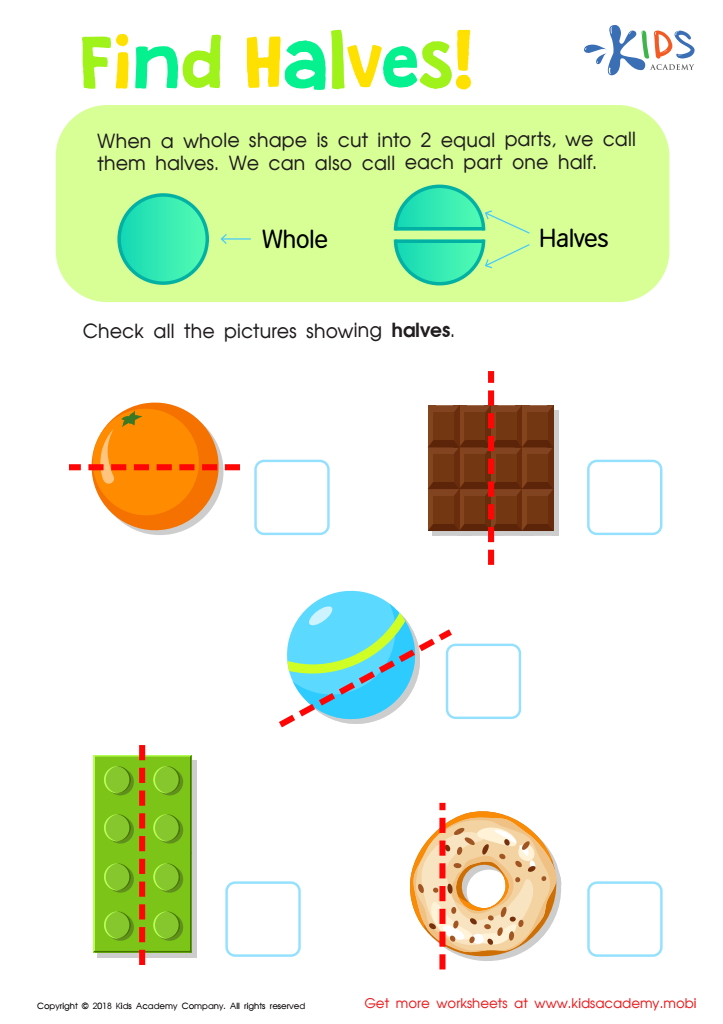
Find Halves Worksheet
If your child can tell you what two, three and four equal parts are called, give yourself a pat on the back! If not, this worksheet can help. Halves are two equal parts of a whole shape. Check the pictures in this printable pdf to help your child understand.
 Assign to My Students
Find Halves Worksheet
Worksheet
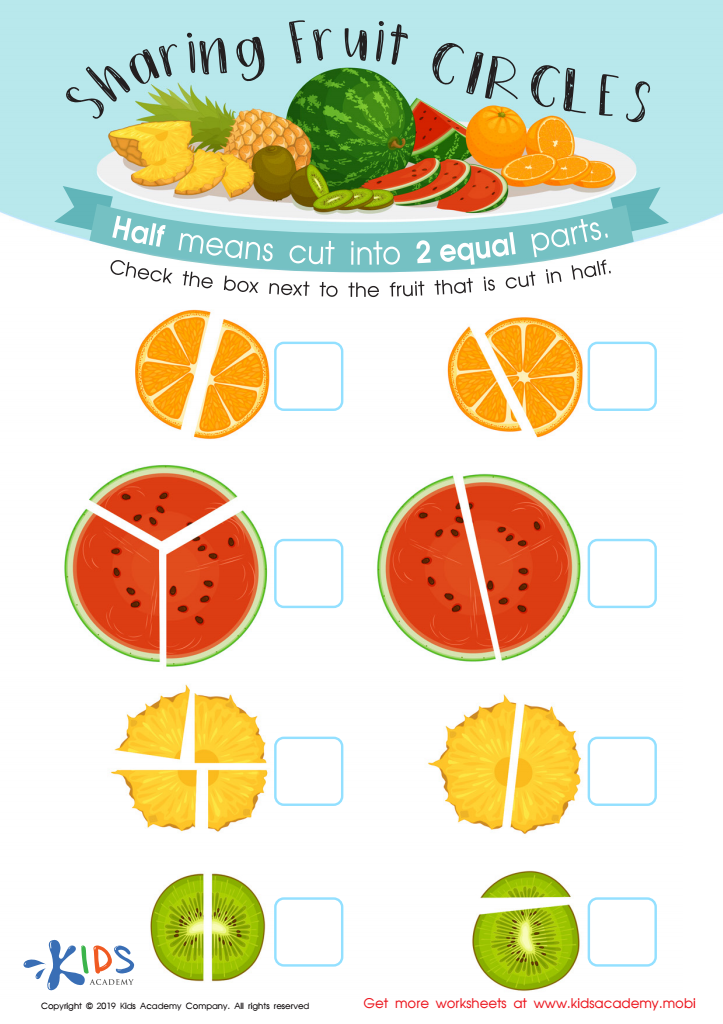
Sharing Fruit Circles Worksheet
Fruits are tasty and bright! Can your kids name some of their favorites? With this worksheet, you can use fruit to teach your kids geometry. Talk about how shapes can be cut into halves. Ask them to tick the box for the fruit halves in the printout.
Sharing Fruit Circles Worksheet
Worksheet
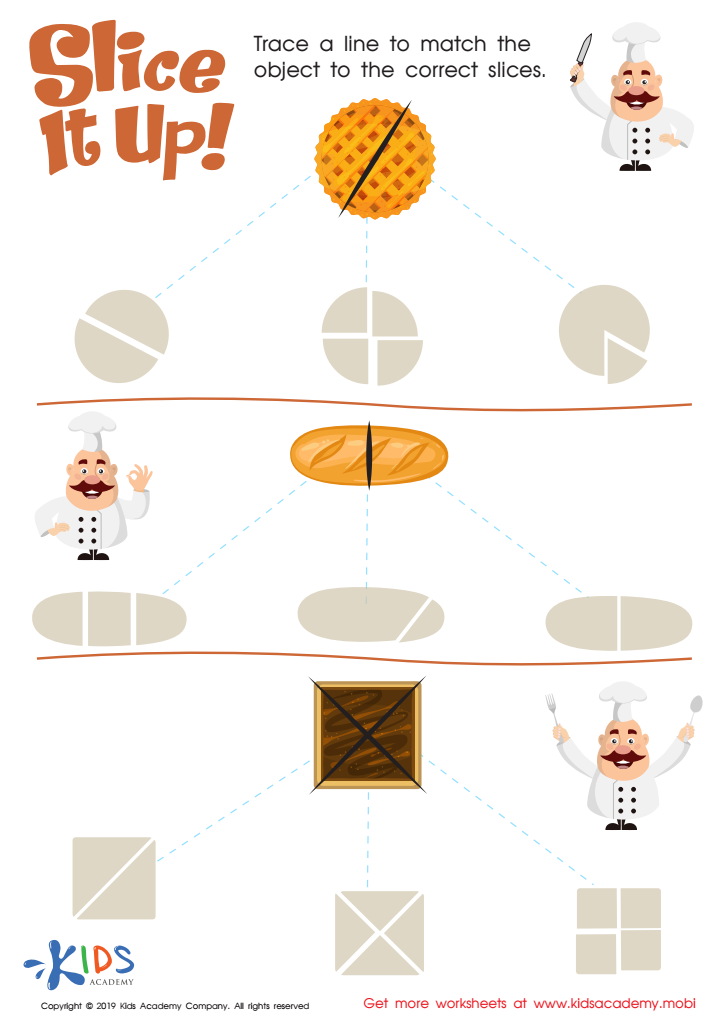
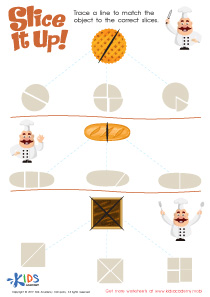
Slice It Up Worksheet
Try this fun math, reading and writing worksheet with your kids! They will love the colorful activities that perfect coordination and tracing. Engaging learning exercises help keep young minds sharp and boost skills. With these worksheets, your kids will be academically ahead of the curve!
Slice It Up Worksheet
Worksheet
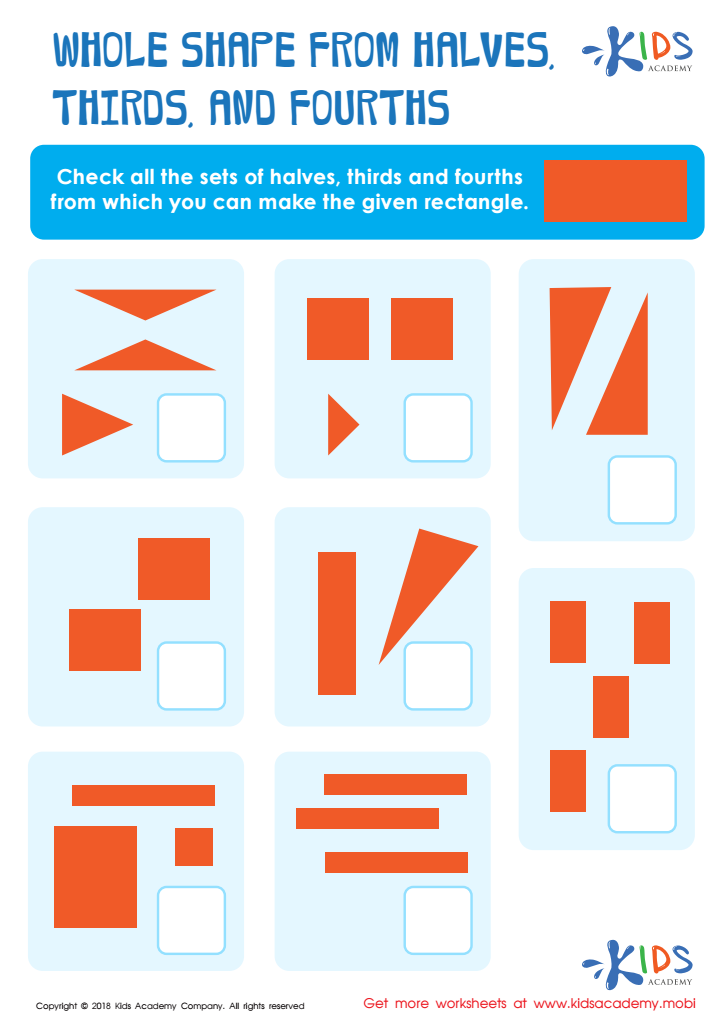
Whole Shape from Halves, Thirds and Fourths Worksheet
Explain to your students that they can make a new shape by combining halves, thirds, and fourths of a shape. Show them the worksheet with the rectangle at the top and ask them to find which sets of halves, thirds, and fourths make it. Have them check all the correct sets.
Whole Shape from Halves, Thirds and Fourths Worksheet
Worksheet
Join Kids Academy for Free
Who is primarily going to use this learning content?







Basic math skills, including easy fractions of shapes, are fundamental building blocks for children’s understanding of mathematics. When parents and teachers emphasize the importance of these skills, they provide students with the necessary tools to grasp more complex concepts later on. Recognizing fractions of shapes helps children develop critical thinking and problem-solving abilities, as they learn to quantify parts of a whole in tangible ways.
Moreover, understanding fractions enhances children's spatial awareness and promotes creativity. Engaging with fractions through shapes fosters a hands-on learning experience where students can manipulate physical objects, making abstract concepts more relatable and comprehensible. This experiential learning can lead to greater student engagement and motivation.
Furthermore, mastery of basic fractions lays the groundwork for real-world applications. Everyday situations, from cooking to shopping, often involve fractional reasoning. By nurturing these skills early on, parents and teachers equip children with practical knowledge they will use throughout their lives.
Overall, integrating easy fractions of shapes into early education sets students on a path for academic success, fosters enthusiasm for mathematics, and cultivates useful life skills. Prioritizing these foundational lessons is essential in helping children become confident and proficient in their mathematical journeys.