Basic geometry understanding Extra Challenge Geometry Worksheets for Ages 3-7
3 filtered results
Difficulty Level
Grade
Age
-
From - To
Subject
Activity
Standards
Explore our "Basic Geometry Understanding Extra Challenge Worksheets" designed for ages 3-7. These engaging and interactive worksheets aim to enhance young learners' grasp of fundamental geometry concepts. Children will enjoy fun activities that involve shapes, angles, and spatial awareness, fostering creativity and critical thinking. Our resources are tailored to suit different learning styles, making geometry accessible and enjoyable for every child. Perfect for teachers and parents alike, these extra challenge worksheets provide stimulating practice that reinforces classroom learning. Help your little ones build a strong foundation in math and geometry with our captivating and educational materials!
Favorites
With answer key
Interactive
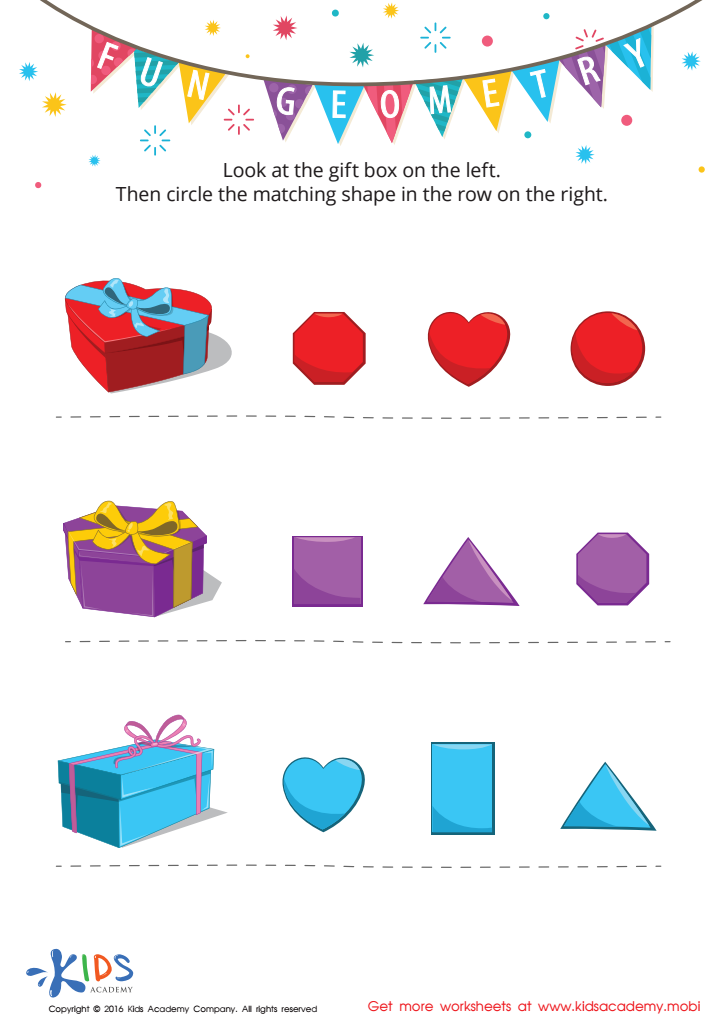
Fun Geometry Worksheet
Give your child the gift of learning with this fun and educational geometry matching worksheet! It'll help them develop essential matching and problem-solving skills while having fun. Vibrant pictures will excite them to complete it and get a better grasp of the world around them.
 Assign to My Students
Fun Geometry Worksheet
Worksheet











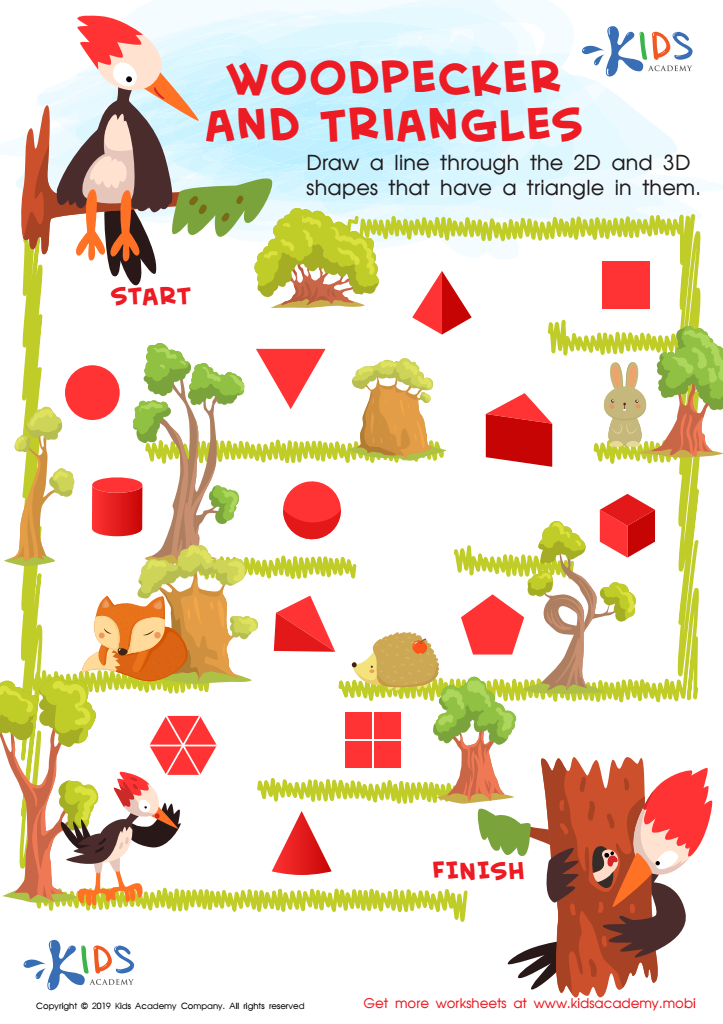
Woodpecker and Triangles Worksheet
Woodpeckers peck wood, and this printout helps kids learn about triangles. Ask your kindergartners to draw a triangle, then draw a line through the shapes that have a triangle in them to help the woodpecker get out of the maze.
Woodpecker and Triangles Worksheet
Worksheet
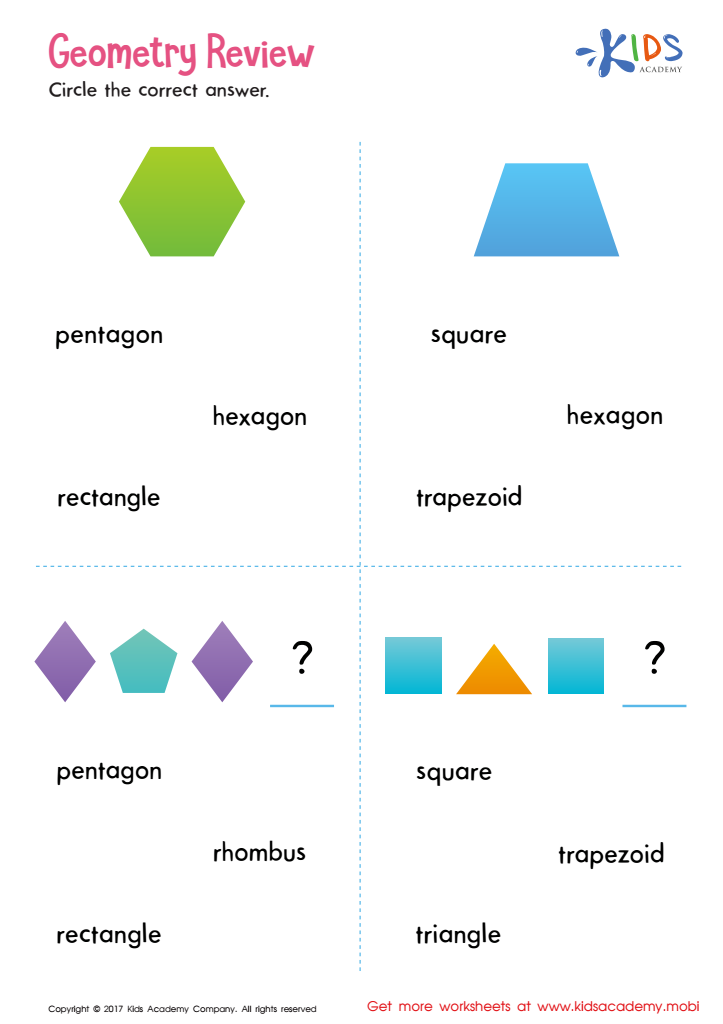
Geometry Review Printable
Repetition is key to success; give your child the practice they need with this geometry worksheet.
Geometry Review Printable
Worksheet
Join Kids Academy for Free
Who is primarily going to use this learning content?








Understanding basic geometry is essential for children ages 3-7, as it lays the foundation for essential mathematical skills they will encounter later in life. Parents and teachers should care deeply about incorporating geometry into early learning due to its numerous cognitive and developmental benefits.
Firstly, engaging with geometric concepts enhances spatial awareness. Young children typically explore their environments through play and manipulation of shapes, helping them recognize patterns and relationships. This foundational understanding is key for skills like problem-solving, critical thinking, and logical reasoning.
Secondly, geometric understanding fosters creativity and imagination. Through activities that involve shapes, such as building with blocks or drawing, children learn to visualize and construct ideas, which boosts their artistic expression and innovation.
Furthermore, geometry also promotes language development. As children describe shapes, sizes, and spatial relationships, they expand their vocabulary and communication skills, which are vital for academic success.
Lastly, early exposure to geometry instills a positive attitude toward math. By making learning interactive and enjoyable, children develop confidence in their abilities, reducing anxiety around mathematical concepts as they grow.
In conclusion, investing in geometric understanding for young learners equips them with crucial life skills that impact their overall educational journey.