Visual discrimination Extra Challenge Geometry Worksheets for Ages 3-7
3 filtered results
Difficulty Level
Grade
Age
-
From - To
Subject
Activity
Standards
Boost your child's geometry skills with our Visual Discrimination Extra Challenge Worksheets, designed specifically for ages 3-7! These engaging and age-appropriate printable worksheets help young learners develop critical visual discrimination abilities by identifying, comparing, and sorting various geometric shapes. Our activities provide fun and interactive ways to hone essential skills, fostering a strong mathematical foundation. Perfect for home or classroom use, these worksheets not only support cognitive development but also nurture a love for learning. Explore a variety of challenges that make geometry exciting while ensuring your child masters key concepts through visual recognition and analysis. Start their geometric journey today!
Favorites
With answer key
Interactive
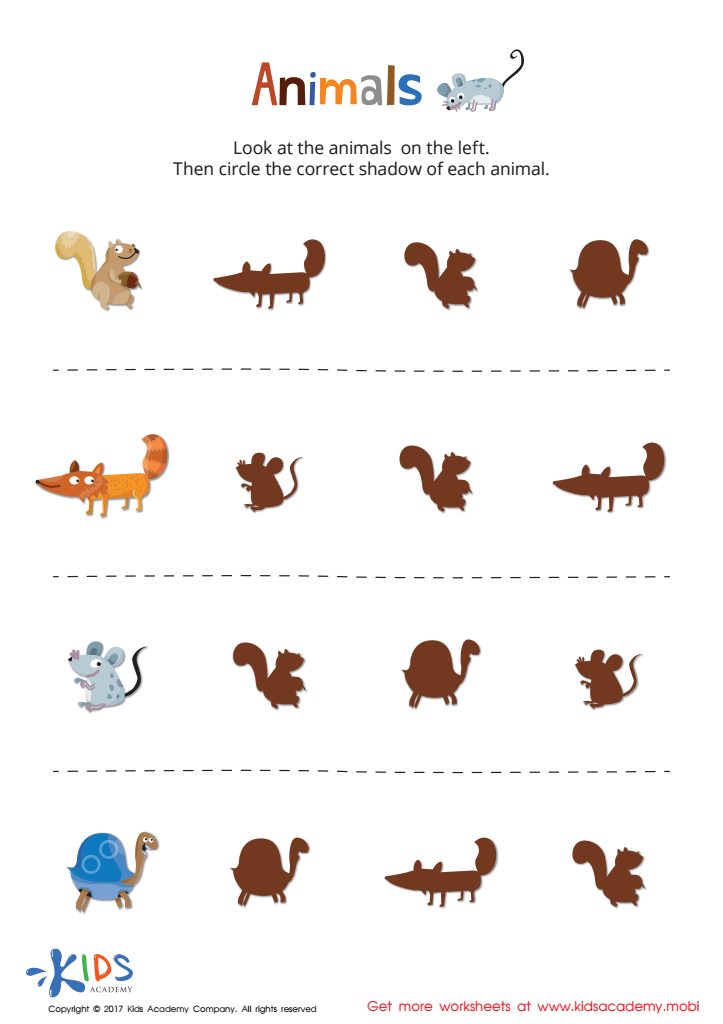
Animal Shadows Sorting Worksheet
This fun worksheet helps your child sharpen many skills. It features animals to match shapes and practice relative directions. Your child will sort animal features, practice spatial recognition, and recognize right/left. Plus, you can use it to start conversations about the animals. And try it also with fruits and veggies to boost sorting skills.
 Assign to My Students
Animal Shadows Sorting Worksheet
Worksheet











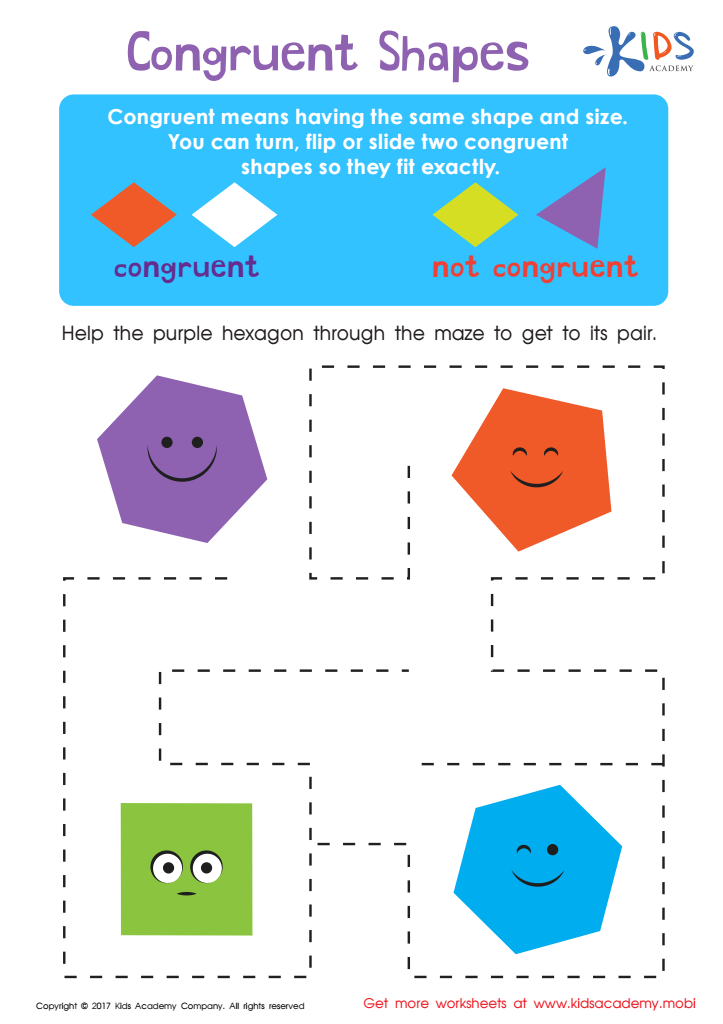
Congruent Shapes Worksheet
Help your child find the twin of the purple hexagon! This congruent shapes worksheet is great for increasing vocabulary while challenging mental rotation skills.
Congruent Shapes Worksheet
Worksheet
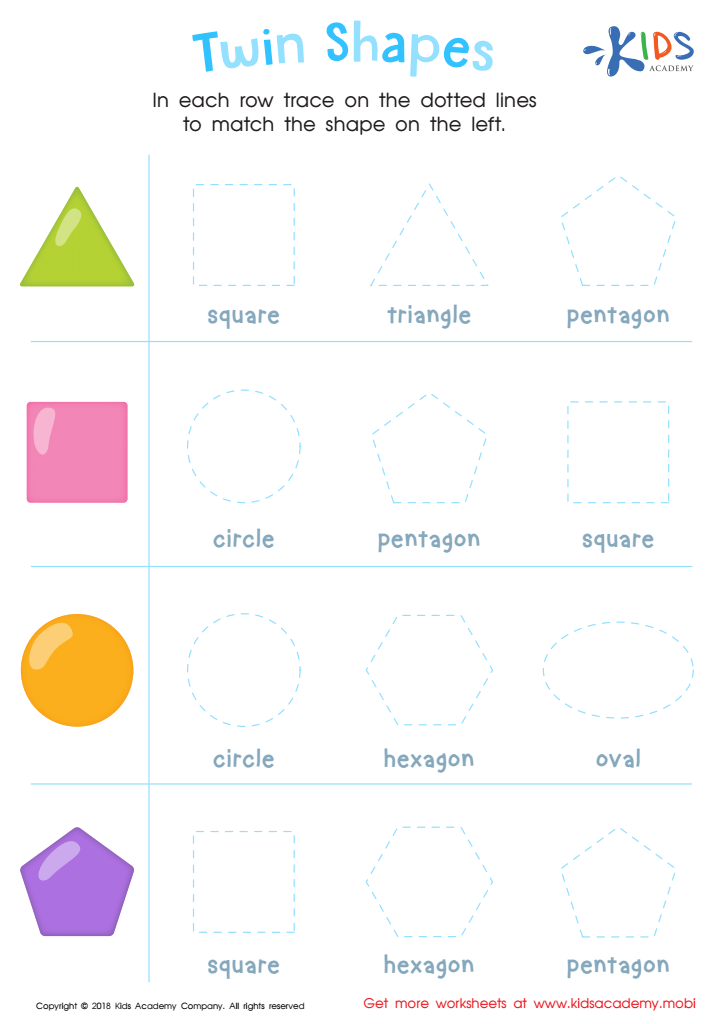
Twin Shapes Dot-to-Dot Worksheet
Test your child's ability to copy with this worksheet. Ask them to find and name the four shapes on the left. Then, they must match each with the dotted lines on the right. Help your child with all four shapes in this fun exercise.
Twin Shapes Dot-to-Dot Worksheet
Worksheet
Join Kids Academy for Free
Who is primarily going to use this learning content?








Visual discrimination is a crucial skills development area for children aged 3-7 that significantly influences their cognitive, academic, and social growth. Engaging with Visual Discrimination Extra Challenge Geometry helps young learners distinguish between different shapes, sizes, and spatial relationships. This foundational skill is vital as it serves as a precursor to math, reading, and critical thinking.
Parents and teachers should care about this program because it enriches children's understanding of geometric concepts, promoting early mathematical skills. As students learn to identify shapes and their properties, they harness problem-solving abilities and develop logical thinking, paving the way for more complex subjects later on.
Moreover, visual discrimination enhances fine motor skills and can improve concentration and attention to detail. These skills are transferable to various learning scenarios, enriching children’s overall educational experiences. Additionally, engaging in geometry-related activities fosters collaboration and communication among peers, nurturing social skills.
Investing time in Visual Discrimination Extra Challenge Geometry not only supports academic readiness but also empowers children to explore and make sense of the world around them creatively and critically, thus cultivating well-rounded learners prepared for future educational pursuits. For parents and teachers alike, nurturing these skills is a vital investment in a child’s holistic development.