
Spatial awareness Extra Challenge Geometry Worksheets for Ages 3-8
5 filtered results
Difficulty Level
Grade
Age
-
From - To
Subject
Activity
Standards
Explore our "Spatial Awareness Extra Challenge Geometry Worksheets" designed for children ages 3-8. These engaging worksheets help young learners enhance their spatial understanding through fun, interactive activities. By solving problems related to shapes, sizes, and positions, kids improve their ability to visualize and manipulate objects in their environment. Our thoughtfully crafted prompts encourage critical thinking and problem-solving skills while ensuring that learning remains enjoyable. Perfect for home or classroom use, these worksheets support foundational math concepts and prepare children for future academic success. Boost your child's spatial awareness and geometry skills today with this enriching resource!
Favorites
With answer key
Interactive
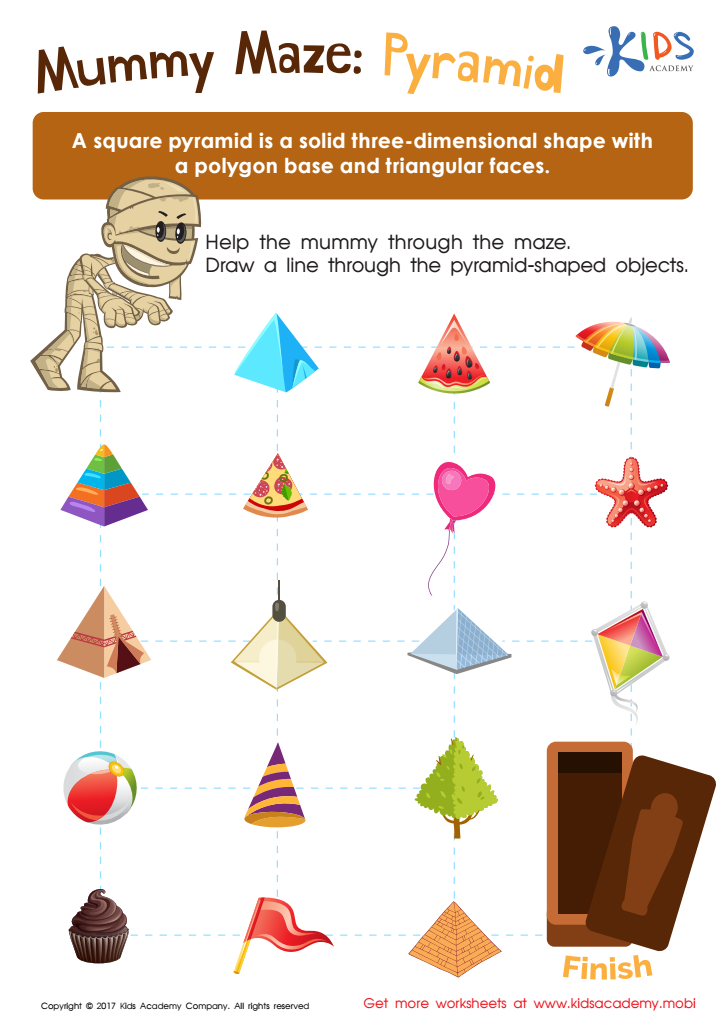
Mummy Maze: Pyramid Printable
Let's learn to spot 3D shapes, such as the iconic pyramid! This fun pyramid geometry worksheet PDF provides interesting illustrations and a maze to help your child identify pyramids in the pictures.
 Assign to My Students
Mummy Maze: Pyramid Printable
Worksheet











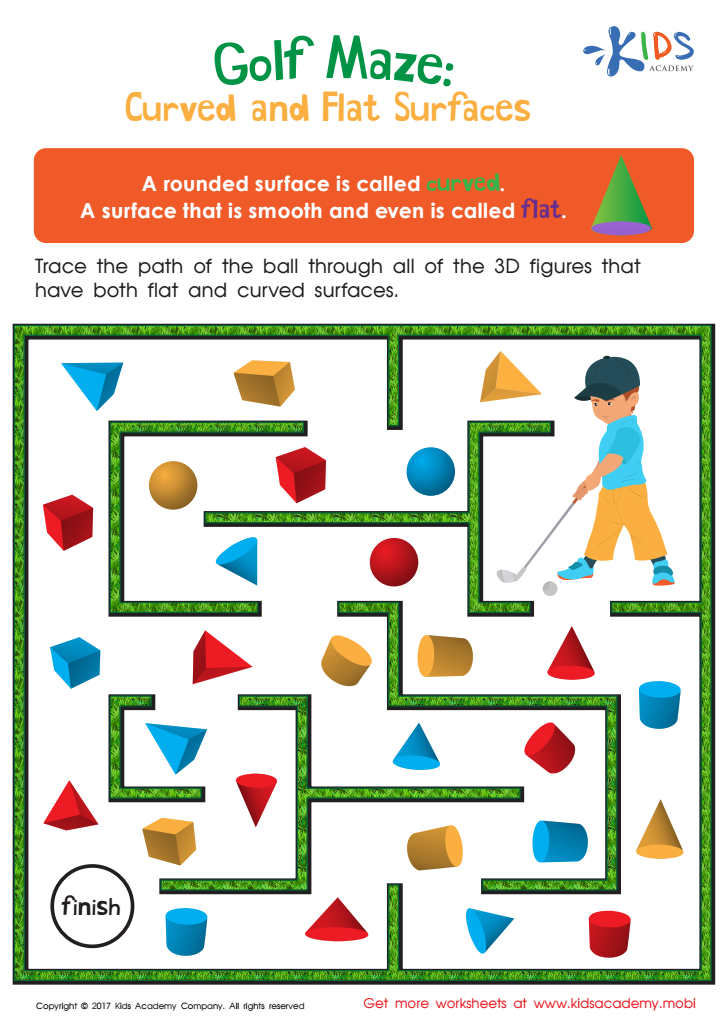
Golf Maze: Curved and Flat Surfaces Worksheet
Give your child a fun and educational challenge with this geometry maze! Your child will navigate 3D shapes to find objects with flat and curved surfaces, while learning important math concepts.
Golf Maze: Curved and Flat Surfaces Worksheet
Worksheet
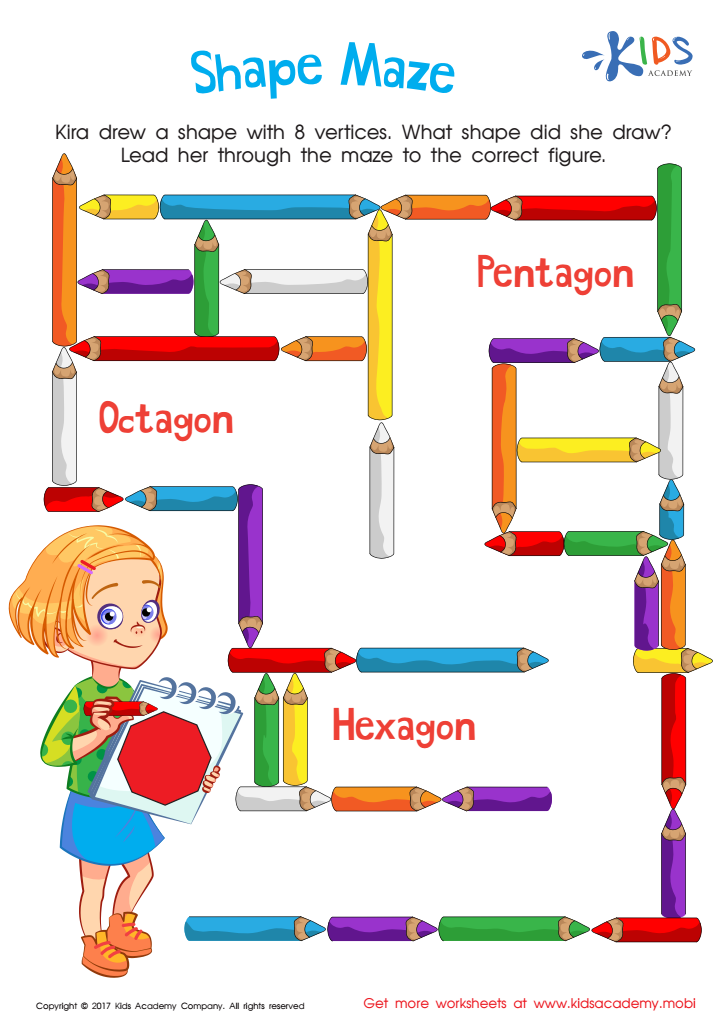
Shape Maze Worksheet
Test your child's geometry knowledge with this fun printable maze! They'll need to identify shapes with 8 vertices to find their way through the maze and get the correct answer.
Shape Maze Worksheet
Worksheet
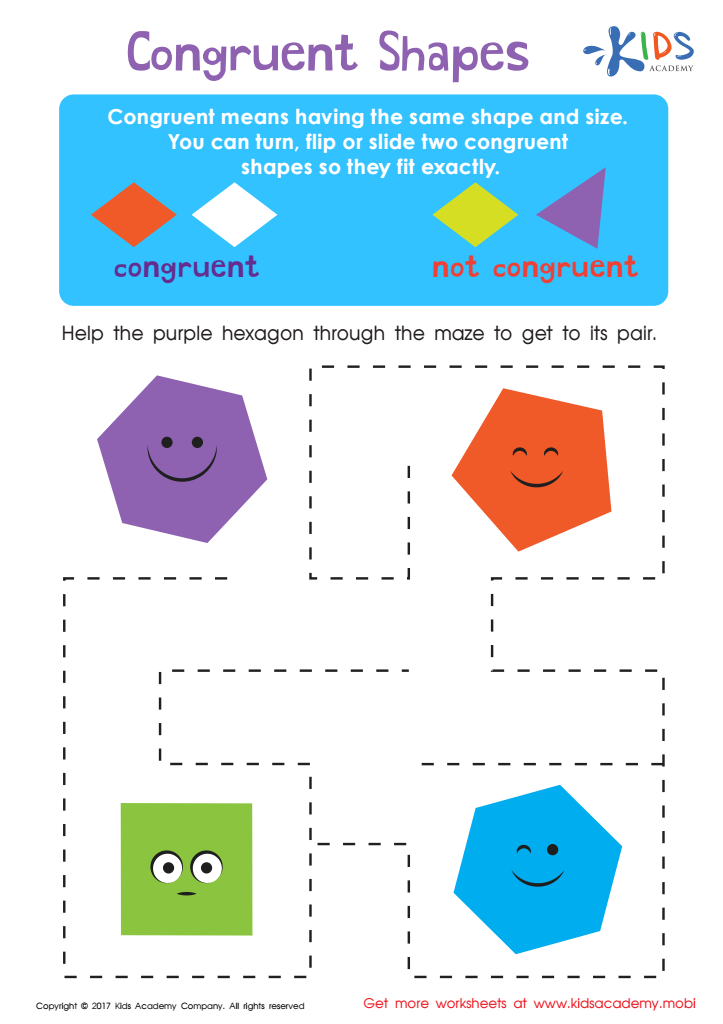
Congruent Shapes Worksheet
Help your child find the twin of the purple hexagon! This congruent shapes worksheet is great for increasing vocabulary while challenging mental rotation skills.
Congruent Shapes Worksheet
Worksheet
2D and 3D Shapes Worksheet
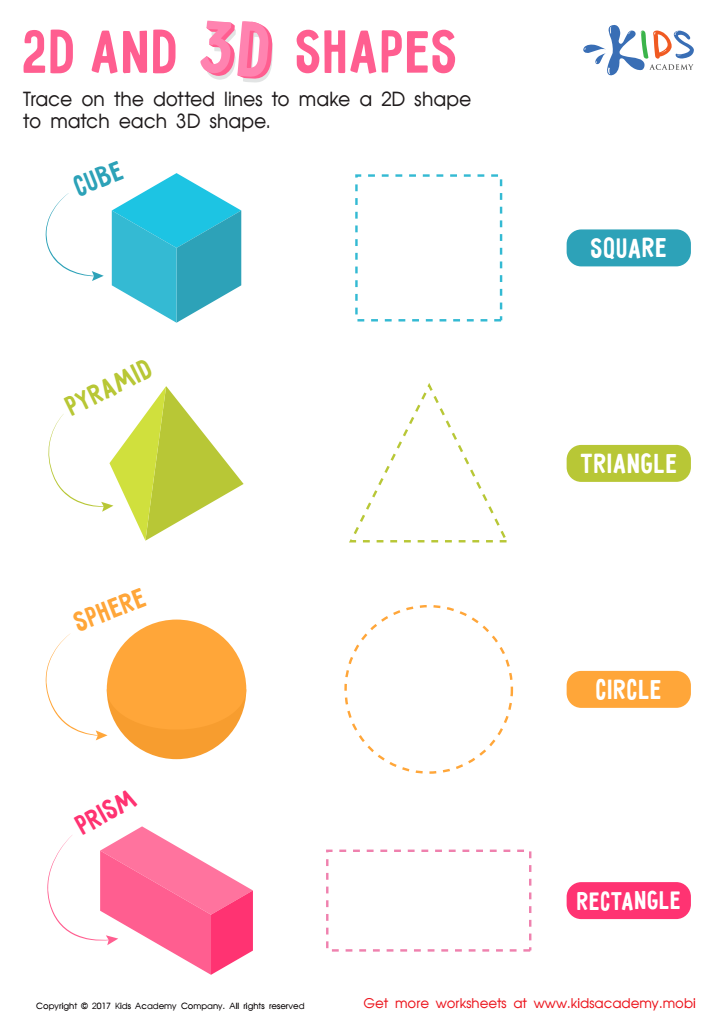
Introduce your child to 3D and 2D with this traceable worksheet. With dotted lines, help them trace and make a 2D shape for each 3D shape: square, triangle, rectangle, and circle. Show them there's more than one way to draw! You may have taken them to a 3D movie, or they've seen some fantastic 3D art. Now they can wonder no more.
2D and 3D Shapes Worksheet
Worksheet
Join Kids Academy for Free
Who is primarily going to use this learning content?








Spatial awareness is a fundamental skill that impacts a child's ability to understand their environment and interact with it effectively. For children aged 3-8, developing spatial awareness through geometry is essential as it lays the groundwork for critical thinking, problem-solving, and creativity. Parents and teachers should prioritize this learning area for several reasons.
Firstly, spatial awareness fosters skills essential for mathematics. Understanding shapes, sizes, and how objects relate to one another enhances a child's ability to grasp complex mathematical concepts later on, such as geometry and measurement.
Moreover, this skill aids in motor development. Activities involving spatial tasks, such as puzzles or block building, improve coordination and fine motor skills, essential for writing and other daily activities.
Additionally, strong spatial awareness supports reading and writing proficiency. Children learn to interpret visuals, such as maps and diagrams, which are key in education across subjects.
Finally, these skills boost confidence and independence. As children learn to navigate their surroundings and manipulate objects effectively, they grow more self-assured in their abilities. Engaging in spatial awareness activities provides a solid foundation for lifelong learning, making it a priority for parents and teachers alike.








