Understanding fact families Extra Challenge Math Worksheets for Ages 3-8
3 filtered results
-
From - To
Enhance your child’s math skills with our "Understanding Fact Families Extra Challenge" worksheets designed for ages 3-8. Created to foster a deeper comprehension of addition and subtraction relationships, these fun and engaging printables provide an extra challenge for young learners. By exploring fact families, kids develop critical thinking and improve their problem-solving abilities. Perfect for home or classroom use, our worksheets cater to various skill levels with vibrant illustrations and intriguing puzzles. Give your child the tools they need to succeed in math with these expertly crafted educational resources from Kids Academy.
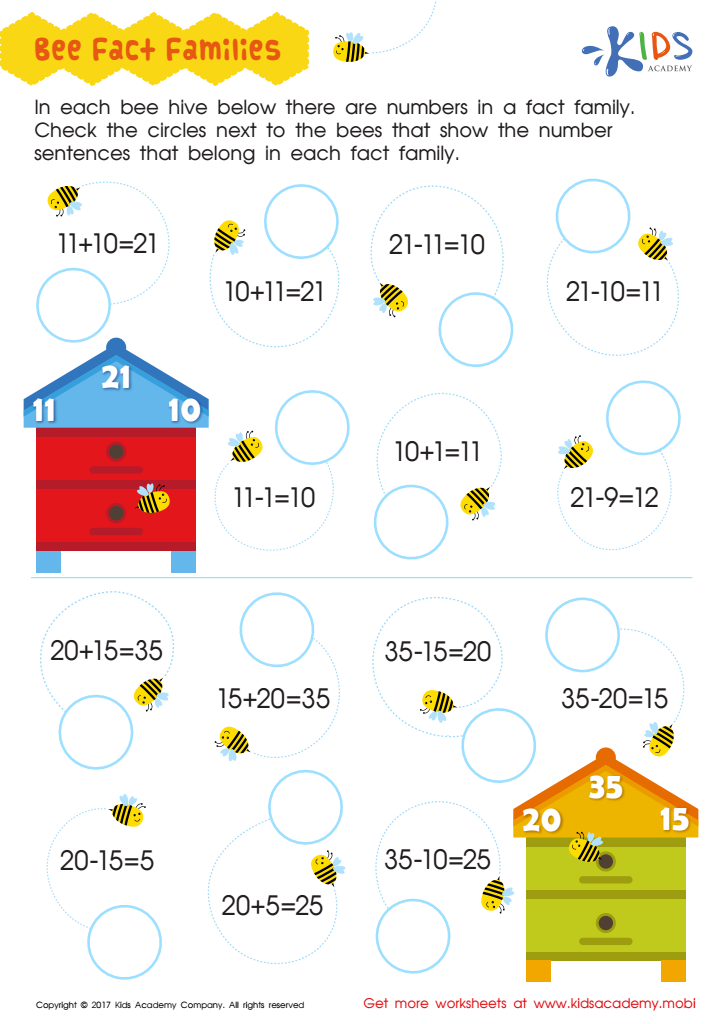
Fact Families Worksheet
 Assign to My Students
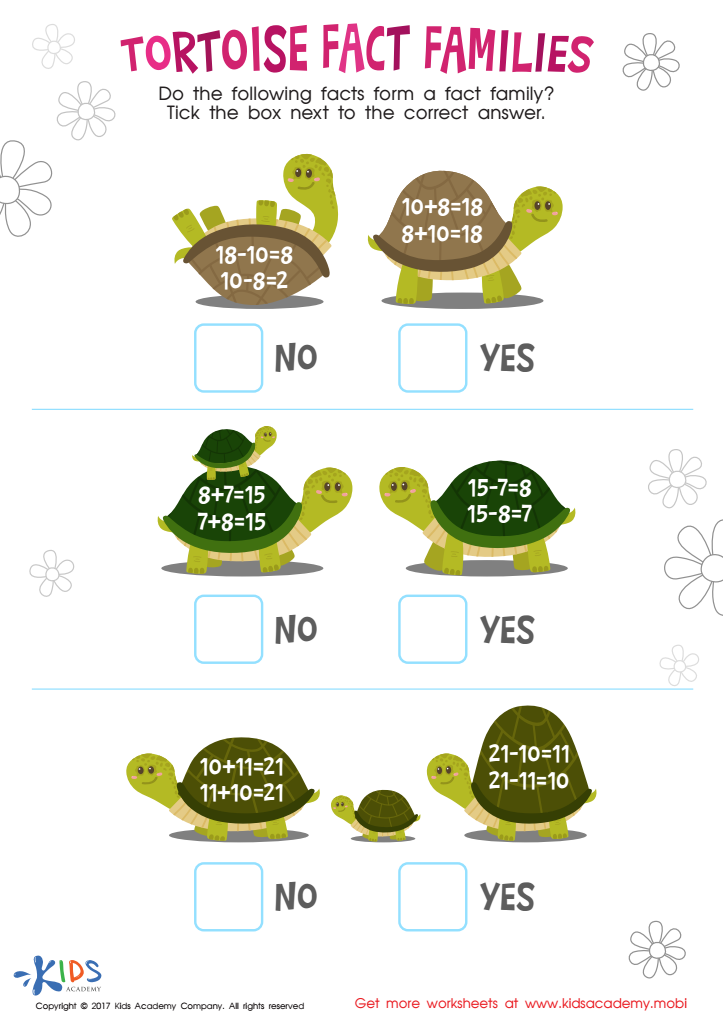
Tortoise Fact Families Printable
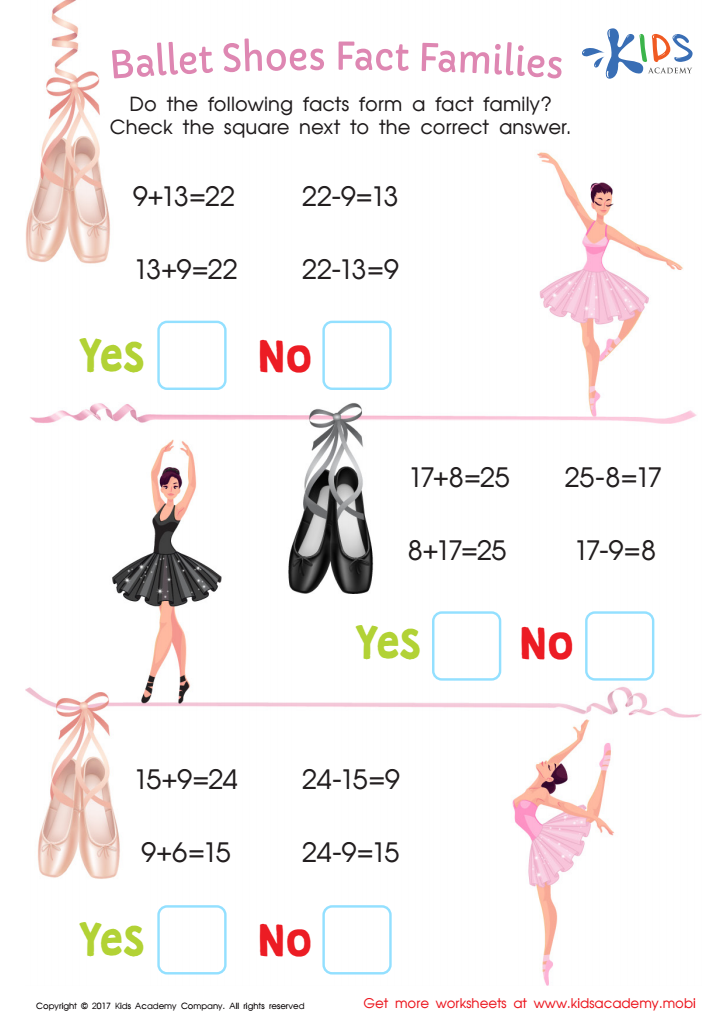
Ballet Shoes Fact Family Printable







Understanding fact families is a fundamental part of early mathematics education for children aged 3-8. Fact families consist of related addition and subtraction (or multiplication and division) equations that use the same numbers. Mastering these relationships enhances a child's number sense and mathematical intuition.
First, grasping fact families helps children see connections between numbers and operations. Instead of viewing each math problem in isolation, they start to understand that numbers are interconnected. For instance, knowing that 2+3=5 also means that 3+2=5, 5-3=2, and 5-2=3. This holistic understanding builds stronger mental arithmetic skills.
Second, mastering fact families sets a foundation for more complex math concepts. Addition and subtraction are inverse operations, and knowing one can easily help children derive the other. This relational understanding is crucial as they progress to multiplication, division, and beyond.
Also, encountering fact families as an "Extra Challenge" means young learners are stretching their brains beyond the basics, fostering a love for learning and problem-solving. This confidence-boosting success translates into better classroom performance and a positive attitude towards mathematics in the long term.
Finally, early proficiency in math lays the groundwork for future academic and career opportunities. Thus, parents and teachers focusing on this topic invest in children's cognitive development and lifelong success.