Understanding plurals Extra Challenge Writing Worksheets for Ages 3-8
5 filtered results
Difficulty Level
Grade
Age
-
From - To
Subject
Activity
Standards
Discover the "Understanding Plurals Extra Challenge Writing Worksheets" designed for children ages 3-8, perfect for reinforcing essential grammar skills. These engaging worksheets provide fun and interactive exercises that help young learners grasp the concept of pluralization, transforming singular words into their plural forms. Utilizing colorful visuals and relatable examples, our materials encourage children to think critically while honing their writing prowess. Ideal for classroom activities or at-home learning, these worksheets will make mastering plurals exciting and accessible. Enhance your child's literacy journey with our comprehensive collection designed to nurture their understanding and application of plurals in a playful way!
Favorites
With answer key
Interactive
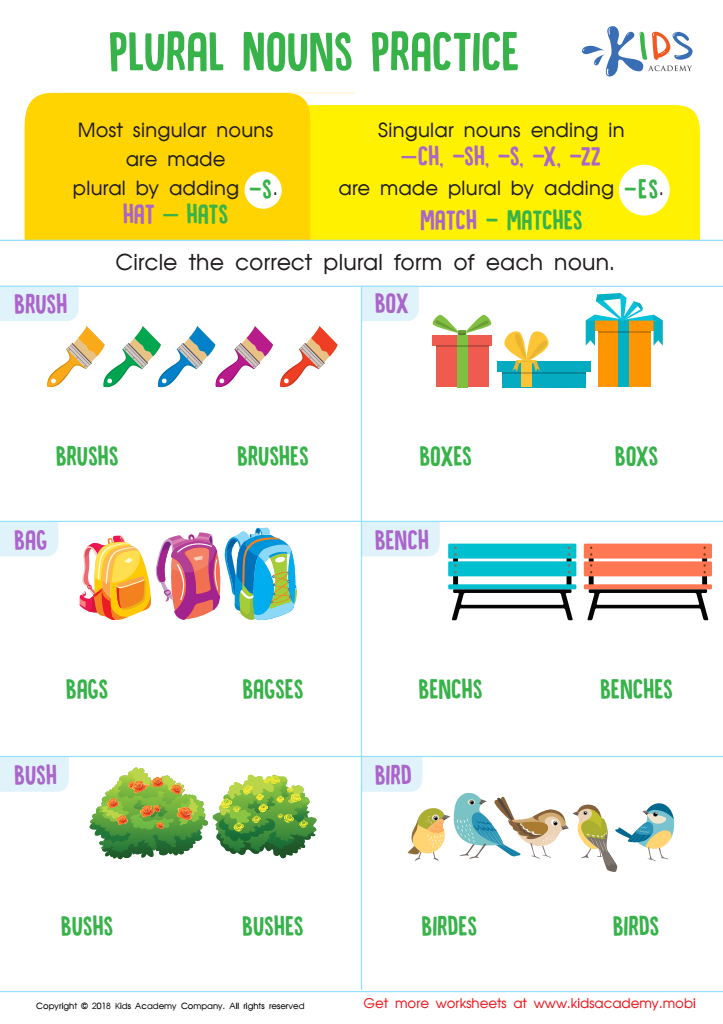
Plural Nouns Practice Worksheet
Explain to your child that most singular nouns become plural by adding "-s". E.g. "cat"->"cats". For words ending in "-ch", "-sh", "-s", "-x", or "-zz", add "-es". E.g. "buzz"->"buzzes". Then, get them to circle the right plural form of each noun on the worksheet.
 Assign to My Students
Plural Nouns Practice Worksheet
Worksheet
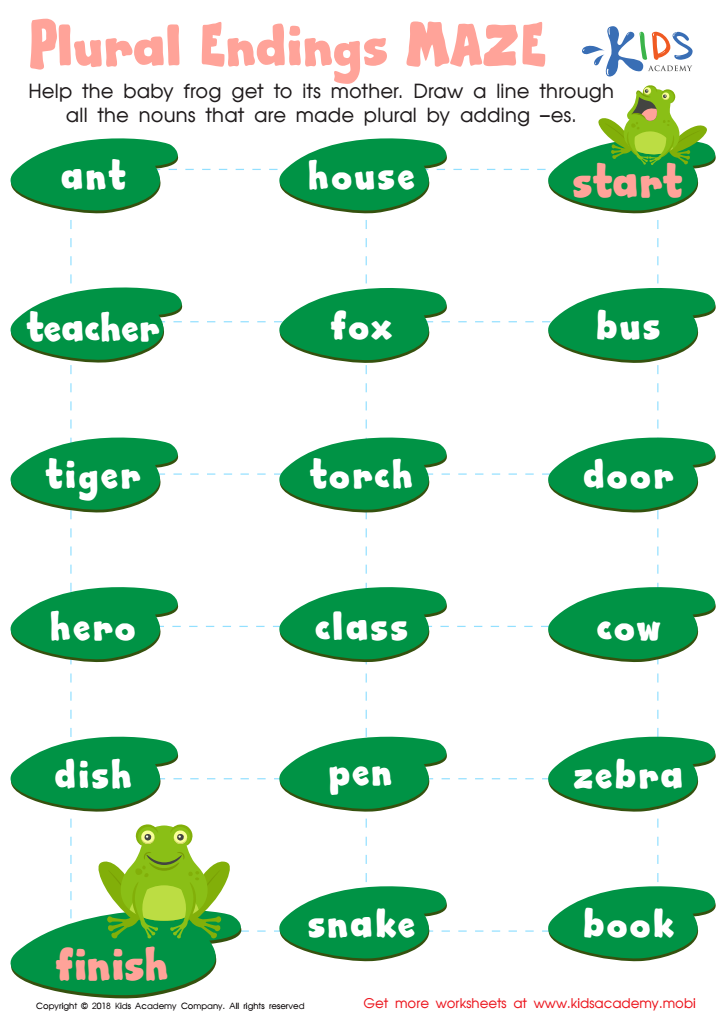
Plural Endings Maze Worksheet
Help your child have fun while learning new things with this worksheet. Does your child know that some nouns require '-es' to make them plural? Use this pdf to teach them the rule and get the little frog to its mother – draw a line through the words with '-es' plural forms.
Plural Endings Maze Worksheet
Worksheet
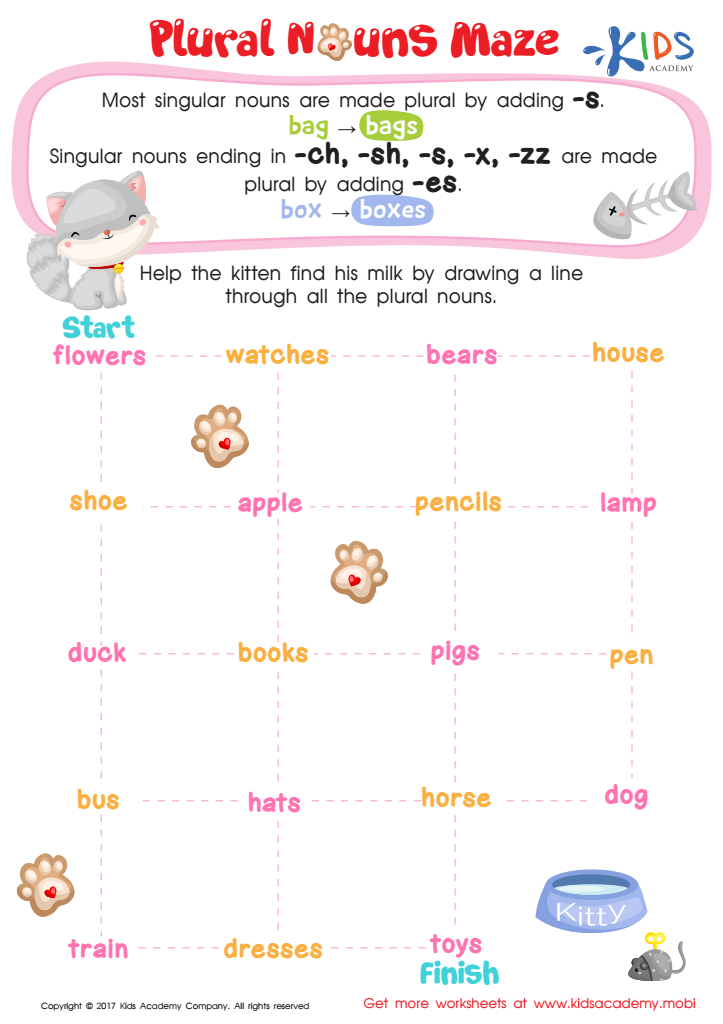
Plural Nouns Maze Worksheet
Oh no, the kitty needs her milk! Help your learner navigate the maze by drawing a line through the plural words. Review the grammar rules on -s and -es endings, then get to work to guide the kitten to her bowl! Download this PDF worksheet to start.
Plural Nouns Maze Worksheet
Worksheet
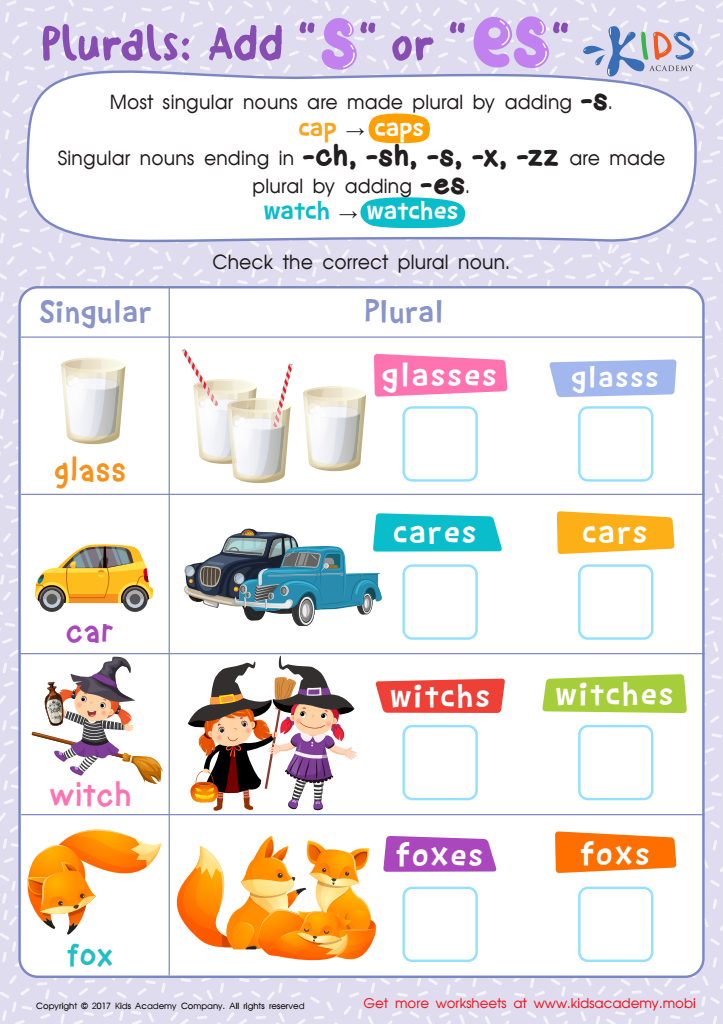
Plurals: "–es" or "–es"? Worksheet
Learning plural nouns can be tough for young readers. This worksheet shows them the difference between singular and plural spelling with cute images. Read each word and check the correct version. Remind them why the other ending can't be used.
Plurals: "–es" or "–es"? Worksheet
Worksheet
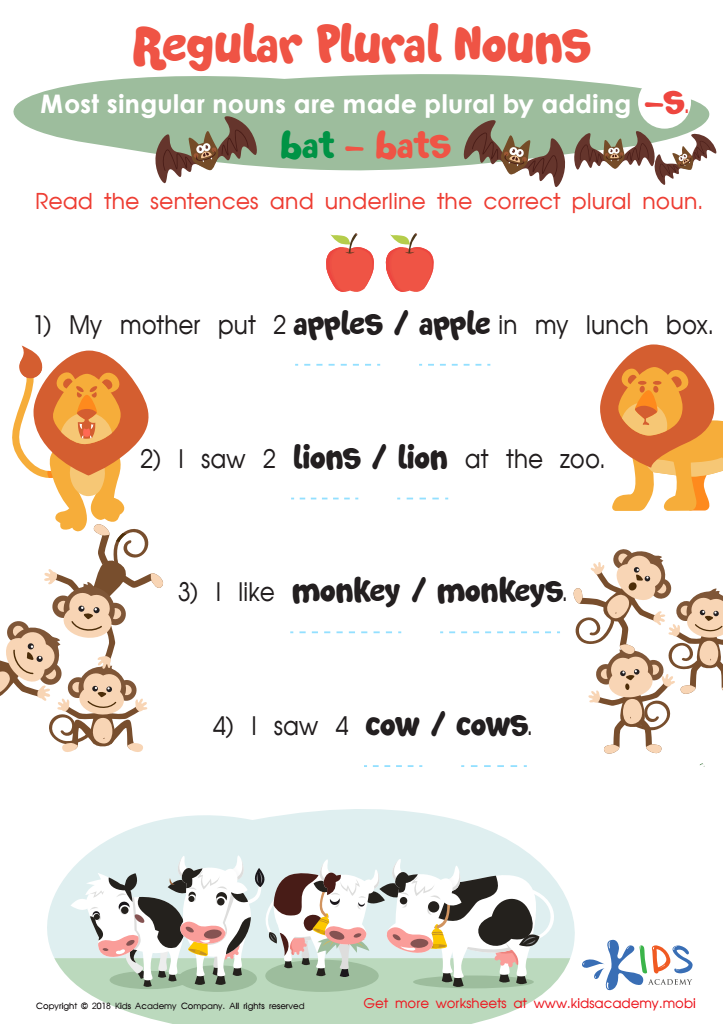
Regular Plural Nouns Worksheet
Your child should know the rule of adding '-s' to form plurals of nouns by now. Examples: bat-bats, cat-cats, song-songs etc. If they understand this, the task in the worksheet should be easy. Read the sentences and ask them to underline the correct plural noun.
Regular Plural Nouns Worksheet
Worksheet
Join Kids Academy for Free
Who is primarily going to use this learning content?







Understanding plurals is crucial for children aged 3-8 as it lays the foundation for their literacy development and overall language skills. Plurals help children make sense of the world around them by allowing them to communicate the difference between one and many, fostering better comprehension and expression. When teachers and parents emphasize plurals, they encourage good grammar habits early on, promoting clear communication.
Recognizing and correctly using plurals can significantly enhance children’s reading and writing abilities. As they encounter texts, understanding plural forms enables them to grasp the meaning of sentences more effectively. In addition, developing pluralization skills links to broader cognitive skills, including critical thinking and language processing.
Moreover, teaching plurals can turn into a fun and engaging activity—such as through playful games, songs, or stories—making learning a joyful experience. Engaging children in conversations about quantities can also enrich their vocabulary, boosting their overall language acquisition.
Ultimately, focusing on plurals can significantly impact a child's academic success and social interactions. By nurturing these skills, teachers and parents equip children with essential tools to navigate their educational journeys with confidence, promoting a lifelong love of learning and language exploration.