
Strategic thinking development Extra Challenge Worksheets for Ages 4-6
3 filtered results
Difficulty Level
Grade
Age
-
From - To
Subject
Activity
Standards
Introduce your little ones to the exciting world of strategic thinking with our Extra Challenge Worksheets designed for ages 4-6! These engaging activities help young minds develop critical problem-solving skills through fun and interactive exercises. Each worksheet blends elements of logic and creativity, encouraging children to think ahead and explore different solutions. Perfect for home or classroom use, these resources promote cognitive growth while keeping learning enjoyable. Watch as your child learns to make informed choices and gains confidence in their thinking abilities. Download our Strategic Thinking Development worksheets today and watch their potential unfold!
Favorites
With answer key
Interactive
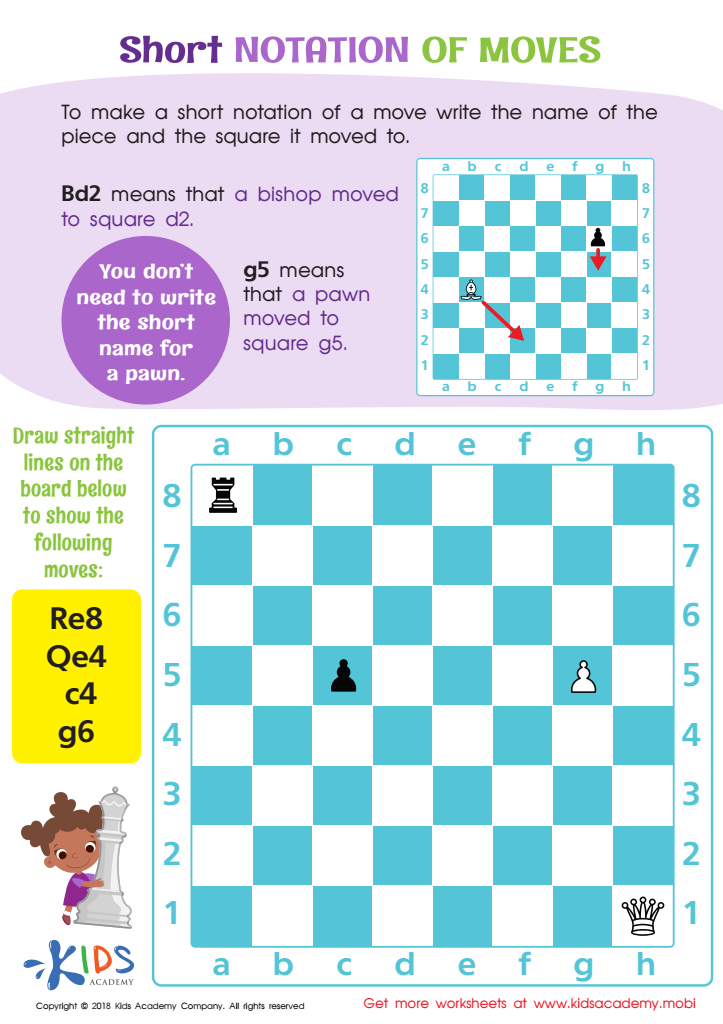
Short Notation of Moves Worksheet
To master chess, you need more than just knowing the pieces and their moves - you need to be able to make notations of your moves. To make a short notation, write the piece name and square it moved to; for example, Bd2 for bishop on d2. Pawns don't need the piece name, just the square; e.g. g5. Show your kids how to draw lines to the board for the moves given.
 Assign to My Students
Short Notation of Moves Worksheet
Worksheet
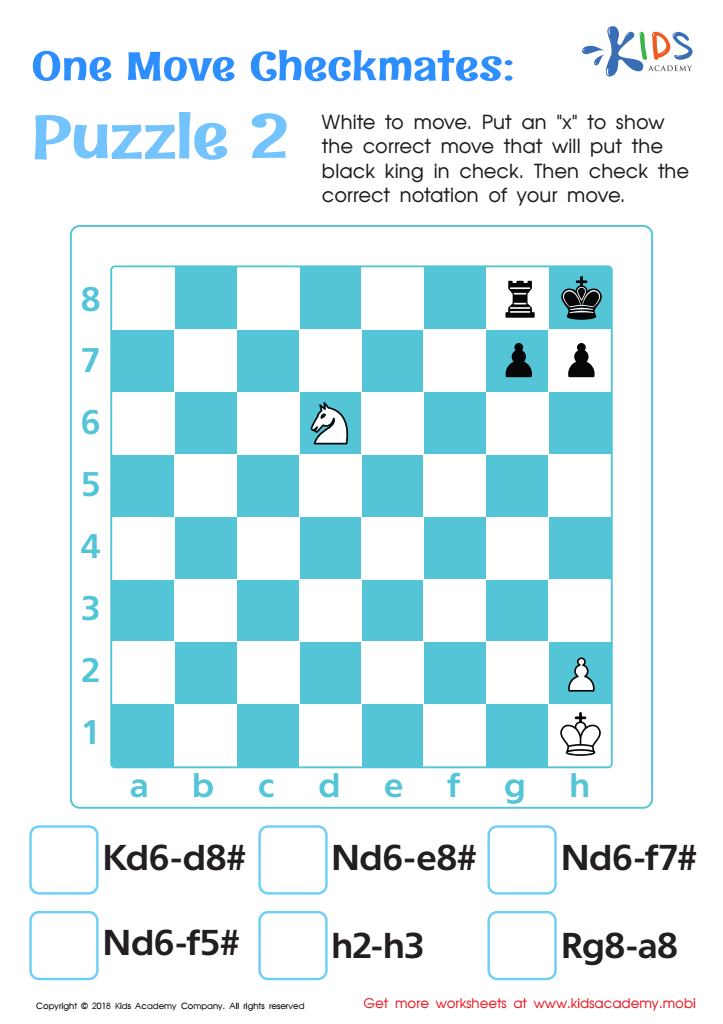
One Move Checkmates: Puzzle 2 Worksheet
Fine-tuning logic and critical thinking skills can be tricky but this free PDF offers a fun way for little logisticians to practice visual-spatial relationships and strategizing to checkmate the black king. It also boosts directional and reading skills which makes it a great brain-building puzzle.
One Move Checkmates: Puzzle 2 Worksheet
Worksheet
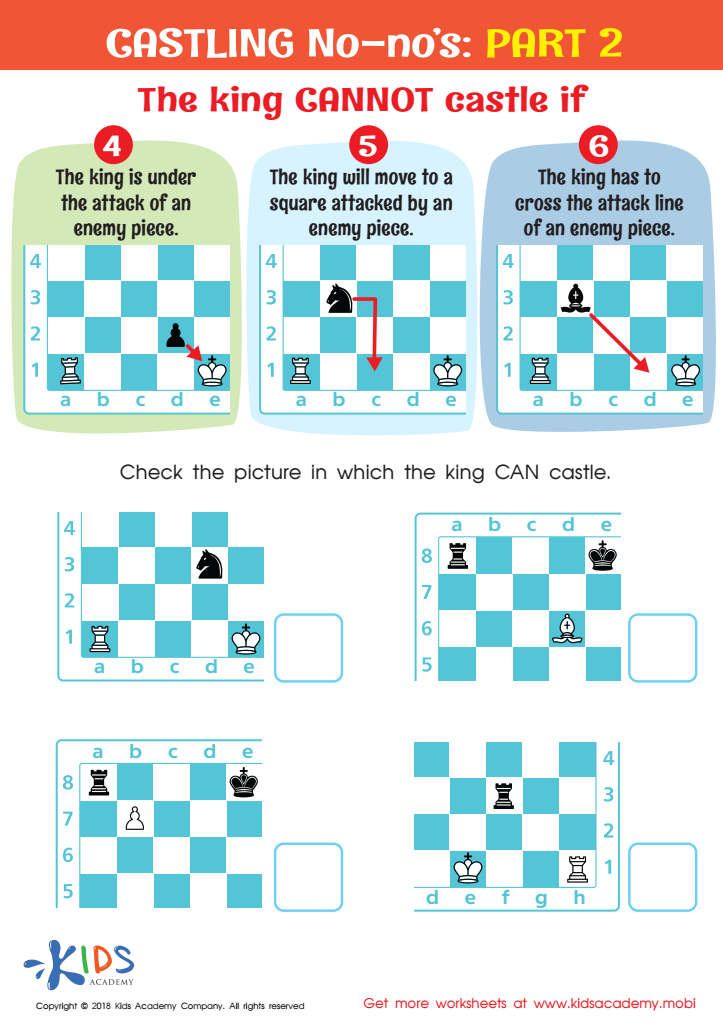
Castling No - no's: Part 2 Worksheet
Teach your child the rules of castling: no castling if the king is under attack or will move onto an attacked square, or cross an attack line. To prepare for a game of chess, help your child complete the exercise of identifying when the king can castle – check the pictures.
Castling No - no's: Part 2 Worksheet
Worksheet
Join Kids Academy for Free
Who is primarily going to use this learning content?





.jpg)

Strategic thinking development is essential for children aged 4-6 as it lays the groundwork for important cognitive skills that shape their future learning and problem-solving abilities. At this young age, children are naturally curious and eager to explore their surroundings, making it an ideal time to introduce strategic thinking. Engaging in activities that challenge children to plan, predict outcomes, and evaluate results fosters critical thinking and enhances decision-making skills.
Parents and teachers should care about this developmental aspect because strategic thinking encourages independence and self-confidence in young learners. By nurturing these skills through interactive games, puzzles, and storytelling, adults can help children become effective problem solvers and enhance their creativity.
Moreover, developing strategic thinking helps children to understand the concept of consequences, enabling them to make thoughtful choices in various scenarios. This capability directly influences their social interactions, laying a robust foundation for collaborative learning and teamwork in the classroom.
Ultimately, investing in strategic thinking at a young age not only equips children with life-long skills but also creates a richer, more engaging educational experience, setting them on a path toward successful learning and personal growth. In a world that increasingly values critical thinking, this skill set can significantly enhance children’s futures.








