Counting skills Extra Challenge Subtraction Worksheets for Ages 4-9
3 filtered results
Difficulty Level
Grade
Age
-
From - To
Subject
Activity
Standards
Enhance your child's math journey with our "Counting Skills Extra Challenge Subtraction Worksheets," specially designed for ages 4-9. These engaging worksheets focus on subtraction while integrating essential counting skills to strengthen your child's numerical understanding. Each activity is tailored to boost confidence and foster independence as students tackle progressively complex problems. With vibrant illustrations and interactive formats, learning becomes an enjoyable adventure. Perfect for reinforcing classroom lessons or providing exciting home practice, our worksheets cater to varying skill levels. Watch your little ones master subtraction, develop critical thinking, and gain a solid foundation in math with these easy-to-use resources!
Favorites
With answer key
Interactive
Missing Numbers Worksheet
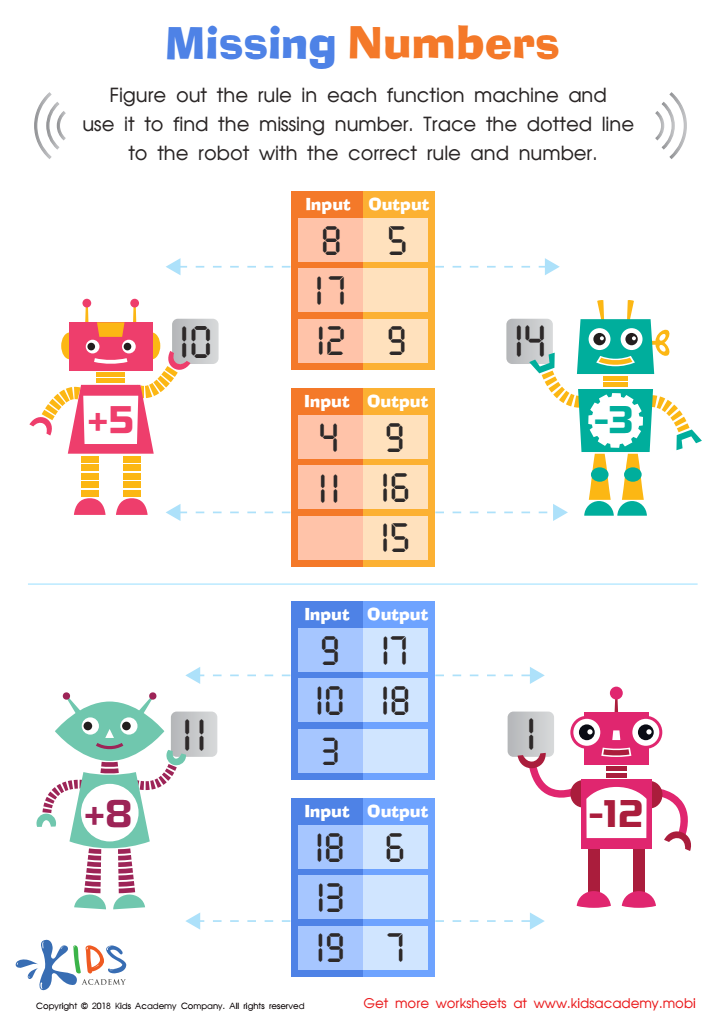
Elementary students can learn the important pre-algebra skill of solving for missing numbers! Our robots guide them along with number-filled bellies and missing answers in their hands. Kids can examine the other numbers in each graph, use the rule to solve the missing number, and check their work with the missing number to ensure correctness.
 Assign to My Students
Missing Numbers Worksheet
Worksheet
Find Two at the Zoo Worksheet
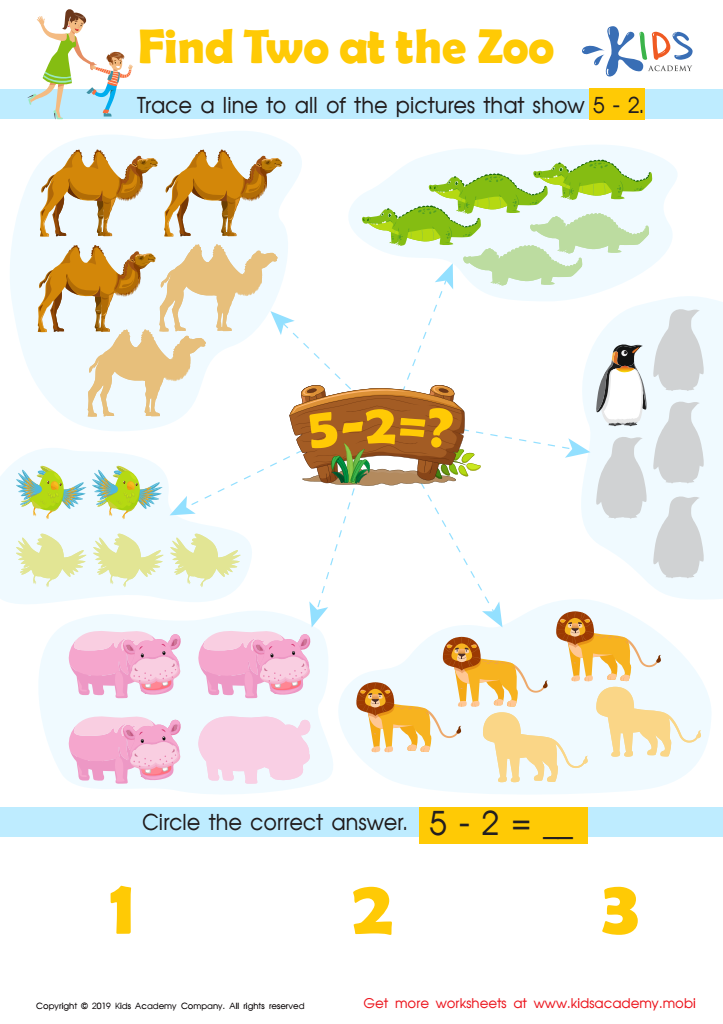
Help your kids overcome math fears and practice subtracting numbers with this traceable PDF. Ask them to identify the 6 groups of animals in the picture and count the animals in each group. Then, help them trace a line to all of the pictures that illustrate the equation 5-2.
Find Two at the Zoo Worksheet
Worksheet
Fruity Fives! Worksheet
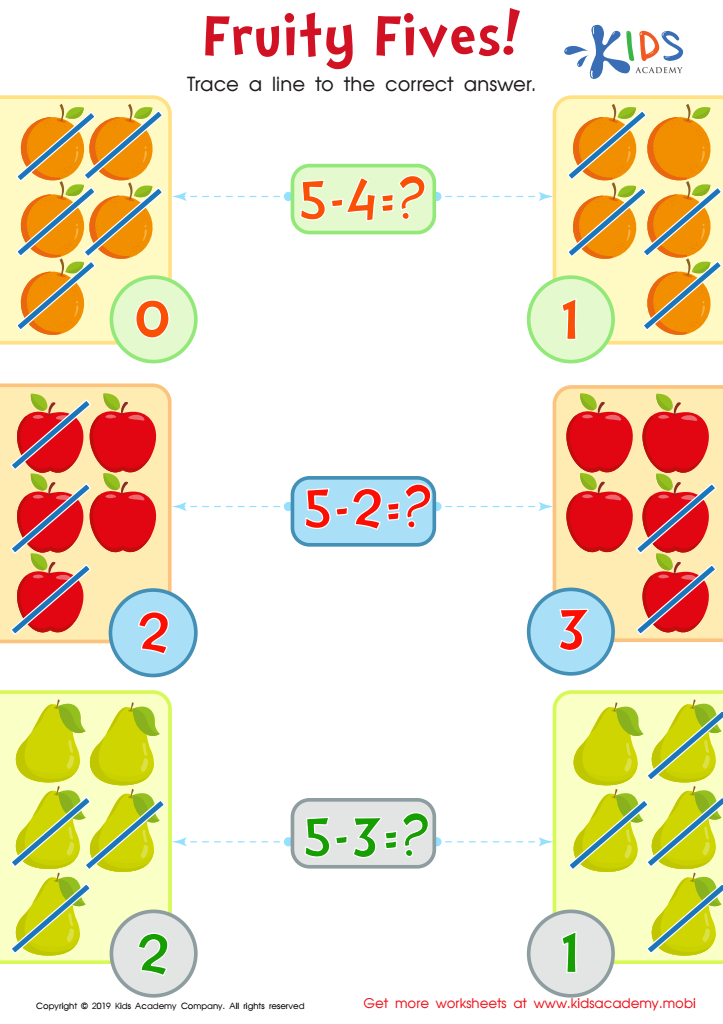
This tracing sheet has three equations for your kids to solve. Make learning fun with colorful objects and text! They may need help, so be prepared to assist them. Help them solve the equations and trace a line to the correct answer.
Fruity Fives! Worksheet
Worksheet
Join Kids Academy for Free
Who is primarily going to use this learning content?








Parents and teachers should prioritize counting skills and subtraction challenges for children aged 4-9 for several crucial reasons. First, foundational math skills form the cornerstone of a child's overall academic success. By engaging children in counting and subtraction activities, they develop critical thinking and problem-solving abilities that extend beyond math. These skills not only enhance arithmetic proficiency but also improve cognitive functions, including memory and attention.
Moreover, counting and subtraction form the basis for more advanced mathematical concepts that children will encounter as they progress in their educational journey. Introducing these skills early ensures that children are not just rote learners but can also apply their knowledge in real-life situations, enhancing their confidence in tackling mathematical problems.
Additionally, interactive counting and subtraction activities can foster a positive attitude towards learning and promote cooperative play, encouraging teamwork and social skills among peers. Through creative challenges and engaging games, children can develop a love for learning that will serve them well throughout their education. By investing time and resources into developing strong counting and subtraction skills, parents and teachers significantly contribute to a child’s self-esteem, academic performance, and long-term success.