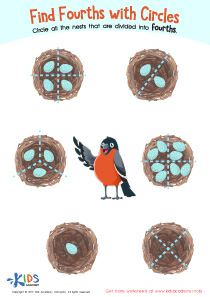
Spatial awareness Extra Challenge 2D Shapes Worksheets for Ages 5-7
3 filtered results
Difficulty Level
Grade
Age
-
From - To
Subject
Activity
Standards
Boost your child’s geometric understanding with our "Spatial Awareness Extra Challenge 2D Shapes Worksheets" designed for ages 5-7! These engaging and interactive worksheets provide a fun way for young learners to explore 2D shapes through varying activities. By tackling challenges that involve identification, sorting, and manipulation of shapes, children enhance their spatial reasoning skills while building a strong foundation in geometry. Perfect for home or classroom use, these worksheets make learning enjoyable, encouraging children to think critically. With vibrant visuals and age-appropriate exercises, your child will develop confidence and proficiency in recognizing and working with shapes in their environment. Get started today!
Favorites
With answer key
Interactive
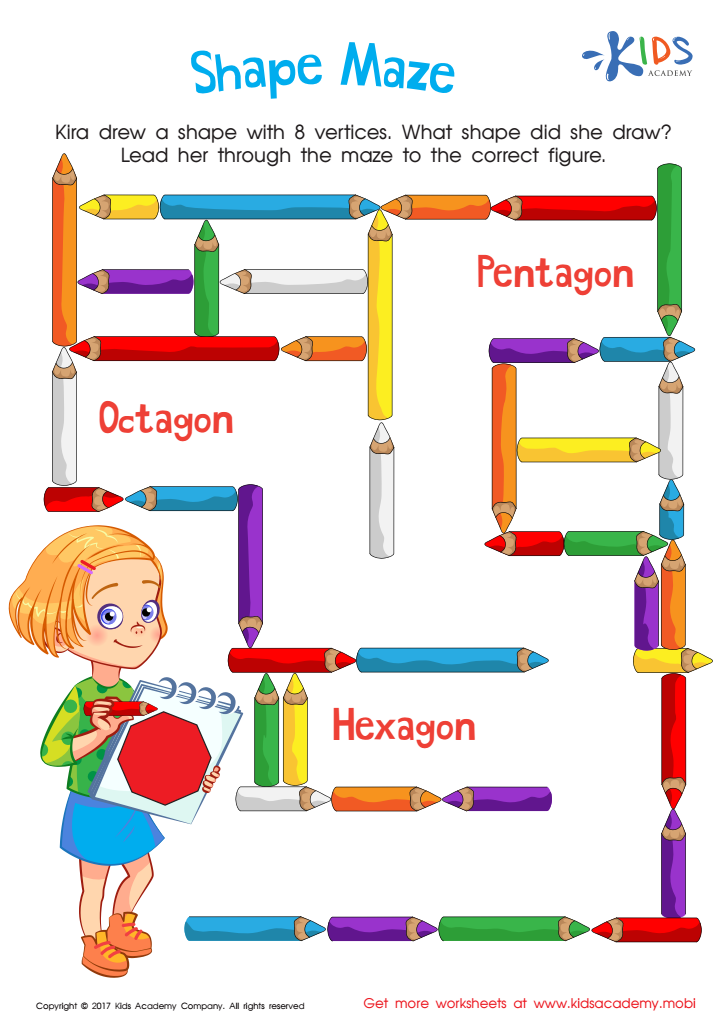
Shape Maze Worksheet
Test your child's geometry knowledge with this fun printable maze! They'll need to identify shapes with 8 vertices to find their way through the maze and get the correct answer.
 Assign to My Students
Shape Maze Worksheet
Worksheet











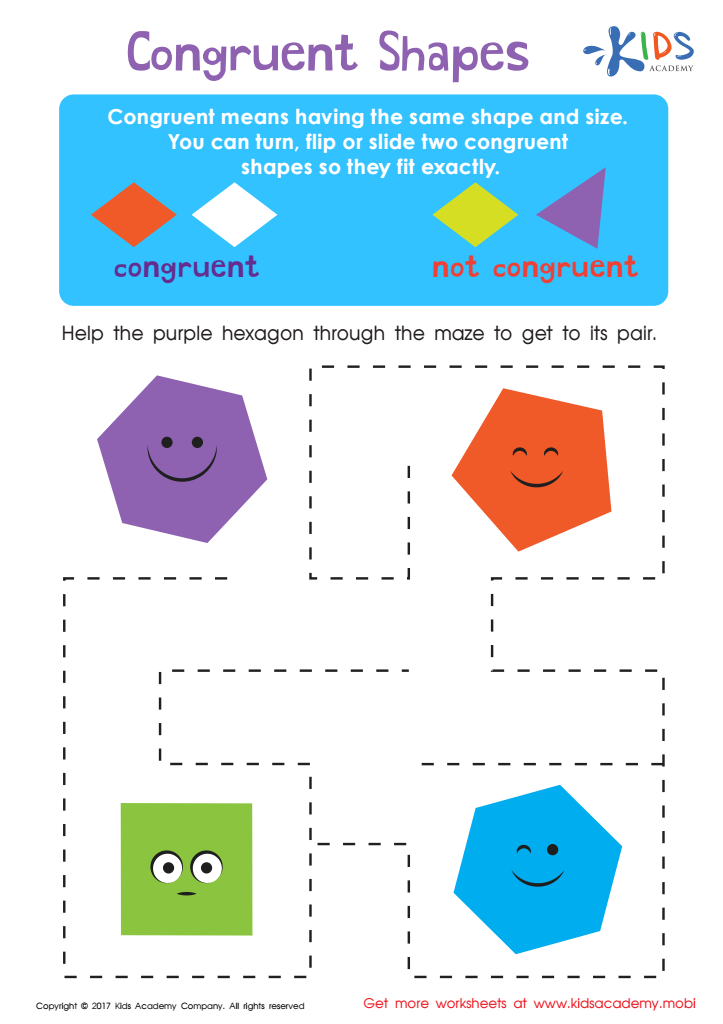
Congruent Shapes Worksheet
Help your child find the twin of the purple hexagon! This congruent shapes worksheet is great for increasing vocabulary while challenging mental rotation skills.
Congruent Shapes Worksheet
Worksheet
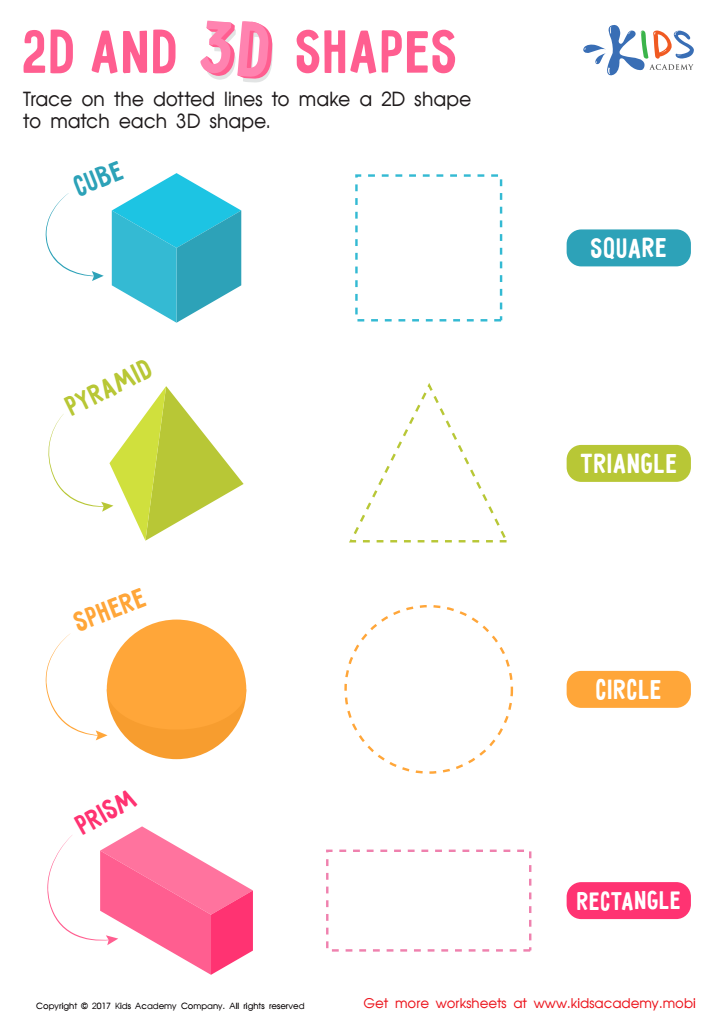
2D and 3D Shapes Worksheet
Introduce your child to 3D and 2D with this traceable worksheet. With dotted lines, help them trace and make a 2D shape for each 3D shape: square, triangle, rectangle, and circle. Show them there's more than one way to draw! You may have taken them to a 3D movie, or they've seen some fantastic 3D art. Now they can wonder no more.
2D and 3D Shapes Worksheet
Worksheet
Join Kids Academy for Free
Who is primarily going to use this learning content?








Spatial awareness is a crucial cognitive skill that helps children understand their relationship with the world around them. For children aged 5-7, developing spatial awareness through engaging activities like Extra Challenge 2D Shapes plays an essential role in their overall learning and development.
First, spatial awareness enhances problem-solving skills. By recognizing and manipulating 2D shapes, children learn to identify patterns, dimensions, and positions. This skill is foundational for grasping more complex mathematical concepts later in life, such as geometry and spatial reasoning.
Second, strong spatial awareness contributes to academic success beyond mathematics. It supports reading comprehension, as children often need to visualize information from texts, maps, or diagrams. Moreover, it fosters creativity and innovation, allowing children to think outside the box as they explore different ways to arrange shapes and create designs.
Finally, spatial awareness impacts everyday life, aiding in tasks like navigation, understanding maps, and even engaging in team sports. When parents and teachers promote spatial awareness through playful challenges, they equip children with skills that lead to independent thinking, critical analysis, and confidence in their abilities. By focusing on 2D shapes, they support a well-rounded education and prepare children for future learning opportunities.