Spatial awareness Extra Challenge 2D Shapes Worksheets for Ages 6-8
3 filtered results
Difficulty Level
Grade
Age
-
From - To
Subject
Activity
Standards
Boost your child's spatial understanding with our "Spatial Awareness Extra Challenge 2D Shapes Worksheets for Ages 6-8." Specifically designed to enhance mathematical thinking, these engaging worksheets help kids recognize, understand, and manipulate 2D shapes. Perfect for young learners, these activities encourage problem-solving, visual discernment, and critical thinking. Watch as your child confidently navigates through intricate exercises that challenge their perception and spatial reasoning skills, laying a strong foundation for future learning. Download today to provide your child with enriching opportunities that make learning both fun and educational!
Favorites
With answer key
Interactive
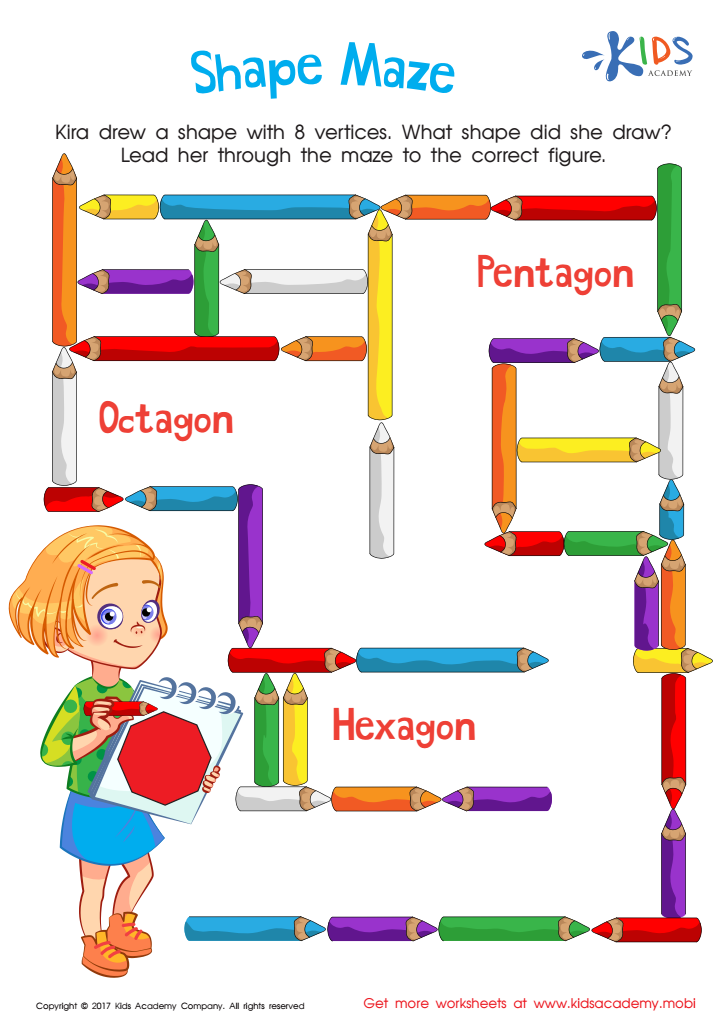
Shape Maze Worksheet
Test your child's geometry knowledge with this fun printable maze! They'll need to identify shapes with 8 vertices to find their way through the maze and get the correct answer.
 Assign to My Students
Shape Maze Worksheet
Worksheet


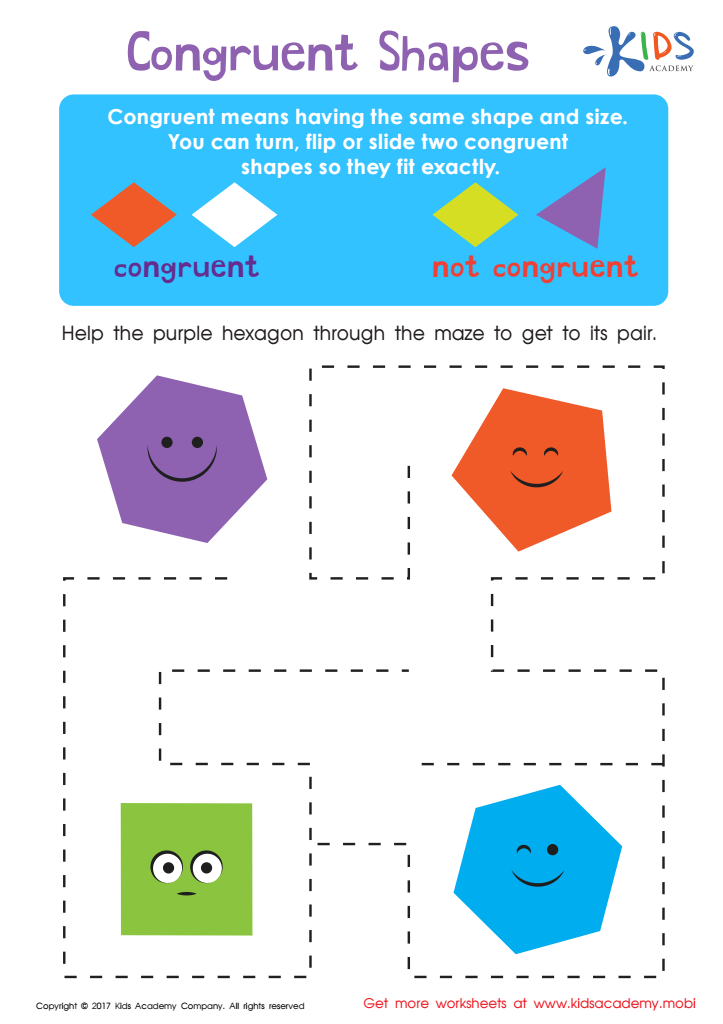
Congruent Shapes Worksheet
Help your child find the twin of the purple hexagon! This congruent shapes worksheet is great for increasing vocabulary while challenging mental rotation skills.
Congruent Shapes Worksheet
Worksheet
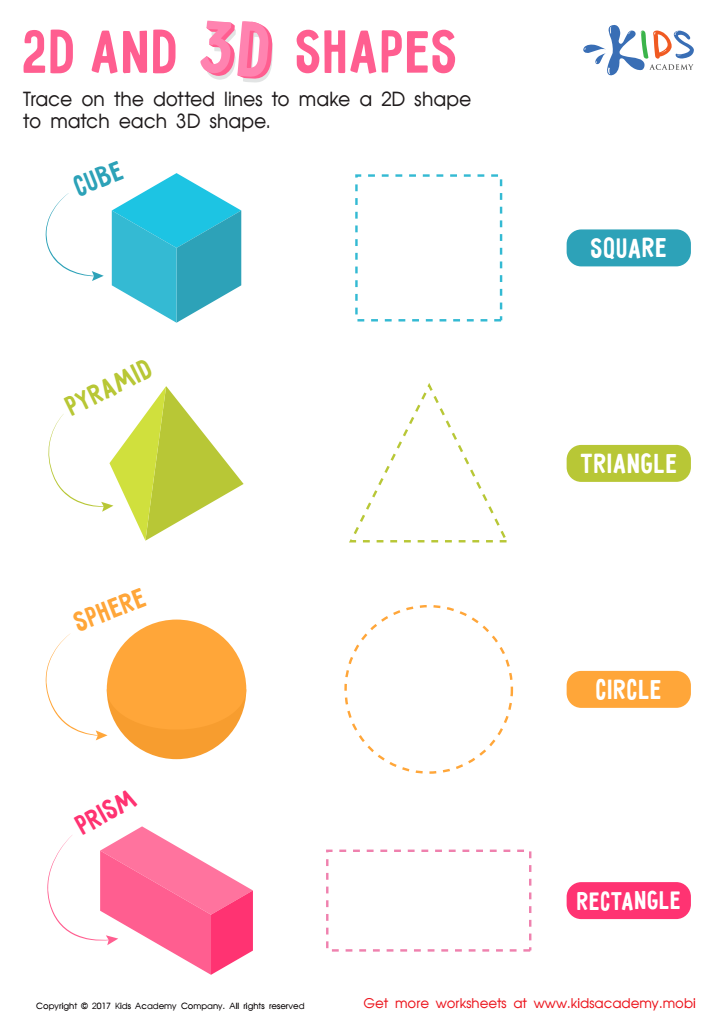
2D and 3D Shapes Worksheet
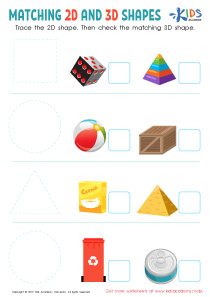
Introduce your child to 3D and 2D with this traceable worksheet. With dotted lines, help them trace and make a 2D shape for each 3D shape: square, triangle, rectangle, and circle. Show them there's more than one way to draw! You may have taken them to a 3D movie, or they've seen some fantastic 3D art. Now they can wonder no more.
2D and 3D Shapes Worksheet
Worksheet
Join Kids Academy for Free
Who is primarily going to use this learning content?








Understanding spatial awareness and 2D shapes is crucial for young children because these skills lay the groundwork for more advanced learning in subjects such as geometry, mathematics, and even daily problem-solving. Children between the ages of six to eight are developing foundational cognitive abilities, and activities that focus on spatial awareness help them grasp concepts of size, shape, position, direction, and patterns.
When children engage in spatial awareness challenges and explore 2D shapes, they enhance their ability to visualize and manipulate objects mentally. This boosts their problem-solving skills and improves their capacity to understand more complex mathematical concepts later on. Moreover, these activities support the development of hand-eye coordination and fine motor skills, as children often use their hands to manipulate shapes and fit pieces together.
Parents and teachers should care about fostering these skills because they contribute to overall cognitive development. Encouraging spatial awareness through play and targeted exercises makes learning fun and engaging, helping children to stay motivated and cultivate a love for learning. Ensuring children at this stage build a robust understanding of spatial relationships and 2D shapes equips them with essential tools for academic success and practical everyday situations.